



Maximised crude carrier for Japan trade
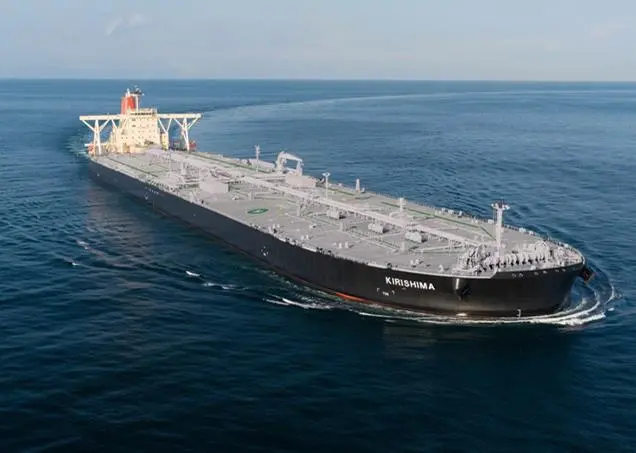
Kirishima is the first example of the neoVLCC concept, a recent addition to the family of ‘eco-ship’ designs developed by Mitsui Engineering & Shipbuilding (MES).
Constructed at the Chiba yard of MES to the account of Asiaship Maritime, the VLCC has entered service with the fleet controlled by Mitsui OSK Lines, under the management of group company MOL Tankship.
The ship is replete with premium energy saving features, including G-type super-long-stroke MAN main engine, high-efficiency propeller, optimised bow and stern form, and waste heat recovery (WHR) system, giving added effect to the scale economy afforded by a cargo intake volume of 352,076m3.
The propulsion engine is a seven-cylinder model of the G80ME-C9.5 diesel, specified at a maximum continuous rating (MCR) of 25,250kW, giving direct drive to the propeller at 65rpm. As a prolific MAN licensee and the leading Japanese manufacturer of large, low-speed marine engines, MES has retained a higher proportion of the overall shipbuilding value by manufacturing the machinery in-house at its Tamano works.
Exhaust gas from the main engine is used to generate steam in a waste heat boiler and which is then fed to a turbo generator system, delivering electrical power into the ship’s grid.
In keeping with the strengthening of international regulations governing SOx emissions, the vessel incorporates a dedicated, low-sulphur fuel tank and provision has been made for future retrofitting of an exhaust gas cleaning plant. Investment in environmental protection is also represented by a cargo vapour emission control system (VECS).
Reflecting the high electrical load entailed with a VLCC, including that arising from cargo heating and cargo handling, the auxiliary outfit is based on four aggregates of 4,814kVA individual output.
The ‘eco-ship’ neo series from MES began with the neo66BC bulker of 66,000dwt, followed by neo57BC and neo60BC versions, and with a fourth design, the capesize neo182BC type, making its service debut last year. The neoVLCC is thus the fifth design in the line-up. A sixth type, the neo82GC, is proposed for LNG and liquefied ethane transport.
PRINCIPAL PARTICULARS
|
Length overall |
339.5m |
|
Breadth, moulded |
60.0m |
|
Depth, moulded |
28.5m |
|
Draught, summer |
21.1m |
|
Cargo capacity |
352,076m3 |
|
Deadweight |
312,539t |
|
Gross tonnage |
159,793t |
|
Main engine power(SMCR) |
25,250kW |
|
Generators |
4 x 4,814kVA |
|
Class |
ClassNK |
|
Flag |
Panama |
|
Complement |
36 |
Related Articles
 PROPULSION
 GENERAL NEWS
 HYDROGEN