



Shuttle tanker testing ground for VOC systems
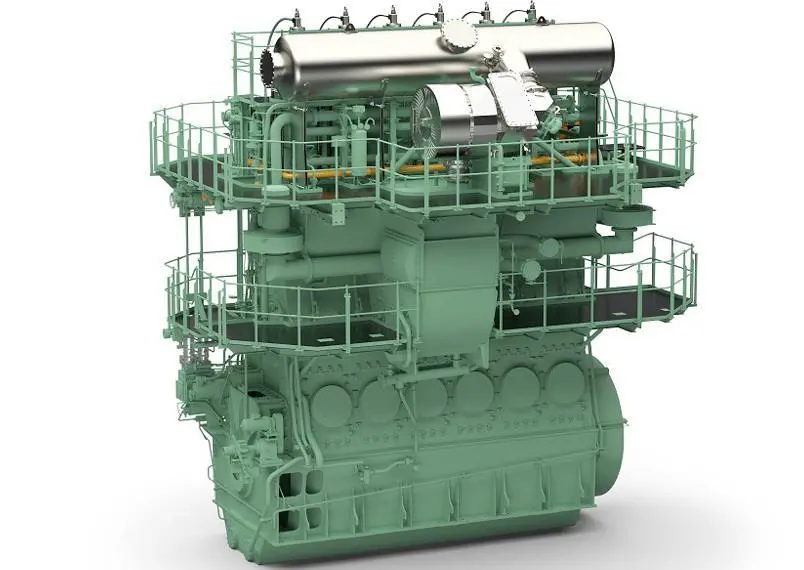
WinGD and Wärtsilä Gas Systems have tested a mix of natural gas and volatile organic compounds (VOC) in WinGD’s dual-fuel demonstrator engine in Trieste. The capability has already been specified by AET for a pair of shuttle tankers and could hold considerable attraction for the oil and gas industry. The tankers are being built for Singapore based AET Tankers at Samsung Heavy Industries shipyard.
The test – witnessed by AET, Statoil, OSM Maritime Group, Samsung Heavy Industries and Hyundai Heavy Industries – demonstrated the engine’s capabilities under various load scenarios with up to 20% VOC in the fuel mix. The engine maintained performance throughout transfers from pure natural gas (NG) to a VOC mix, as well as transferring to diesel mode and back again. The test confirmed that NOx emissions remained well below IMO Tier III levels while operating on the VOC mix.
VOCs are a waste product from crude oil handling and transport, representing both a hazard and a loss of revenue to oil and gas producers and shippers. Historically, they were either discharged into the atmosphere or burned off.
Marcel Ott, senior project manager, dual-fuel technology, research and development, WinGD, said: “An early finding on the first X-DF engines was that their inherently stable combustion gave scope to run the engines on gas with lower methane numbers. We have applied this knowledge to the new fuel combination.”
Ott noted that no significant changes in performance or behaviour is required for X-DF engines to burn the NG-VOC fuel mix. “Aside from a few precautions according to ambient and boundary conditions, no hardware modifications and no application-specific control functions are required on the engine, and standard tuning can be retained. Likewise, the gas handling safety philosophy is identical with X-DF dual-fuel engines burning natural gas solely,” he said.
LOW-PRESSURE BOOST
The project also established that the X-DF engines’ low-pressure gas admission helps to mix VOC into the natural gas fuel, as condensation of the heavy hydrocarbons in the VOC can be avoided.
Dominik Schneiter, vice president, research and development, WinGD, said: “Our X-DF engines now offer ship owners a further way to improve their environmental footprint while reducing fuel cost. The NG-VOC capability will add a further dimension to the benefits that make our X-DF engines such a strong contender for ship owners facing tighter emissions controls and increased operating costs.”
VOC recovery technology from Wärtsilä will also be deployed on the two new shuttle tankers being built for Statoil in South Korea, helping them to save tonnes of fuel each year.
Wärtsilä’s scope of supply comprises the VOC recovery plant, the liquefied VOC fuel tank, the fuel mixing unit, the LNG fuel tank and fuel supply system, the gas valve unit (GVU) and two Wärtsilä 34DF dual-fuel auxiliary engines. The contract is worth more than €30 million.
“The fuel savings efficiency of the system enables a fast pay-back time, while the reduction in emissions of CO2 equivalents is as much as 40% when compared to conventional solutions,” says Timo Koponen, vice president, processing solutions, Wärtsilä Marine Solutions.
VOC MIXTURE
The equipment is scheduled for delivery to the yard commencing in the autumn of this year. When completed, the tankers will operate on LNG as the primary fuel, but VOC – the gas evaporating from the oil cargo tanks – will also be utilised as fuel by mixing it with the LNG so reducing the vessels’ bunkering needs.
This will be made possible by the VOC recovery system, which offers the potential for savings of over 3,000 tonnes of fuel each year per vessel. This is in addition to the notable environmental benefits the use of gas as fuel provides by enabling a significant reduction in CO2 emissions.
The twin-screw, 125,000dwt vessels are destined for work with Norwegian oil company Statoil (recently renamed Equinor), transporting oil from its fields on the Norwegian and UK continental shelves to land-based terminals. The novel fuel arrangement and related systems will contribute to an expected fuel saving of around 1,000 tonnes a year compared with conventional tankers.
The dual main engines will feature shaft generators to produce the electricity required for the vessels’ hotel load. This electrical power will be managed by ABB’s Onboard DC Grid power distribution system. The grid is designed to be highly configurable and allows for the use of variable speed generators. It is also well suited for LNG fuelled engines as it allows them to be operated at a more stable load.
Power systems will be controlled by ABB’s integrated Power and Energy Management System (PEMS), which enables generators to run at variable speeds optimally. In traditional AC systems, generators run at fixed maximum speed irrespective of the power demand on board, leading to unnecessary engine wear and poor fuel efficiency at lower loads.
Related Articles
 ALTERNATIVE FUELS & LUBRICANTS
 ALTERNATIVE FUELS & LUBRICANTS
 ALTERNATIVE FUELS & LUBRICANTS