



MAN adds LPG to two-stroke fuel mix
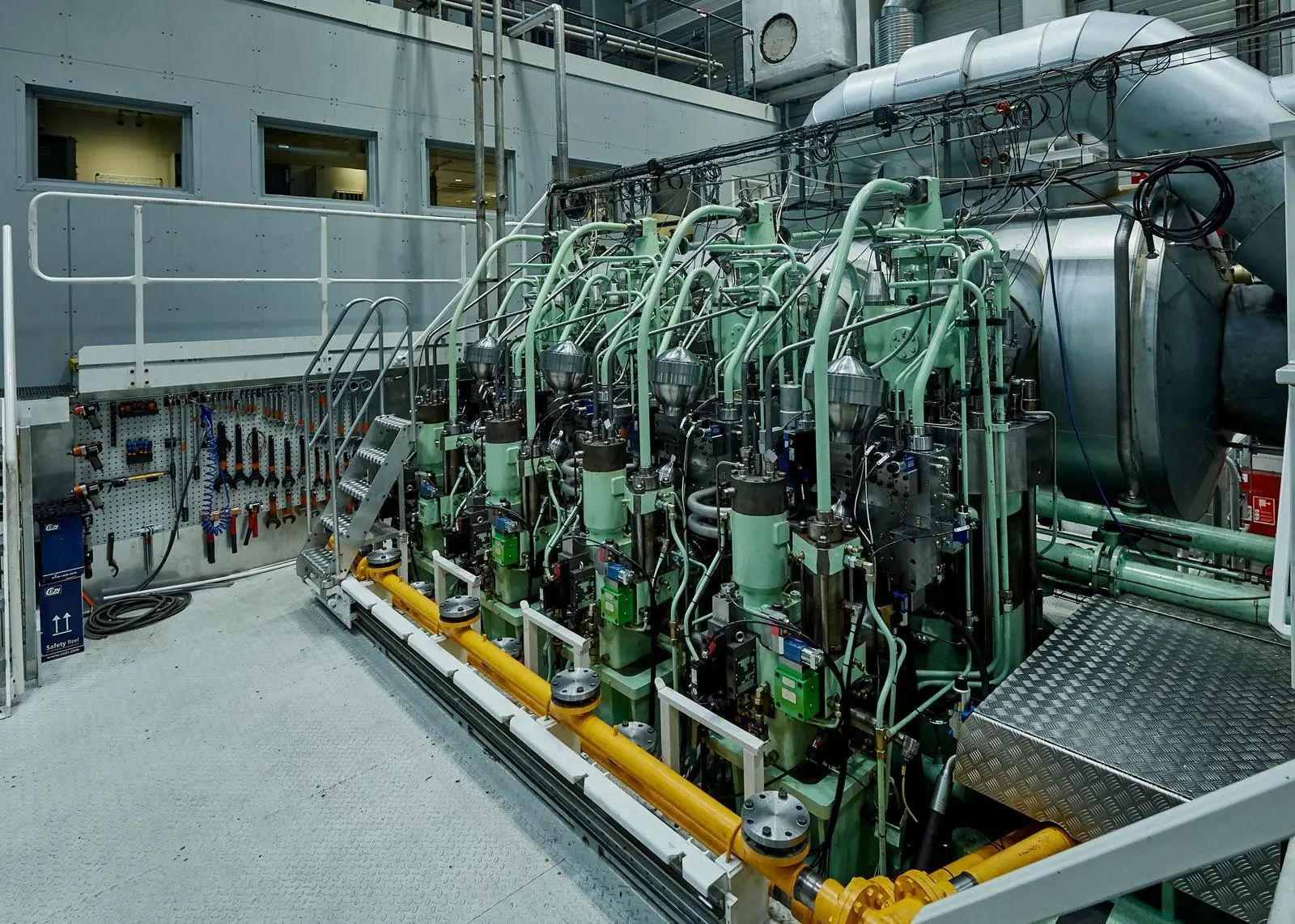
On a sunny September day in Copenhagen, guests gathered to witness the latest step towards shipping’s gas-fuelled future. While LNG has dominated the alternative fuel mix until now, a new contender has emerged and, with it, a new two-stroke engine capable of harnessing its advantages. Enter liquified petroleum gas (LPG) as a marine fuel, and MAN Energy Solutions’ ME-LGIP engine.
MAN’s naming protocol is a death-trap for dyslexics. The new engine is not called the ME-LPGI, nor (as this reporter mistakenly tweeted) the ME-LPIG. The chosen ME-LGIP moniker stands for MAN’s electronically controlled engine (ME) with liquefied gas injection for propane (LGIP). Liquefied gas injection distinguishes the engine from its LNG-fuelled counterpart, the ME-GI (gas injection) engine – the difference being whether the fuel is a gas or liquid upon injection. The ‘P’ for propane distinguishes the ME-LGIP from the methanol-burning ME-LGI engine – along with butane, propane is one of the two main components of LPG.
Offering similar environmental advantages to LNG, LPG is distinguished from its better known, methane-based counterpart in that it does not require cryogenic storage and is available at almost every port. A further advantage is that pricing has been lower than heavy fuel oil (HFO) in recent years. A 2016 study conducted by MAN and class society DNV GL found that for the years 2014-2016, fuelling a very large gas carrier (VLGC) with LPG instead of HFO would result in a saving of US$2.5 million.
Pricing becomes more complicated when looking beyond the introduction of IMO’s 2020 sulphur rules. A newbuild VLGC with LPG-burning engine would cost less than one with an LNG engine, but slightly more than a similar ship with a scrubber installed for HFO operation. Both would of course offer substantial savings in fuel costs compared with burning low-sulphur fuel oil (LSFO). But the LPG-burning vessel, MAN claims, would be better protected from volatility in HFO and LSFO pricing.
If pricing is not a definitive advantage, the other benefits have been enough to stimulate considerable interest in LPG over the past year. In January – a month before MAN revealed it was in collaboration with Hyundai Heavy Industries Engine and Machinery Division to develop the ME-LGIP engine – plans were announced for the first dedicated LPG bunkering facility in Korea, with a new turbine-driven coastal car ferry to become the first customer next year.
EARLY ADOPTERS
After MAN revealed its engine development project, the announcements gathered pace. In March Belgian company Exmar selected the engines for two newbuild very large gas carriers (VLGCs) to built at Hanjin Heavy Industries’ yard in Subic Bay by the third quarter of 2020. In May, Dorian LPG revealed a memorandum of understanding with Hyundai Global Services to investigate the retrofitting of up to 10 VLGCs with LPG-burning engines in anticipation of IMO’s new fuel sulphur rules from 2020.
But the first ME-LGIP engines on the market will be retrofitted on four BW LPG gas carriers as part of a deal announced with impeccable timing, just three days before MAN presented its new engine to press, partners and potential customers. The conversions – expected to begin at drydockings scheduled in 2020 – will see the retrofitting of four MAN B&W 6G60ME-C9.2 HFO-burning engines to 6G60ME-C9.5-LGIP LPG-propelled dual-fuel engines.
Options for further retrofits are included in the deal. BW LPG owns a fleet of 35 very large gas carriers and three large gas carriers as well as operating several chartered and jointly owned vessels. Pontus Berg, senior vice president of technical and operations, BW LPG, told The Motorship that the company had identified 17 very large gas carriers in that fleet as suitable for LPG-burning engines. Speaking at the launch event in Copenhagen, Berg was effusive about the potential of LPG as a marine fuel.
“LPG has been around for a while and we are glad to see it moving into the marine business as sustainable and compliant fuel,” he said. “For us it was a no brainer. It takes us above and beyond compliance, installation is cheap compared to LNG engines and LPG is available everywhere. Our customers are keen to start selling LPG as a marine fuel.”
MAN also believes the use of LPG is a no-brainer, to the extent that it is forecasting that the ME-LGIP engine will eventually gain a 100% share of the two-stroke engine contracting market among LPG carriers. The company sees an early retrofit opportunity among LPG carriers or VLGCs with long, trans-oceanic routes. Today there are 60 such vessels, all with MAN’s ME-C engines that could be retrofitted for LPG fuel.
RETROFIT OPPORTUNITY
Beyond these early prospects, MAN believes the retrofit opportunity is substantial. There are over 3,000 ME-C engines in service, all of which are potential retrofit candidates. For some sectors there is an incentive to switch – the engines can also burn volatile organic compounds, the gasses given off when crude oil is moved, meaning that shuttle tankers and crude carriers could be early beneficiaries.
Bjarne Foldager, vice president sales and promotion, two-stroke business unit, MAN Energy Solutions, explains: “The ME-LGIP can also burn liquid volatile organic compounds, a deliberate move on our part since IMO will inevitably turn its focus towards the reduction of volatile organic compounds in the future. Accordingly, we view the ME-LGIP as also ideally suited to the propulsion of shuttle tankers and very large crude carriers.”
For other sector, price will remain the persuasive factor, but MAN has faith that in the long term the move to gas fuel is inevitable. It believes that it is in line with other industry stakeholders when it predicts that, by 2030, more than 20% of the global fleet will be using gas as fuel. Its LPG move is simply the latest in a string of developments along that line.
The ME-LGIP builds on these technical developments, sharing the same platform as its ME-GI and ME-LGI predecessors. The fuel booster injection valve (FBIV) has been tweaked to allow for an injection pressure in the range of 500-600 bar. The fuel line comprises: a fuel gas supply system to take the LPG from a service tank and ensure the required temperature, pressure and fuel quality on the engine; a fuel valve train to enable safe isolation of the engine during shutdown and maintenance, including nitrogen purging; and a vent system with knock-out drums to prevent LPG leaks if venting is required.
Foldager adds: “In gas mode, the ME-LGIP engine operates on just 3% pilot oil and down to 10% load. Ultimately, we expect the engine to operate without the need for pilot oil.”
MAN and its early LPG customers believe there will be a substantial market for the new marine fuel as the industry continues to move away from liquid hydrocarbons. With the ME-LGIP, the company has extended its portfolio of engines designed to face shipping’s complex fuel future.
Related Articles
 ALTERNATIVE FUELS & LUBRICANTS
 FUELS & LUBRICANTS