



Flettner investment pays off for Fehn
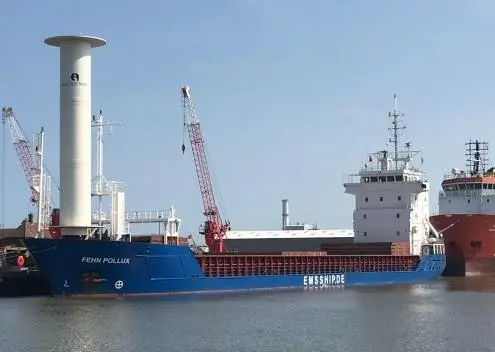
Trials have been running since July on board the 4,200dwt multi-purpose coaster, Fehn Pollux.
Professor Michael Vahs of the University of Applied Science in Emden/Leer in Germany said that the data evaluated so far significantly outperforms data modelling calculations with the prototype delivering more thrust than the main engine when running in perfect conditions.
The rotor is 18 metres high and has a diameter of three metres. After lengthy test runs ashore, the rotor is now being tested under real conditions on board the 90m Fehn Pollux.
The University of Applied Sciences has developed a purpose-made measuring and control system for this project, which enables scientists to gather transparent and reliable performance data.
Onboard Fehn Pollux more than 50 different data are continuously collected and computed in real time by the Flettner control system on the bridge. The computer uses the data to calculate the optimum settings for the rotor under the current conditions.
Whilst more data is optimum in assessing performance accurately, results so far are encouraging.
“The data gathered so far allows us to say, that the Eco-Flettner saves a noticeable amount of fuel,” said Professor Vahs.
“We are also able to prove, that for ship owners the investment into this sailing system is worth considering, because it pays off in a few years.”
Fifteen companies from around Leer have been involved in the development and construction of the sailing system. The project is funded by the EU and coordinated by maritime research and training company, Mariko.
Related Articles
 ENERGY SAVING DEVICES
 ENERGY SAVING DEVICES
 AMMONIA