



New transhipment vessel for grain exports
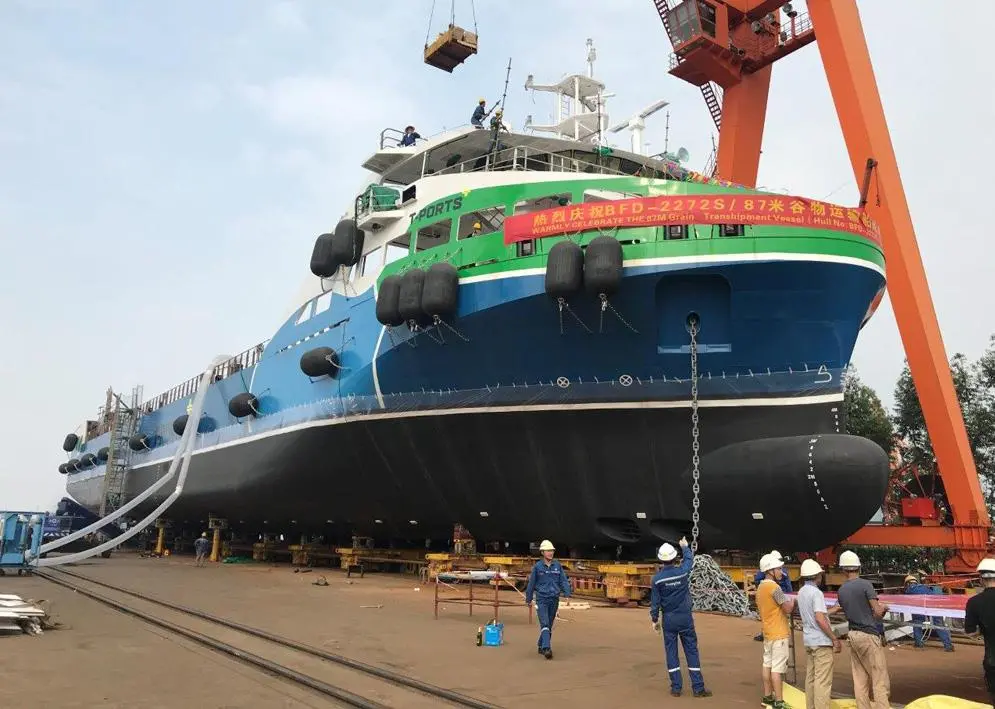
The 3,600dwt, 87m-long Lucky Eyre will shuttle grain grown on South Australia’s Eyre Peninsula to deep-sea bulk carriers anchored some five nautical miles offshore. The investment in the bespoke transfer vessel, offering high standards of productivity and seakeeping, is the complement to the creation of a shallow-water, common-user export facility in Lucky Bay.
Following launching from Bonny Fair Development Company’s Nansha yard in Guangzhou, Lucky Eyre was moved to China Communications & Construction Co at Shanghai for the installation of a materials handling system, with a rated discharge capacity of 1,800 tonnes per hour.
The vessel was conceived by Sea Transport Solutions (STS) of Southport, Queensland, which has a track record in developing transhipping technology for minerals transportation in Australia’s northern regions. Fundamentally different to conventional transhipment vessels, Lucky Eyre has a stern ramp and totally enclosed cargo handling system, with a forward arrangement of bridge and superstructure.
The design’s flexibility is expressed in a laden draught of just 3.5m and the capability to make a beach landing, while the cargo space lends itself to a payload of containers.
In fair weather, it is estimated that the vessel will be able to deliver some 10,800-13,250 tonnes of cargo to waiting bulkers offshore. This will allow Panamax ships to be fully loaded within the five-day industry norm.
Powering versatility and redundancy is vested in a propulsion system based on four 450kW engines, and the vessel is understood to have achieved 13 knots on speed trials. In the interests of operational continuity, the design has been developed and tested for conditions up to 2.5m wave height and 25-knot winds.
LOCAL ALTERNATIVE
The project as a whole brings competition into the sector, offering farmers in the upper Eyre Peninsula a new and local grain export handling and storage option, as an alternative to existing routings via deepsea bulk ports in South Australia. By requiring a harbour depth of only 3.9m, the transhipment vessel has obviated the need to establish a new deepwater facility. The Lucky Bay port development entails relatively low capital expenditure and no major dredging, obviating the much higher costs of building a deepwater terminal and associated infrastructure.
The A$115m (US$85m) infrastructure and supply chain project has been initiated by a joint venture of STS, South Australian fund manager Inheritance Capital Asset Management and Duxton Asset Management. From the three partners, a new operating entity has been formed under the name T-Ports. Besides the Lucky Eyre and the new port facilities featuring 430,000t of grain storage, it includes a further 150,000t of up-country storage capacity. Farmer customers are also participating in the equity of T-Ports.
STS and T-Ports claim that grain producers will save between A$5 (US$3.7) and A$20 (A$14.8) per tonne by using the new, low capital cost supply chain, compared to existing routings. In addition, the ship and the port provide a potential means of importing fertilisers at a cost saving of A$25-40
(US$18.5-29.5) per tonne relative to present delivery arrangements through Port Lincoln or Adelaide. The system also offers scope to service mineral export flows.
The export and storage facilities expected to be ready to receive and export grain for the 2019/2020 harvest season, with the vessel due to arrive in Australian waters by the second quarter of next year.
Related Articles
 PROPULSION
 GENERAL NEWS
 HYDROGEN