



Clean start for new era of expedition cruising
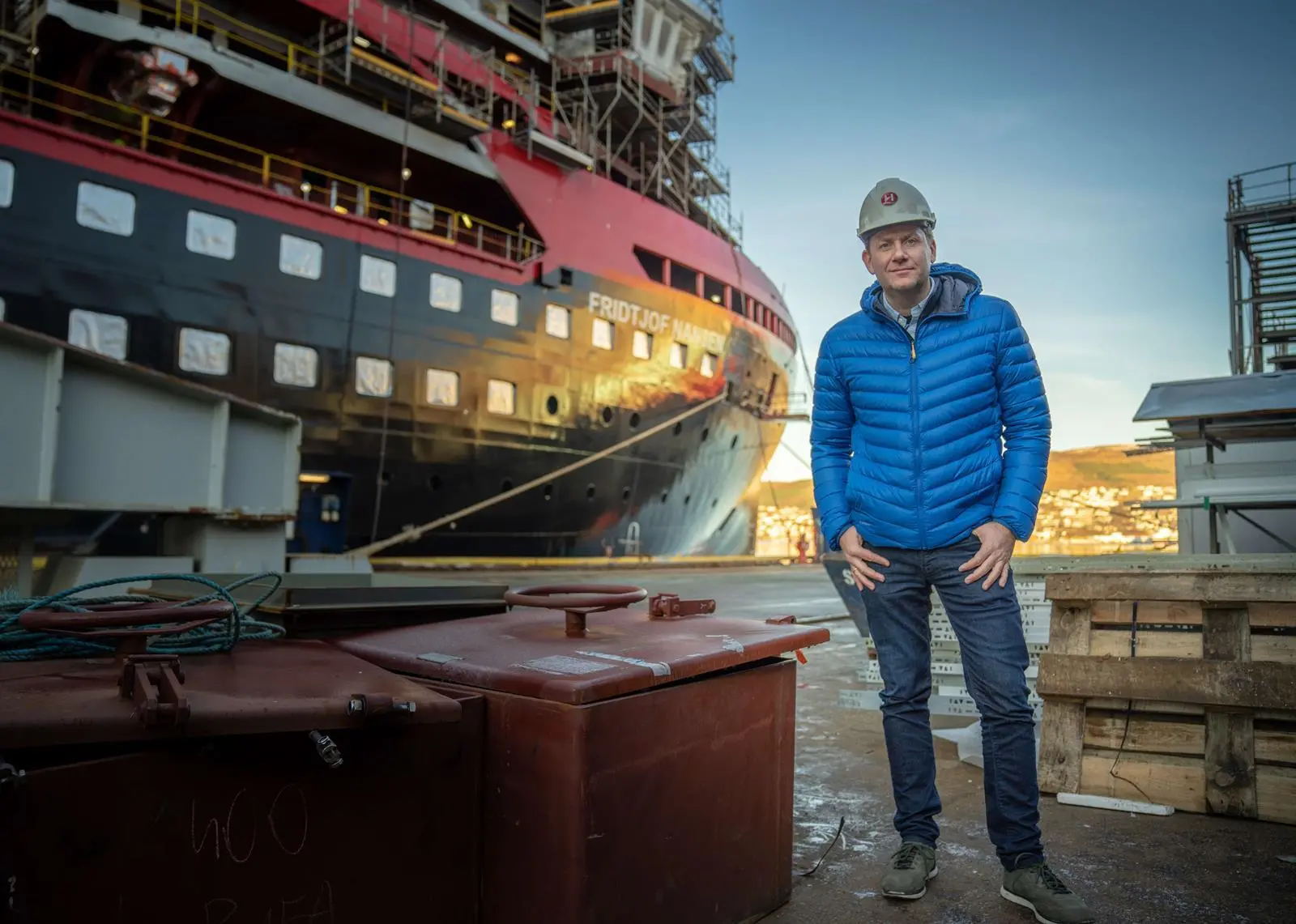
Even on a dark, mid-December morning, the fjord-side road from Ulsteinvik town centre to Kleven shipyard offers tantalising glimpses of two of the Norwegian shipbuilder’s most intriguing projects – the polar expedition cruiseship Roald Amundsen, due to begin operations in May 2019, and sister ship Fridtjof Nansen, which will enter service later in the year. The pair, which will carry up to 530 passengers on luxury expedition cruises to both the Arctic – sailing the Northwest Passage – and Antarctic, are striking not just for their sleek red, black and white lines. These are the first cruise ships to feature battery propulsion; an arrangement that Hurtigruten hopes will help to preserve the pristine waters in which the ships will sail.
When The Motorship visited Kleven – owned by Hurtigruten since the cruise and ferry operator rescued the yard from financial trouble last year – members of the mainstream press were taking their first tour of Roald Amundsen, even while contractors raced to finish cabins and communal areas. Cruise critics, whose endorsement can make or break a ship’s reputation in the competitive luxury segment, focused on those areas as well as the destinations and on-ship services. Seemingly of less interest was the claim that Hurtigruten’s hybrid ships will enable zero-emission sailing.
For now, that claim is some way from reality. The 1.35MW/h of battery power installed on the Roald Amundsen will be used to improve fuel efficiency, by around 20% compared to the same design without batteries. In the present configuration the company aims to use the batteries for peak shaving – running the engines at a constant load that charges the batteries when energy demand is low and, when energy demand exceeds engine output, discharges the batteries for a power boost.
The Corvus battery systems currently look lonely in a battery room designed to hold up to six times the number of modules. When the dual battery rooms are eventually filled – by which time batteries weighing a total of 80 tonnes will offer a capacity of 6.5MW/h – Hurtigruten will be able to sail into and out of ports and sensitive areas using battery power alone. But this will not happen for the first year or two of operation at least.
The Bergen B33:45 engines are installed on a cruiseship for the first time, and are governed by Rolls-Royce automation and an energy management system that manages the vessel’s battery systems as well as the four generators. The propulsion arrangement is designed to comply with safe return to port requirements introduced in 2016 which mean that passenger ships must offer enough redundancy in propulsion and navigation to offer safe return should an emergency occur. The rules mean that the ship houses an emergency bridge and segregated battery and engine rooms. This has added complexity to the power arrangement too – according to chief engineer Frank Hermansen, the ship is divided vertically into four zones, meaning that loss of power in one will not affect the other zones.
NOT PRESENT
One unusual system that will not, in the end, be onboard either vessel is the hybrid water system that was due to be delivered by Presentwater. The system offered a potentially cost-effective solution both to the challenge of ballast water treatment and the provision of drinking water onboard, which is either costly if water is bunkered or highly energy intensive if water is cleaned onboard. The Presentwater solution involved ballasting water that would then be treated to drinking standard, with the waste discharged as grey water – thus neatly avoiding the need to install a ballast water management system.
Unfortunately, the Presentwater system failed to gain approval from DNV GL and Hurtigruten was unwilling to be the prototype user of an unapproved system – quite understandably given the exposure of a cruise line to safeguarding passenger health and safety. Instead, just one system from Presentwater – the company’s waste heat recovery concept – is installed, rather than the whole hybrid ballast/drinking water system.
The company has decided that its ships serving the Norwegian coastal route will burn LNG as a fuel, via Rolls-Royce’s lean-burn, pure gas B33:46 engines (and assisted by batteries). Six ships will be retrofitted from the first quarter of 209 at a yard that has yet to be contracted, but is likely to include at least some work at F0sen – the yard in southern Norway that Hurtigruten rescued, having already contracted significant work to the yard when it ran into financial difficulty. The Norwegian operator has thus, perhaps unwillingly, become a proponent of the operator-owned shipyard model, with its current orders keeping both Kleven and Fosen in work.
For how long the company will be able to sustain its yards without outside business is an important question. Even one cruiseship a year is not enough to keep Kleven busy, and Hurtigruten has given no firm commitments beyond its letter of intent for a third vessel. Despite the insistence of Daniel Skjeldam, Hurtigruten’s effusive and energetic CEO, that the company needs to build more ships, many observers suspect that Kleven will be under Hurtigruten ownership only until orders from other quarters (including an anticipated rebound in offshore building) make the yard an attractive investment opportunity again.
BIOGAS BEGINNINGS
The work to reduce emissions does not stop with LNG and batteries. Hurtigruten has also announced that it will use biogas created from fishery waste provided by its LNG supplier. The company says that this biogas is the carbon-neutral fuel it can place on its ships and believes that LBG has the ability reduce emissions from LNG by up to 60%. It will be introduced slowly, initially representing 10% of bunkered gas when the company’s six LNG-battery cruise ferries come into service on Norway’s coastal route in 2021.
Skjeldam says: “There is no biogas network currently and we want to help build it. We cannot do it alone but we are a big buyer and we can encourage the development of biogas supply.”
Regardless of the move to biogas along the Norwegian coast, Hurtigruten’s first three hybrid expedition vessels will run on Marine Gas Oil, mainly due to the lack of LNG bunkering infrastructure at its destinations. Ships four and beyond, though, could be fitted out for dual-fuel flexibility. Such a move would entail a major design change because of the different engines, safety requirements and tank spaces that LNG fuel would require.
There is little doubt that Hurtigruten’s first vessels are, like their namesakes, exploring uncharted territories. Battery packs will eventually enable them to sail emission-free for longer than ever before on ships of this size. The future for powering in the expedition cruising sector could well lie in other fuels – in LNG or even fuel cells (see panel). But as all pioneers know, the first steps are the hardest to make, and Hurtigruten deserves recognition for pushing the boundaries of cruiseship capabilities.
Related Articles
 PROPULSION
 GENERAL NEWS
 HYDROGEN