



Diverse projects broaden Gulf maritime market
On 26 November last year, one of the most ambitious shipyard projects in the world came a step closer to fruition, when Saudi Aramco signed a contract with China Power Construction Group (Power China) to build the nearly 12 million square metre King Salaman International Complex at Ras Al-Khair on Saudi Arabia’s east coast.
Saudi Aramco, along with joint venture partners Hyundai Heavy Industries, Saudi shipping company Bahri and UAE-based offshore construction specialist Lamprell, envisions the shipyard becoming the biggest in the world, capable of building four offshore rigs and more than 40 ships a year (including three very large crude carriers), as well as servicing 260 vessels or offshore units. It is part of the kingdom’s ‘Vision 2030’, under which Saudi Arabia hopes to repatriate some of the US$12 billion it is currently spending on shipbuilding overseas and create a US$17 billion windfall of its own, including 80,000 jobs.
The new yard is a sign of Saudi Arabia’s ambition to evolve from an oil-producing country to one that also supplies the services and infrastructure around oil. And the US$3 billion construction contract with Power China has strategic importance for that country too, under the Belt and Road initiative that has seen China invest in transport, logistics and infrastructure projects across Asia, Africa, the Middle East and Europe.
Power China has appointed its subsidiary, Shandong Electric Power Construction Co (SEPCO), as the general contractor for engineering, procurement and contracting for the King Salaman project – one of the largest in the Chinese group’s history. SEPCO has already established a project department and has begun preliminary planning and design, procurement and pre-construction preparation work.
Initial production and service operations at King Salaman International Complex are expected to open this year, with the facility gearing up to full capacity by 2022. And with orders for 20 rigs and 52 ships already on the books over the next decade, the venture – trading as International Maritime Industries – will need that capacity soon.
To the south of Saudi Arabia’s eastern coast lies the United Arab Emirates, with the emirates’ promontory into the Persian Gulf making it a natural hub for maritime activities. With so many projects underway in a country that includes some of the biggest shipyards in the region, it is hard to pinpoint the most newsworthy. One seemingly small recently announced project highlights interest in the region from more established European players and the continued investment that the UAE is drawing to its shores
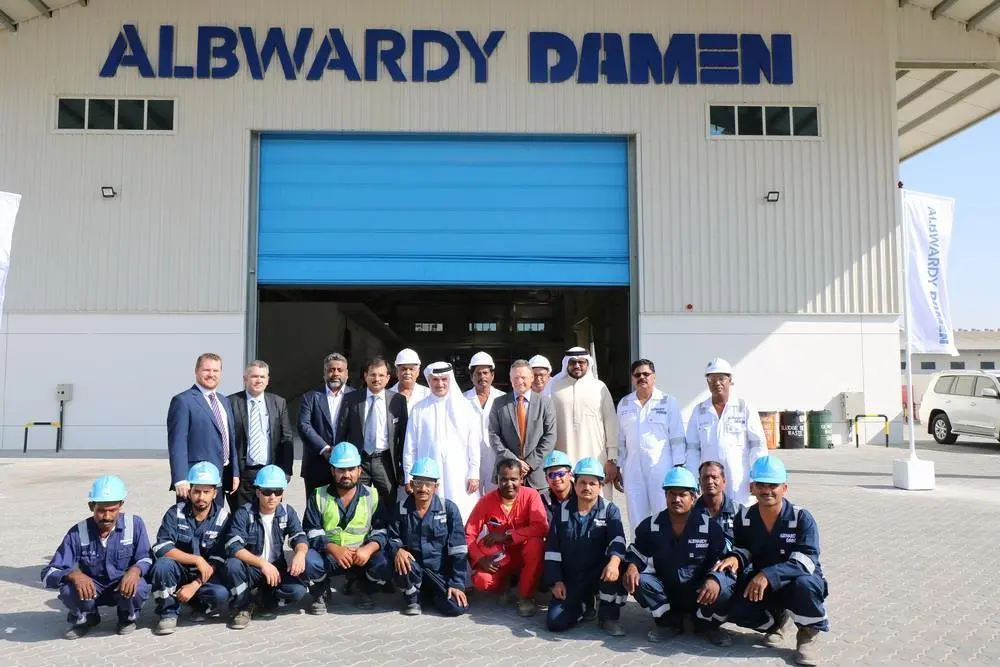
Albwardy Damen, the ship repair business established in the UAE by Dutch group Damen and joint venture partner Albwardy Marine Engineering, celebrated its tenth anniversary on 15 November 2019 by opening its new ship repair facility at Dubai Maritime.
Since 2008, Albwardy Damen has grown in size and capability to become a significant newbuild and ship repair yard. In the first half of 2018 alone, it repaired and built over 100 vessels. The new site at Dubai Maritime City enhances this capability by giving the joint venture a state-of-the-art facility in a strategic location at the heart of Dubai. This benefits not only the customers of Albwardy Damen, but also contributes to the local economy and the UAE’s own strategy for the maritime market, the ‘Maritime Vision 2030’ programme.
Lars Seistrup, managing director, Albwardy Damen, says: “Our new Dubai facility allows us to deliver the same exceptional levels of safety and quality as our yard at Sharjah. In addition, Dubai Maritime City is strategically located at the heart of Dubai, making it a highly convenient destination for our customers and one from where we can deliver a second-to-none service.”
Albwardy Damen has 1,100 employees of 26 nationalities and offers a range of ship building and ship repair skills, supported by an extensive engineering division. Over the past ten years tugs, workboats, dredgers, fast crew suppliers and other vessels from Damen’s design portfolio have been delivered to local ship owners.
Ali Albwardy, chairman and director, Albwardy Investment, says: “The primary aim of the company has always been to offer its current and potential customers the ultimate in service excellence. Albwardy Damen’s tremendous growth over the past ten years is a strong testament to its never-ending pursuit of technical innovation and its dedication to providing services according to the satisfaction of consumers.”
Bounce back north to Qatar, and a Dutch influence is evident again in a new project expanding Milaha shipyard. Located in the South of Qatar in Mesaieed Industrial City and in proximity to the new Hamad Port, Milaha Shipyard operates across for sectors: offshore vessels; navy and coast guard units; yachts; and commercial ships. It also carries out afloat repairs either at anchorage or at quayside.
Since its foundation in 1978, Milaha has repaired approximately 8,000 vessels belonging to regional and international shipowners. The yard also serves the industrial markets by providing maintenance, shutdown, fabrication and workshops services.
The yard currently occupies an area of 150,000 sqm and operates 2 floating docks, one synchrolift and extensive workshops facilities needed to perform dry-docking, maintenance and repair services for vessels up to 150m loa. Recently Milaha launched a new repair shed to accommodate vessels up to 50m loa.
Now the company has selected Royal HaskoningDHV to develop plans to upgrade its Shipyard facilities in preparation for further growth in current markets and expansion into new areas of operations.
Commenting on the upgrade plans, Abdulrahman Essa Al-Mannai , president and CEO, Milaha, says: “The phased upgrade for our shipyard is being done to support our business strategy and to increase the shipyard’s market share in four diversified target market sectors, all with minimal disruption to the ongoing operations at the facility.”
When completed, the shipyard will have an increased capacity and efficiency in handling ship repair works of larger and more complex size. The planned upgrades include a new larger floating dock, larger and enhanced workshops and an overall revamping of the facilities.
Erik Oostwegel, CEO, Royal HaskoningDHV, adds: “We are honoured to be appointed by Milaha Shipyard for this major upgrade investment planning for the whole shipyard production facilities to meet the challenges of the next 40 years”
The upgrade is expected to commence in early 2019 and to be completed by the third quarter of 2020.
Elsewhere, shipyards are looking njot necessarily to boost capacity, but instead to find more opportunities for the capacity they already have. One example is Arab Shipbuilding & Repair Yard (ASRY) in Bahrain, which in August 2018 announced that it would be launching a new fabrication and engineering division. The new arm – which will provide modular fabrication, steel structures, piping solutions, offshore structures and vessel construction – is the fourth pillar in the company’s newly defined core services, which also include repair and conversion for commercial ships, naval vessels and offshore units.
“Fabrication and engineering are already part of ASRY’s DNA as they are key elements in our ship and rig repair business,” says Andy Shaw, CEO, ASRY. “There is significant growth potential in the regional fabrication sector, starting with Bahrain, where our ownership structure as a Bahrain government-owned entity will provide stability and longevity to meet clients’ long-term needs.”
The move is a response to regional demand for fabrication facilities. ASRY believes that new developments in the petrochemical, desalination, and energy sector in have pushed demand beyond current supply. ASRY can offer more than 40 years’ experience in steel, piping and mechanical workmanship, more than 5,000 employees on site, and almost 1.5 million square metres of work space with instant access to water transport links.
“There is currently approximately US$490 billion worth of projects in pre-execution phase across the Gulf Cooperation Council in our target sectors of power, gas, oil, chemical, water and industrial,” explains Sauvir Sarkar, new construction and engineering senior manager, ASRY. “Already there are insufficient fabrication facilities in the region, and even fewer in Bahrain. Much of the fabrication and engineering work is being contracted outside of the region. ASRY can now be considered now a preferred option for fabrication work in the region.”
Related Articles
 PROPULSION
 GENERAL NEWS
 HYDROGEN