



DEBUT FOR FUTURE-PROOF IRISH FERRY
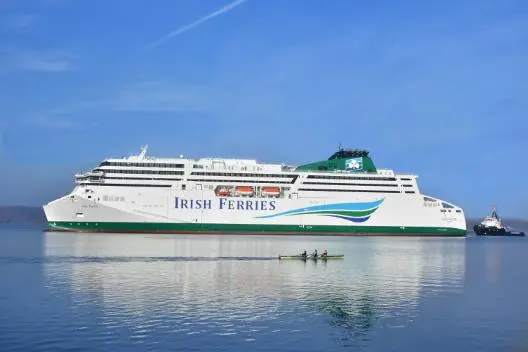
The ship blends a payload capacity for 1,800 passengers and 2,800 lane-metres of freight with a raft of advanced solutions in energy saving and environmental protection, incorporating the design optimisation that is a trademark of shipbuilding main contractor Flensburger Schiffbau-Gesellschaft (FSG).
Ordered in May 2016 for stipulated delivery in May 2018, the project has been hit by delays such that the vessel missed the entirety of her planned, inaugural summer season. Initially, FSG had re-scheduled entry into service for September 2018, attributing the hold-up to “delays in the delivery of interior components for public areas, and on the electrical system installation in the hull and deckhouse”. But completion was subsequently deferred again. It was not until 12 December that the Flensburg yard stated that she had been handed over to contractual owner Irish Continental Group.
Following shakedown, crew familiarity and berthing trials at various ports used by Irish Ferries, W.B.Yeats made her first commercial sailing to Holyhead on 22 January.
Flexibility has been built into the design to enable her to be deployed throughout Irish Ferries’ route network and meet all seasonal operational requirements. W.B.Yeats is destined to become the mainstay of the company’s Dublin/Cherbourg run from March 2019 onwards, providing a direct alternative to UK landbridge routings for Irish hauliers, traders and travellers to and from Continental Europe. The service option could gain in relevance following the UK’s planned secession from the EU.
The new flagship of the Irish fleet employs a diesel-mechanical propulsion system, based on four MaK medium-speed engines driving twin controllable pitch propellers through a pair of Siemens reduction gears. Each of the main engines is an eight-cylinder model of the M43C series, rated at 8,400kW, to provide a total power concentration of 33,600kW. The layout confers a high degree of operational flexibility and redundancy, with the capability to maintain 22.5 knots.
To allow continued use of heavy fuel oil and meet the toughest sulphur controls in any area, the vessel is equipped with exhaust gas scrubbers. Future-proofing is also expressed in the installation of a ballast water management system.
Irish Continental Group, owner of Irish Ferries, sealed a contract with the Flensburg yard in January 2018 for a second newbuild. Due to be commissioned on the Dublin/Holyhead route by mid 2020, she will become the largest cruise ferry worldwide in terms of vehicle capacity, whereby provision for 1,800 passengers will be complemented by 5,610 lane-metres of ro-ro deck space, corresponding to 330 freight units. Propulsive power will be equivalent to that of the W.B.Yeats, at 33,600kW.
The European Investment Bank (EIB) provided EUR75m ($85.6m currently) in financing towards the EUR150m (US$171.1m) capital cost of the W.B.Yeats, and has made a further EUR80m ($91.3m) available for the second newbuild project, which has commanded a price of EUR162.5m (US$188.5m). The long-term loans are being made under the EU’s Green Shipping initiative, aimed at supporting newbuild or retrofit projects regarded as having particular merits as to emission-reducing and energy-saving elements.
While primarily a tool of business expansion and enhanced efficiency in the Ireland/France and Ireland/UK traffic, W.B. Yeats embodies long-term thinking as to deployment potential and asset value, having been built to ice class criteria. DNV GL’s 1C ice class notation specifies the requirements for hull strength, machinery systems and equipment as well as procedural rules applicable to operations in light ice and light, localised drift ice conditions often encountered in estuaries and coastal areas of northern continental Europe.
Her construction has entailed recourse by FSG to subcontractors in Gdansk, Poland. Blocks of fore and aft superstructure were fabricated, and to some degree outfitted, by Marine Projects, which in turn placed fabrication of the central block with Holm Construction. Flat sections for the superstructure came from Stocznia Gdansk (Gdansk Shipyard).
PRINCIPAL PARTICULARS—W.B.Yeats
|
Length overall |
194.8m |
|
Length bp |
186.5m |
|
Breadth, moulded |
31.6m |
|
Draught, scantling |
6.7m |
|
Draught, design |
6.5m |
|
Gross tonnage |
54,985gt |
|
Passengers |
1,800 |
|
Lane-metres, freight |
2,800m |
|
Freight vehicles |
165 |
|
Dedicated car deck capacity |
300 |
|
Main engines |
4 x 8,400kW |
|
Speed |
22.5 knots |
|
Class |
DNV GL |
|
Flag |
Cyprus |
Related Articles
 PROPULSION
 GENERAL NEWS
 HYDROGEN