



RAISING THE BAR IN CARGO DREDGER DESIGN
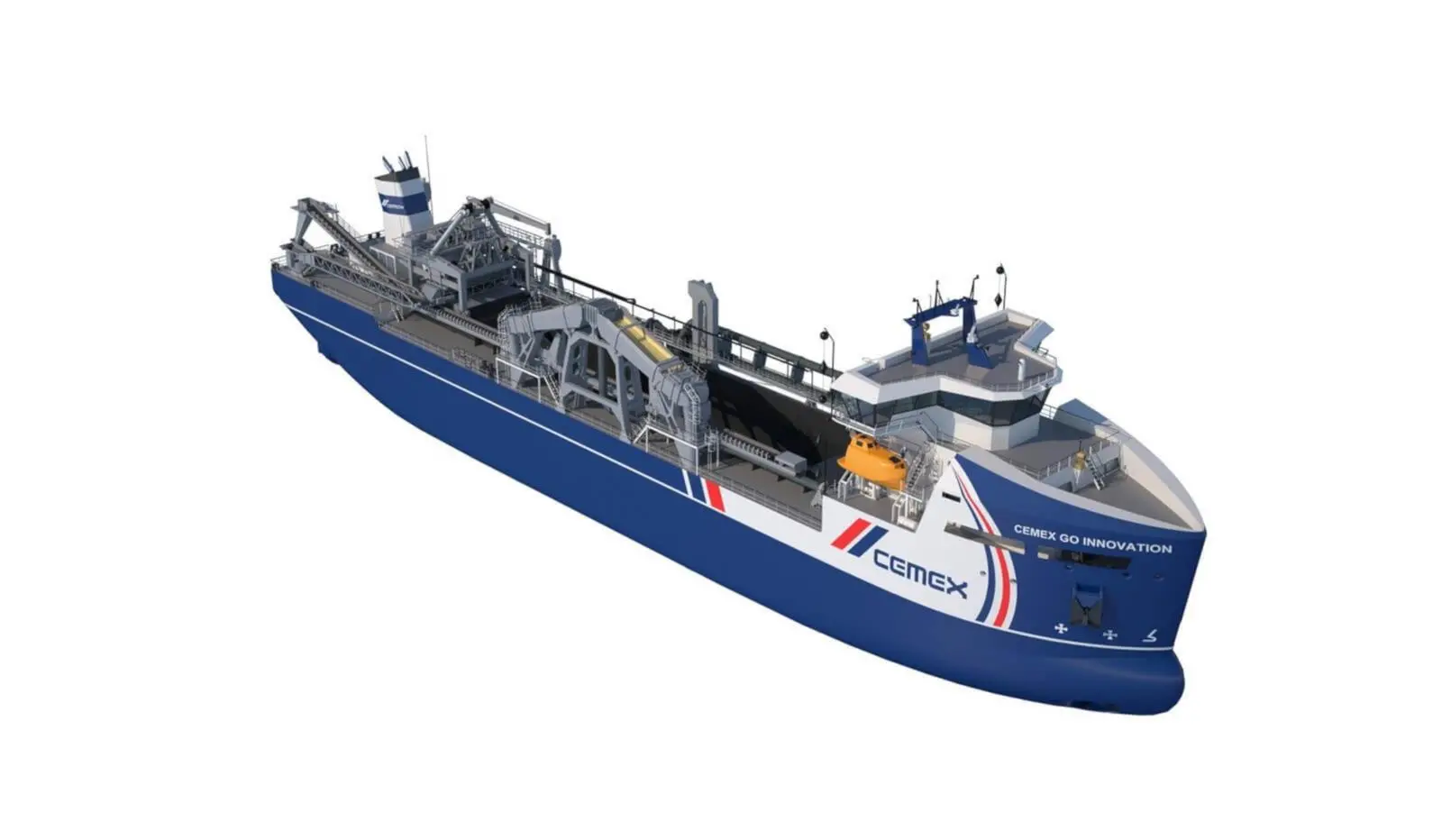
With the capability to extract sand and gravel from the seabed at depths up to 55 metres, the trailing suction hopper dredger has been developed to maintain operations in arduous North Sea conditions, carrying cargoes direct to river and coastal terminals in the UK, Netherlands, Belgium and northern France. She will be the first new dredger to be commissioned by CEMEX UK Marine for 21 years, and heralds a substantial advance in efficiency, productivity and environmental technology.
The 7,000-dwt CEMEX Go Innovation will be able to convey 20% more aggregates per trip than the ship to be replaced, the 1990-built, 99-metre Sand Heron, and will be equipped to work further out to sea than the latter, which has a 33-metre maximum dredging depth.
Southampton-based CEMEX UK Marine, part of Mexican-owned building materials supplier CEMEX, awarded the £30m (US$39.6m) vessel construction contract to the Damen Shipyards Group, which assigned the project to Romanian subsidiary Damen Shipyards Galati. With the owner’s concept as the reference point, the design developed for the newbuild is the Damen MAD (Marine Aggregate Dredger) 3500.
The MAD portfolio is the result of extensive market research and owner consultations conducted by the Dutch shipbuilding group, addressing a marine aggregates sector faced with ageing tonnage and increasing product demand.
The prospective addition to the CEMEX fleet will be distinguished by Lloyd’s Register’s ECO notation, a voluntary accreditation that demonstrates standards in design, construction and operation that go beyond statutory requirements. LR provided integral support to Damen during the design concept stage, optimising the dredger to maximise payload through structural efficiency.
The ship’s level of environmental engineering reflects not only the need to comply with the growing weight of legislation relating to emissions and criteria for offshore dredging, but also issues relating to noise and vibration as regards onboard habitability and cargo working at berths close to urban communities. The dredger will require no ballast water, so dispensing with ballasting operations and helping to allay increasing environmental concerns around biosecurity.
The hull has been formed to render optimal seakeeping behaviour, creating more comfort for the crew and better ensuring productivity and equipment wellbeing in rough weather. The foredeck is enclosed, protecting deck gear and reducing ‘green water’ ingress into the hopper hold.
Among the challenges CEMEX presented to Damen was to develop a dredging system with no inboard pipework, the rationale being to avoid the risk of flooding in the event of dredge pipes becoming fractured or holed over time through constant handling of highly abrasive marine aggregate material. Consequently, all dredge pipes will be arranged above main deck level, conferring greater safety and also easier inspection and crane reach, and breaking new ground in the design of such vessels.
One of the parameters stipulated by CEMEX was an overall length of 103.5 metres, the maximum for navigating the sea lock at the UK south coast port of Shoreham, one of the many discharge and distribution points in the group’s network.
CEMEX Go Innovation has been specified with two medium-speed engines of the Wärtsilä 26-series, prepared for use with selective catalytic reduction(SCR) technology to comply with IMO Tier III NOx emission requirements. The W26 engine is widely used in the dredger market. The ship’s two Wärtsilä controllable pitch propellers will be of the 4D775 type, and the full scope of proprietary supply includes the ProTouch control system. The vessel is required to be able to make fully-laden transits from the dredging grounds to port at 12 knots.
UK firm Royston Diesel Power’s electronic fuel management system, known as enginei, will be installed as part of a suite of digital marine technologies, in the interests of long-term efficiency and operational safety. enginei employs Coriolis flowmeters and sensors to monitor fuel consumption of each engine, tracking against GPS data, voyage details and operational mode. Data is collected, processed and relayed to bridge and engine room touchscreen monitors for review and action by the master. Damen has entrusted compatriot Alewijnse Marine with the complete electrical outfitting of the vessel.
Sand and gravel will be brought aboard using a submerged, wear-resistant Damen dredge pump in the trailing suction pipe, with the material passed through the ship’s screening towers, before storage and de-watering in the hopper. Self-discharge will be realised by applying the grab principle, refined so as to maximise the efficiency of each discharge cycle. The dry unloader has been developed by Damen in conjunction with CEMEX and crane manufacturer PLM. Expeditious turnarounds are vital to competitiveness in the trade, and a 20% advance in unloading rate is anticipated with the new ship.
According to The Crown Estate, the licensing authority for marine aggregate extraction in UK waters, a total of 19m tonnes was dredged by all operators in 2017. Landings in the British market amounted to 14.3m tonnes, direct export cargoes totalled 3.1m tonnes, and beach nourishment and reclamation schemes accounted for 1.6m tonnes.
Related Articles
 PROPULSION
 GENERAL NEWS
 HYDROGEN