



LNG DEBUT IN MED RO-PAX SECTOR
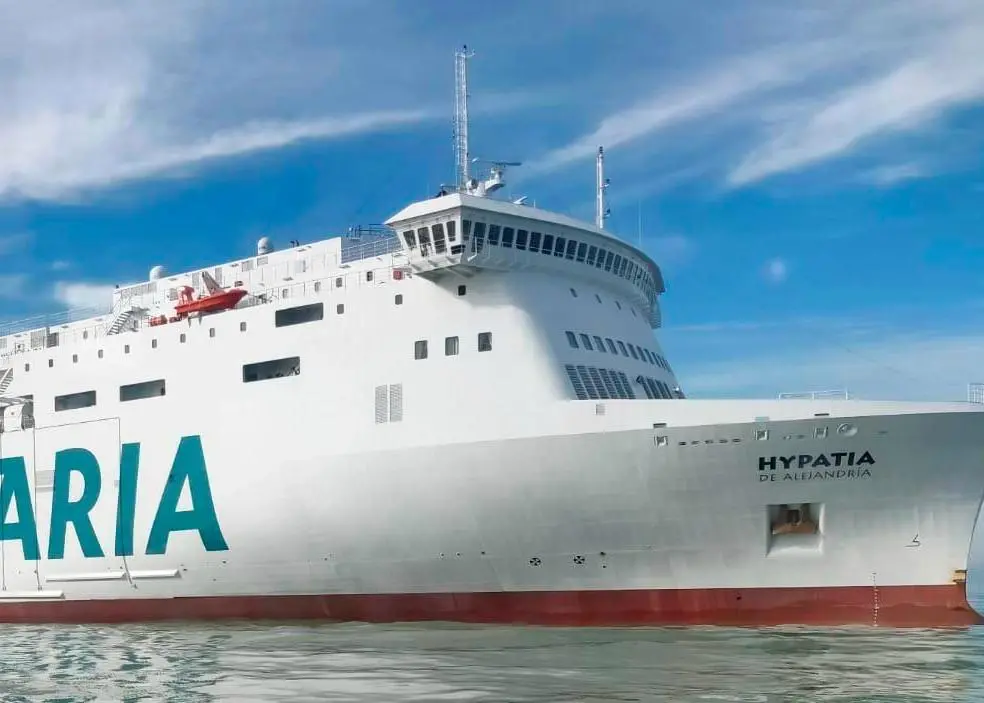
Balearia ordered the pair in January 2017 under a EUR 200 million (US$226m) contract with Cantiere Navale Visentini, the privately-owned Italian shipyard which has been constructing a distinctive breed of ro-ro freight and ro-pax ferries deployed by European companies since the 1990s.
Hypatia de Alejandria cut her teeth on a Barcelona to Palma di Mallorca sailing in February, and will be a mainstay of the route network connecting the Spanish mainland with the Balearic Islands, as will future consort Marie Curie.
The design originates from Trieste-based NAOS and provides freight capacity equating to 2,194 lane-metres plus 160 cars, together with facilities for 810 passengers. The ships are fast, enabling rapid transits at 24 knots in a laden state, drawing a combined 20,600kW power from two Wartsila dual-fuel main engines.
NAOS reported that Hypatia de Alejandria achieved a top speed at partial draught in excess of 26.2 knots on sea trials, demonstrating better performance than the previous, similar newbuilds. Contributory factors were said to be the addition of transom stern flow deflectors, and the use of silicon underwater hull coating.
LNG fuel containment is in two tanks located on the open upper deck aft, offering capacity that confers seven days’ endurance. Balearia entered into a 10-year LNG supply agreement with Spanish utility Naturgy Energy Group, formerly Gas Natural Fenosa.
The vessel is the first in the company’s fleet to roll out an array of digital services and facilities tailored to passengers, and the application of ‘smart’ technology will also extend to remote monitoring from ashore of the propulsion system.
Balearia is no stranger to Visentini’s product line. The fleet includes two ro-pax ferries built at the Porto Viro yard south of Venice in 2002, the Napoles and Sicilia, followed in 2010 by a further vessel of similar type, the Visemar One.
Twin goals of raised operating efficiency and environmental responsibility, with an eye to future legislative developments in the Mediterranean, have led to the adoption of LNG-capable powering arrangements for the latest capital investments. The company plans to run at least half its fleet on LNG within the next three years, and have all ships operating on the fuel in 10 years’ time.
To that end, Balearia announced plans in 2018 to spend a total US$84 million on the conversion of six of its existing ro-pax ferries for operation on LNG, under a programme extending into 2021. In each case, two medium-speed diesel engines will be adapted to dual-fuel engines. Some of the ships have MaK main machinery, and others are MAN-powered. The first retrofit, involving the Napoles, was recently completed at Gibdock’s yard in Gibraltar. Her MAN nine-cylinder L48/60A diesels were adapted as 9L51/60DF units.
The European Union is partially funding the conversion scheme under its Connecting Europe Facility (CEF) aimed at fostering efficient, environmentally-friendly infrastructural developments.
Furthermore, Balearia placed an order during October 2018 with the Spanish shipbuilder Astilleros Armon for a 125-metre, high-speed catamaran ro-pax ferry of Incat design, specified with four Wärtsilä LNG dual-fuel propulsion engines. She is due to be commissioned in 2020 as the Eleanor Roosevelt.
The company stated the following: “The use of LNG allows us to fulfil our commitment to the environment and energy efficiency, while also remaining one step ahead of the new pollutant gas reduction regulations scheduled for 2020.” The port of Barcelona is among the interests in the Mediterranean promoting the use of LNG through its Air Quality Improvement Plan.
Related Articles
 PROPULSION
 GENERAL NEWS
 HYDROGEN