



GERMAN KNOW-HOW IN CHINESE-BUILT DECKCARRIER
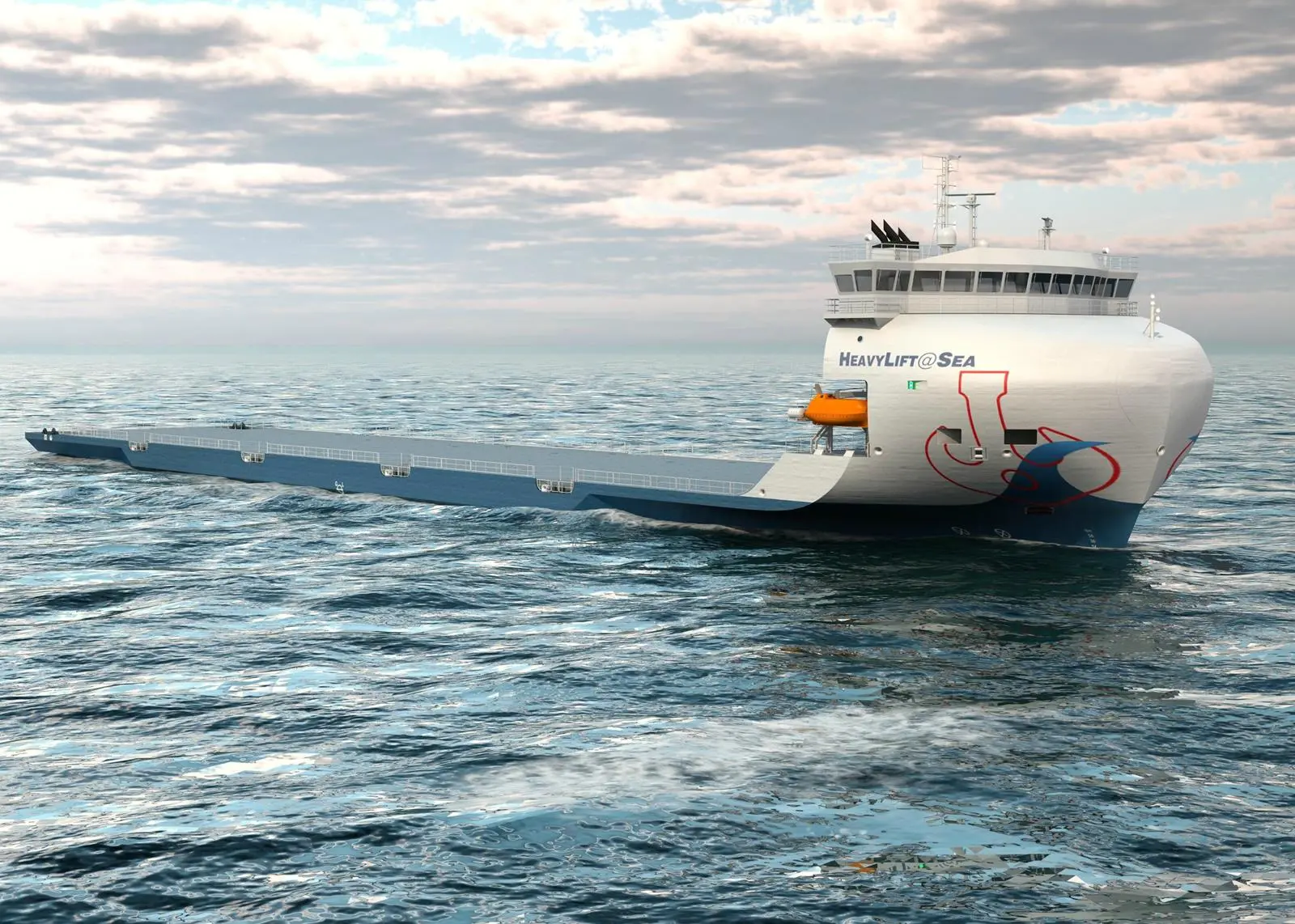
Featuring a forward-located superstructure and a load capacity of 10,000 tonnes on a completely unobstructed, open deck area of 3,600m2, the diesel-electric newbuild will initially be deployed by Hamburg specialist United Wind Logistics(UWL) to transport components for offshore wind projects in the North Sea and the Baltic region.
Designated the DC 10000-type, the vessel has been ordered from Jiangsu Zhenjiang Shipyard and has been conceived to carry heavy cargo, machinery and large modules as well as parts and fabrications that require handling by the ro-ro mode due to considerations of weight and relative fragility, such as structures for the oil and gas industry. The employment scope for the ship potentially extends well beyond the offshore wind energy sector to the worldwide heavy transport market by way of UWL’s associated companies United Heavy Lift and United Engineering Solutions.
UWL’s expertise lies in the delivery of logistic solutions for the transportation of offshore wind turbine components such as blades, nacelles, towers and foundations from manufacturing sites to pre-assembly ports serving offshore windfarm developments. The firm’s turnkey offering includes project management, securing suitable tonnage, design and procurement of grillage and stacking frames, lashing and securing arrangements, and lifting appliances.
The newbuild at Jiangsu Zhenjiang is seen as the first of a series of vessels for UWL, in which Fred Olsen Ocean(FOO) announced on April 1 this year that it had acquired a 50% ownership. The move builds on the Norwegian group’s stake in the business through its existing 100% control of Fred Olsen Windcarrier.
On main dimensions of 148.5m length overall by 28m breadth, the new deckcarrier is configured with a full-width(28m) working deck extending for 130m, and will draw a maximum 5.6m at full load. The 3,600m2 availability for cargo is large in relation to the hull dimensions, and its attainment was due in part to an especially compact superstructure and deckhouse, accommodating a crew of 21. The flat deck has a high load-bearing capability not only in terms of overall mass and distributed load, but also as regards point and linear loads, thereby conferring flexibility both as to wind power components and wider, worldwide heavy cargo deployments. Versatility has been further enhanced by the specification to DP2 dynamic positioning standard, rendering suitability for complex offshore assignments.
As the vessel’s operating profile will encompass calls at a small port in Denmark, HeavyLift@Sea simulated specific access conditions at a test facility in Copenhagen, and employed the results in the design calculations. “There were a number of requirements for this ship that seemed to be mutually exclusive at first,” reported HeavyLift@Sea’s managing director Hendrik Groene. “The width of the required cargo deck had to be reconciled with a ship width that was small enough for the approach to this particularly small Danish port. At the same time, in order for the ship to pass through the Kiel Canal, it had to be taken into account that the deck couldn’t be wider than the waterline.”
To optimise the diesel-electric propulsion system to the ship’s size and configuration, and to achieve maximum manoeuvrability and energy efficiency, the main generators under the aft deck have been divided in an unconventional way. The layout is based on MAN small-bore, medium-speed diesels, and comprises two sets driven by 9L21/31 engines and two with 6L16/24 units as prime movers. The plant will achieve IMO Tier III emissions compliance by virtue of selective catalytic reduction(SCR) technology, as will be especially salient to upcoming Emission Control Area(ECA) requirements governing the North and Baltic seas.
The four gensets will be assembled and tested in China by MAN Energy Solutions’ licensee CSSC Marine Power(CMP). The installation should ensure a laden speed of around 12 knots.
With the diesel generators fitted in the forward part of the hull, the diesel-electric solution obviates the need for very long shaftlines as the cable-fed electric propulsion motors can be placed well aft, Engine usage can be matched to precise power requirements across the operating profile, and run at consistent, optimal load to the benefit of fuel consumption and maintenance requirements over time. The uptakes from the engines pass through the forward structure, avoiding the need for funnel casings in the ship’s revenue-earning section.
Related Articles
 PROPULSION
 GENERAL NEWS
 HYDROGEN