



DUTCH YARDS RESILIENT IN CORE MARKETS
Dutch shipbuilders have developed the broadest business portfolio embracing the smaller types of commercial and naval vessels. Innovation, collaboration in both production and pre-competitive research within and beyond the Dutch maritime cluster, and a ‘can do’ mindset, have collectively had a signal bearing on the industry’s resilience.
Notwithstanding the drive into higher-yield and higher added-value sectors, the Netherlands has retained its pre-eminent European position in the construction and design of both multipurpose vessels and other types of tonnage, much of which is intended for European shortsea and intermediate trades. The Dutch newbuild output has been consistently enhanced in terms of capital cost-competitiveness, operating efficiency and technological standard.
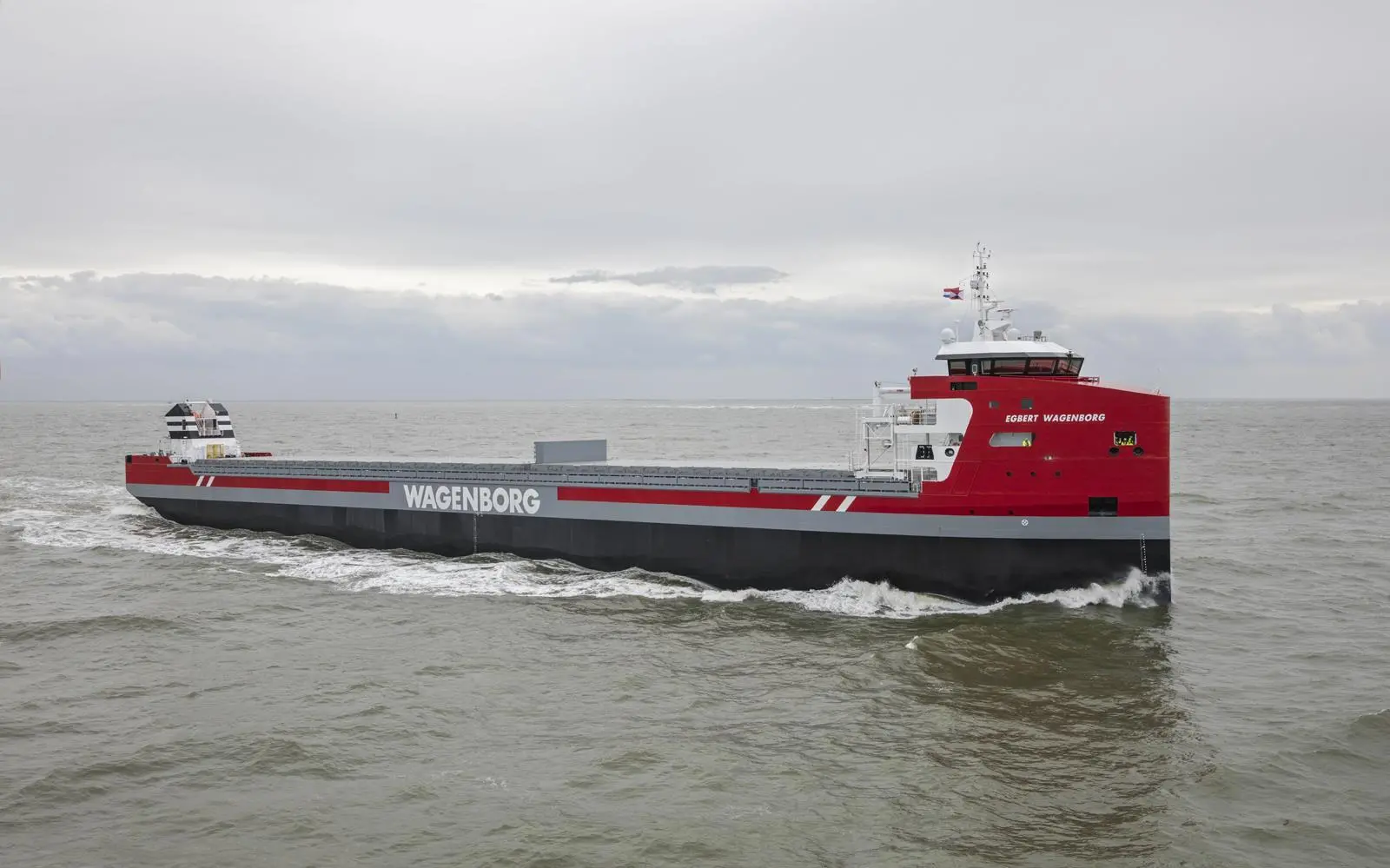
A new milestone in Dutch multipurpose cargo vessel design and construction was signalled by the entry of the Egbert Wagenborg into the fleet controlled by Delzijl-based Wagenborg Shipping, a prominent player in both the deepsea multipurpose cargo vessel market and the European shortsea business. Egbert Wagenborg provided the 2017 debut for the EasyMax concept jointly developed by the shipowner and shipbuilding contractor Royal Niestern Sander, in consultation with specific clients. Wagenborg has recently provided further endorsement of the innovative class, by ordering a second ship for delivery in 2020.
The design combines a load capacity of 14,300 tonnes and underdeck cargo volume of 625,000ft3 with an exceptionally low fuel consumption of nine tonnes per day at 11 knots. EasyMax encapsulates an ‘easy to build, easy to operate, easy to load’ philosophy, and offers extended cargo carrying versatility through an ‘open-top’ notation. Egbert Wagenborg is the largest ship built to date on the landward side of the dykes in the north Netherlands. The 149.95m vessel is the maximum for the northern canalside shipyard at Groningen, and her 15.9m beam is the maximum for access through the sea lock at Delfzijl.
Arklow Shipping, Ireland’s foremost shipping company, and one of Europe’s leading practitioners in the shortsea dry cargo sector, continues to pursue a vigorous fleet modernisation and expansion strategy, and Dutch shipbuilders remain pivotal to this programme.
Family-owned Scheepswerf Ferus Smit added 11 Arklow newbuilds to the orderbook at its Westerbroek yard on the Winschoterdiep inland waterway during 2018. At the same time, the company implemented production of a 16,500dwt class for Arklow at its Leer riverside premises just over the border in Germany. Also located on the Winschoterdiep at Hoogezand, Royal Bodewes has been another important source of Arklow tonnage, most recently completing the final three vessels in a 10-ship series of 5,170dwt singledeckers.
The latest Arklow contracts with Ferus Smit comprise five vessels of 5,150dwt, and six of 9,000dwt. The smaller newbuilds take the workload into 2022/2023 and are continuations of the five-ship Arklow Cadet series handed over in 2016-2017. The 9,000-tonners, spanning delivery slots between the coming autumn and the beginning of 2021, are slightly more capacious than four vessels built to the same account during 2014 and 2015.
Meanwhile, the second of four 16,500dwt shortsea bulk cargo carriers, Arklow Wind, was completed in April this year at Leer. The 149.5m design, offering a 700,000ft3 cargo volume in two holds, is an enlarged and more powerful version of the 8,600dwt type delivered by Ferus Smit to Arklow in 2014 and 2015. Arklow Wave, Arklow Wind and the third and fourth newbuilds are primarily intended for the North Sea and Baltic trading regions, and have each been specified to 1A ice class. To achieve compliance in sulphur Emission Control Area(ECA) zones, the MaK 8M32C main engine is operated on marine diesel oil (MDO).
Royal Bodewes has been chosen to execute a further phase of modernisation of the fleet deployed by UK shortsea operator Scotline. The latest deal calls for a sister to the 4,800dwt Scot Carrier, completed last November, as a representative of the Bodewes Trader series of general purpose, box-hold cargo vessels. The second coaster will be named Scot Explorer, and is expected to be launched during the third quarter of 2019.
The selected design, to Swedish ice class 1B standard in accordance with the owner’s regular, year-round services to and from the Baltic, is a derivative of the 12 year-old, 4,500dwt Scot Leader.
The propensity of the industry in the Netherlands’ northernmost provinces for small, specialised trading vessels is also exemplified by recent years’ continuity in the production of dedicated, self-discharging cement carriers, the latest of which is approaching completion at Ferus Smit’s Westerbroek yard near Groningen. The 8,000dwt Shetland is the third in a series of newbuilds ordered for operation with JT Cement, the joint venture between Erik Thun of Sweden and the Norwegian company KG Jebsen Cement.
The Shetland is slightly larger than the two preceding vessels, the Greenland and Ireland delivered in 2015 and 2016, respectively, and embodies the same LNG-capable main engine installation and ship design concept, featuring a fully enclosed cargo handling system. The automated loading and unloading arrangements are based on fluidisation of the cement through the use of compressed air. Fluidisation in conjunction with slanted tank tops in the holds enables the bulk cement to flow to a central suction point for transfer ashore through the ship’s cargo piping at 500m3 per hour, ensuring dust-free operation in all weather conditions.
Greenland was the world’s first-ever dry bulk cargo vessel powered by LNG dual-fuel machinery, and has provided the template for the soon-to-be-commissioned Shetland, similarly fitted with a Wartsila 34DF-series engine served by a pressurised LNG tank located in the foreship and by marine gas oil fuel tank spaces aft. The virtual absence of sulphur and low NOx emissions achieved in gas mode meets the toughest controls enforced in the fleet’s primary Baltic and northwest European trading sphere.
Royal Bodewes has also shown its mettle in cement carrier contracting, having followed-up last year’s handover of the 7,800dwt Cymbidium to Limassol-based SMT Shipping with an order from the same group for three 4,200 dwt newbuilds.
Cymbidium forms part of SMT’s pneumatic cement bulker business Eureka Shipping, which has contracted the latest trio of vessels. The three-ship deal, understood to entail a total capital cost of around EUR29 million (US$32.5m), has attracted financing from the European Investment Bank(EIB), under its Green Shipping Guarantee Programme.
The EIB is contributing EUR10.1 million (US$11.3m) towards an ABN AMRO-arranged facility, as a vindication of what is viewed as Eureka’s ongoing commitment to environmental stewardship, and in support of the environmental benefits of sea transportation. “The project contributes to a modal shift where, instead of using road haulage, goods are transported by sea, which is considered to be the most sustainable transport mode for this type of cargo,” said the EIB.
The first of the trio, Aalborg White, was side-launched in March this year into the Winschoterdiep at Foxhol by subcontractor Ship and Steelbuilding (SaS), in keeping with the prompt delivery undertaking given by Royal Bodewes for the complete series. The last ship is due at the beginning of 2020. Eureka has had its horizons expanded since mid 2018 as a consequence of Montreal-headquartered CSL Group securing a 50% holding in the company.
The earlier and larger Bodewes-supplied entrant to the Eureka fleet, the Cymbidium, was not only testament to Dutch shipbuilders’ competitiveness in niche sectors, but also to the Dutch industry’s ability to tap into the wider maritime production cluster and lower-cost foreign subcontractors so as to deliver the requisite specification and quality at a competitive price. Primary construction was undertaken in Poland, final outfitting took place at Royal Bodewes’ Papenburg premises in Germany, and Dutch suppliers were entrusted with key elements and systems.
The highly distinctive and forecastle configuration represented by the Groot Cross-Bow is of Dutch conception. It achieves a wave-piercing action, requiring less engine power for a given speed and making for improved seakeeping and onboard habitability in head seas and rough weather.
Damen Shipyards Group has continued to expand its international network, a major new stage in the organisation’s development having been attained through the 2018 takeover of the former Daewoo-owned Mangalia yard in Romania. While Damen is characterised today by the ever-growing production of specialised and custom-built ships applying modular build techniques, it can still also be identified with the prolific output of standardised smaller vessels and craft. Its creation over the years of a functionally integrated global system of vessel construction and outfitting is effectively the Dutch model on a large scale.
The group’s offering of standard designs of shortsea traders and multipurpose cargo vessels has been augmented by the Combi Coaster 2750-type, conceived for operation into small ports and inland waterways. Available with either a fixed or moveable wheelhouse, the latter facilitating navigation through low bridges, the single-hold class has main dimensions of 88.7m x 11.3m. It is an evolution of the Combi Coaster 2500, the most recent examples of which date from late 2013.
Building for stock so as to be able to offer early deliveries has long been practised by Damen in fields favouring a more standardised product. Damen Shipyards Gorinchem’s forward programme is understood to include four examples of the Combi Freighter 3850 type, which has been a popular choice for shortsea exponents in past years, and which last attracted sales in 2013. At 12.5m, the design is beamier than the Combi Coaster 2500, but of similar length.
After a protracted period of tough conditions in both the shortsea and multipurpose sectors, committed owners are investing in more efficient designs to suit the coming decades, and the Dutch industry is at the centre of these developments.
Related Articles
 PROPULSION
 GENERAL NEWS
 HYDROGEN