



FURTHER INVESTMENT BY UK SHORTSEA CARRIER
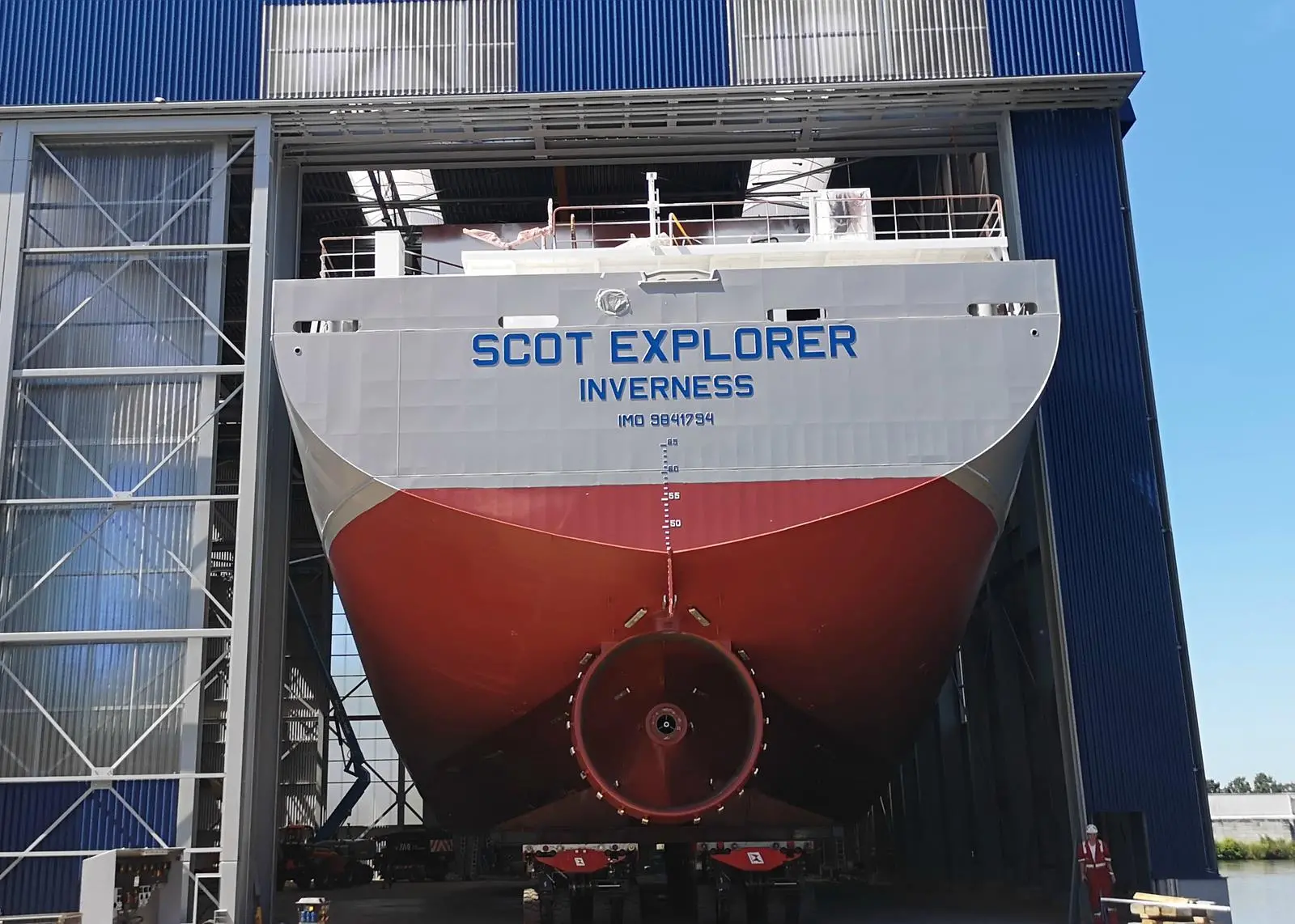
After the delivery of the Scot Carrier in November 2018, construction of the second ship in the series, Scot Explorer, started in February 2019, with an expected launch date in October. The newly-booked third vessel, to be named Scot Ranger, is scheduled to be laid down in early 2020.
The design is a derivation of the company’s 12 year-old, 4,500dwt Scot Leader, representing the Bodewes Trader family of general purpose, box-hold cargo vessel series developed and constructed by the Dutch shipbuilding group.
The specification in the latest Scotline contract has been enhanced to Swedish/Finnish Ice Class 1A standard from the 1B level of the Scot Carrier and nascent Scot Explorer. Ice strengthening reflects the operational demands of providing year-round transport through the Baltic region, including Scotline’s regular services linking Sweden and eastern Baltic states with the UK.
The newbuild ships feature a single hold approximately 62m in length within an overall hull length of 90m, accessed through full-width hatchways and pontoon-type hatch covers reinforced to take weatherdeck-borne cargo. The cargo spaces incorporate special fittings for timber and containers, plus provision for grain separation. The hold volume is about 240,000ft3, and the overall, timber-fitted load capacity is 6,800m3, compared with the 223,355ft3/ 6,325m3 of the 2007-built Scot Leader.
The latest generation, as exemplified by the Scot Carrier, is accordingly well suited to the company’s core trade in timber, woodpulp and other forestry products, as well as for spot business with bulk commodities and large and indivisible project loads.
For the further addition to the series, a main engine of the MaK M25C type in its six-cylinder configuration has again been nominated, proving an economical and compact installation producing 1,850kW for a speed of around 11-12 knots. The inclusion of a 300kW bow tunnel thruster is a pointer to the manoeuvring requirements in the small ports, tidal rivers and restricted berths central to north European shortsea trading.
As with rest of the owned fleet, the future Scot Ranger will be registered under the British flag and classed with Lloyd’s Register. Scotline’s fleet is complemented by group-owned terminals in the UK at Rochester and Inverness, such that it offers customers an ‘all-in-one’ service of shipping, stockholding and distribution, including an extensive, regular route network.
The entry into the fleet of the Scot Carrier precipitated the sale of the previous Scot Ranger, a singledecker of 3,400dwt which had been the company’s first newbuild, delivered from Yorkshire Dry Dock in 1997. Described by Scotline as having given “reliable and productive” service during the 22 years under its ownership, she had been the last delivery by the Hull shipyard.
Royal Bodewes has reinvested substantially in production halls and equipment at its main shipbuilding site at Hoogezand, on the Winschoterdiep waterway east of Groningen. The aft section of the Scot Explorer was recently moved from the new production facilities ready for the next stage of construction assembly and launch during the autumn.
Related Articles
 PROPULSION
 GENERAL NEWS
 HYDROGEN