



More than batteries?
As much of the cargo business has been under pressure to reduce both fuel consumption and emissions, slow steaming strategies have become ubiquitous.
So it’s a matter of concern that the gains are all too easily wiped out by bad weather.
According to a Tokyo University of Marine Science and Technology report, high winds and waves have a greater impact on vessels travelling at lower speeds: fuel consumption can rise by as much as 20%.
The effects are multilayered, says Tatsuya Ohno of Kawasaki Heavy Industries. Not only is it just plain bad for the rotating machinery, but it has particular implications for ships with a flexible power strategy.
If the seas are so dynamic that the propeller blades turn in the air, the suddenly reduced load releases a surge of energy. As a result, a vessel using its gensets for both propulsion and hotel demand could suffer a voltage spike high enough to trip a safety shut-down “resulting in a dead ship”, he explains.
There are other issues facing vessels utilising shaft generators, says Lucas Meubrink of Skeleton Technologies, a solution that’s “becoming more and more common” as an efficient way to meet the hotel load.
However, when a ship slows down, for example when approaching harbour, the shaft speed reduces and so the electrical demand has to be picked up by the auxiliary gensets. Unfortunately, this slow-down itself makes the ship more vulnerable to the effect of heavy seas.
Worse, any voltage surge will make the few moments of hand-over like trying to push a load over a bouncing seesaw. Given rough enough conditions, the auxiliaries will fail to cover the fluctuations and may prevent the switch entirely. It’s a nasty scenario: the gensets can be damaged by the process and so at this point “there is just no good, safe answer” says Meubrink.
Even if the circumstances are somewhat less dire, all this stress increases component failure, pushes up fuel consumption and pulls the engines even further away from their optimum, adds Ohno.
A sensible answer is to use an energy storage backup to compensate for load fluctuations. This would be capable of fielding those inevitable trip events and levelling out the demand on the engines.
But research by KHI shows that a standard lithium-ion battery may not always be the most appropriate solution. Batteries have a high energy density (how much can be stored) but not so much in the way of power density (necessary to meet a fast, deep draw). Getting it wrong comes at a cost: misusing a battery will considerably shorten its lifetime. Further, as Meubrink adds, “the batteries that are designed for this kind of use are really rather expensive… they are oversized, more complex and need water cooling”.
Therefore, if what’s needed is a few seconds of peak demand, one of the supercapacitor technologies might be the answer. There are different versions with slightly different characteristics: for example, Skeleton’s development is based on the charge-holding capabilities of graphene’s nano-structure. Another, by KHI’s collaborator JM Energy, is offering a lithium-ion capacitor (LiC) which is actually a cross between a li-ion battery and an electric double-layer capacitor (EDLC).
While these solutions can seem to be more expensive at first glance, you need to do the sums as weight-for-weight they pack of lot more punch: for example, LiC yields 14,000W per kg compared with a lithium ion battery (LiB) which only has a measly 1,800W per kg.
This is because while LiB relies on a chemical reaction between electrodes and electrolytes, supercapacitors work by holding the charge electrostatically, making a quick release easier.
It’s a neat solution for numerous, high load fluctuations since there’s virtually no degradation of the cells and as a result, while LiB’s cycle life is less than 10,000, LiC’s is upward of 500,000 – and Skeleton pegs its supercapacitors’ life at over a million cycles.
It should be noted that while these technologies are far more stable than batteries there are some differences between them. This is because LiC’s LiB parent bequeaths it somewhere between two to four times greater energy density than an EDLC capacitor, explains Martin Keenan of Avnet Abacus. He adds that while it generally has a higher temperature rating and is somewhat lower in volume and weight, it does have a slightly greater internal resistance, so extremely high peaks are better met by ELDCs. Further, some voltage control is needed: while LiC’s don’t have the reactive chemistry of li-ion batteries and won’t suffer from thermal runaway “you can still damage the device… but it will not result in catastrophic failure”.
So, what kind of length of discharge would be best met by a supercapacitor – and when should a battery be utilised? According to Meubrink, “I’d say a supercap is a good solution for higher power output, under 30 seconds duration”. Keenan says for simple comparison’s sake, an LiC will probably yield “a couple of minutes draw”, but in both cases the price rises concomitantly for more extended demands. Therefore, if a much lengthier output is required, a battery may be more appropriate for commercial reasons.
However, Keenan adds that in scenarios where there is a frequent trickle of energy – for example from solar, wind or kinetic energy harvesting – an LiC can hold onto it for months with very little self discharge, which “might be very attractive for marine applications”.
Most importantly, both have a very different C-rate response to LiB. This results in far greater flexibility, says Meubrink: “As a rule of thumb, you can take a supercapacitor sized for a 500kW discharge over ten seconds, and use it to give you 1MW for five seconds.” What’s more, he adds, “it can charge in the same kind of period”.
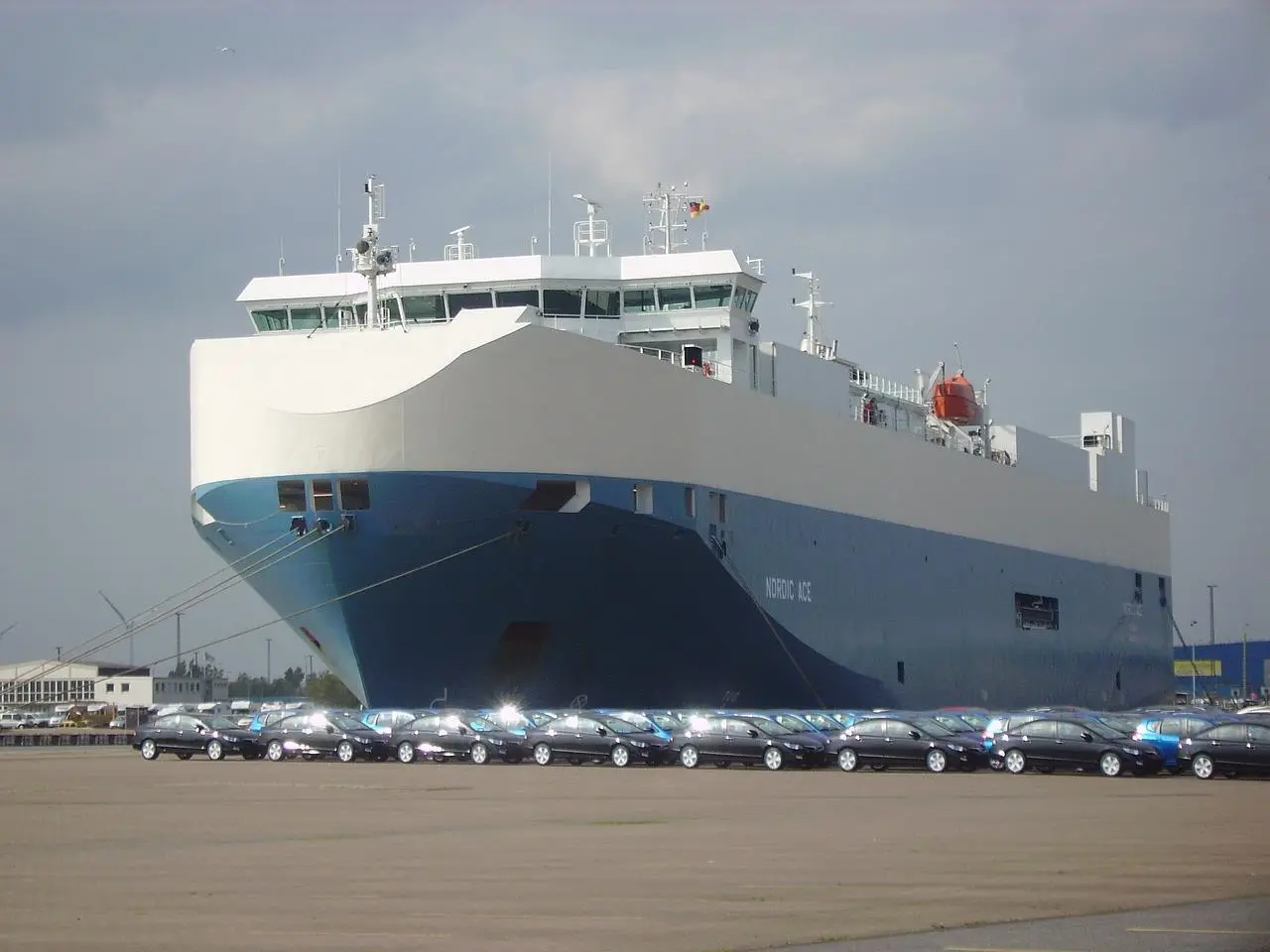
So, how could it work out in practice? The running data from a 13.2MW ocean-going car carrier was used as a study case by KHI to compare the different solutions. Typically high-sided vessels like this can have some issues with wind speeds above 10m/s, and this comparison looked at an ESS that would cover a seven-second, 550kW load fluctuation, that is +/-5% of the total 5.5MW power output and another which covered +/-10% variation. Using JM Energy’s figures, both cases show an LiC is over 60% smaller than an LiB.
There’s another challenge provided by LNG, as more and more cargo vessels are being updated with gas systems “but they’re rather slow reacting to load changes” says Meubrink. “If what’s needed is to increase the power output by around 40% in a few seconds, that’s not something that a low-pressure LNG engine can do, so you need to add an energy source to support it.”
Interestingly, KHI has been looking in a similar direction. One of its studies focused on the most effective way to stop a dual-fuel LNG genset flipping back to diesel mode.
A vital 20 seconds of 600kW support on a 3MW engine could yield gas-only operation with better environmental performance: however, the volume, weight and size of the LiC is around 38% less than an LiB solution. Most importantly, the cost of the LiC is accounted for by the difference in price between gas-only and a dual-fuel installation, underlined Ohno.
However, another KHI study really drives the point home: drillships have a huge heave compensation draw that can rise and fall by a massive +/-6MW across a 10 second period. At present, these drilling rigs utilise several large diesel gensets just to absorb the AHC, predictably pushing up fuel consumption.
The LiC comes out around a third of the scale – and a fifth of the weight – of the LiB for this particular element of the operation, “and so the number of working gensets can be decreased, making a big impact on the operational cost of the drillship for really quite a small investment”, says Ohno.
However, as both Keenan and Ohno note, the differences between the technologies allow them to slot together rather neatly.
For example, the AHC isn’t the only system onboard the drillship that could benefit from electrical support: there’s also the dynamic positioning. Here the longer period necessary to back up one of the gensets can’t be handled by LiC – because when it comes to energy density, LiB has LiC on the ropes with 100Wh to 250Wh per kilo compared to a minuscule 8kWh/kg to 13Wh/kg, “although it’s not really in any way a fair comparison” says Ohno, as they just have different characteristics.
So it seems that a combined solution could do even better in the market than the ESS deployed so far, and a number of players appear interested in taking it further.
While currently under wraps, Skeleton Technologies has “several research and real customer projects” underway, says Meubrink.
For its part, KHI is cooperating with two partners, JM Energy and battery innovator, Corvus, toward the commercialisation of a modular LiC and hybrid LiC/LiB ESS for a range of marine applications. This has recently gained Type Approval by DNV GL; the group expects to launch a containerised solution in 2020.
Finally, as Ohno notes, an installation onboard a longer-run, steady-speed ship makes more financial sense than previous smaller vessel solutions “where it takes far longer to recover the CAPEX”.
Meubrink concludes: “The world is definitely moving.”
Related Articles
 ALTERNATIVE FUELS & LUBRICANTS
 ALTERNATIVE FUELS & LUBRICANTS
 ALTERNATIVE FUELS & LUBRICANTS