



NEW RO-PAX DUO FOR INLAND SEA
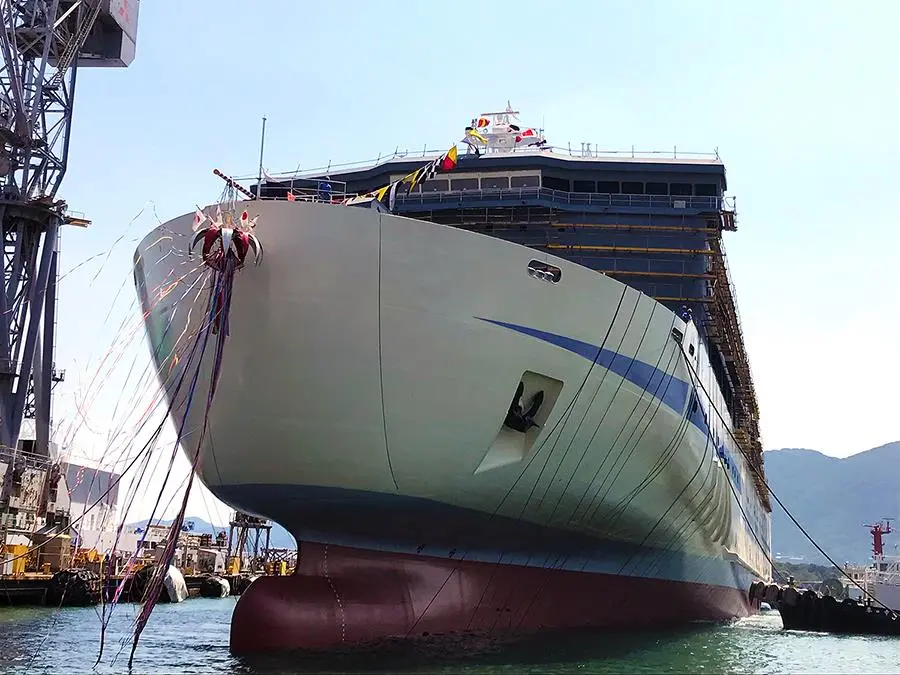
The vessel is the first of two sisters contracted from Mitsubishi Heavy Industries (MHI) by Hankyu Ferry Company to replace 16 year-old tonnage. Construction has been assigned to the Enoura works of MHI subsidiary Mitsubishi Shipbuilding at Shimonoseki, on the Kanmon Strait in western Japan.
Settsu has been arranged for 663 passengers and a ro-ro payload of up to 277 trucks of 8.5m maximum length plus about 188 cars, within main dimensions of 195m x 29.6m x 20,6m. Vehicular access and egress is by way of two side ramps and a stern, axial ramp.
The newbuild pair is to be assigned to the Shinmoji/Kobe route, linking northern Kyushu Island with central Japan, entailing a full traverse of the Seto Inland Sea. Settsu is due to make her operational debut in February 2020, to be followed a few months later by the second-of-class.
The incoming duo will supersede the 2003-built Yamato and Tsukushi, respectively. The former has been sold to Stena RoRo of Sweden, for adaptation to European standards and chartering out, and will transfer from Japanese waters once Settsu takes up duty.
The vessel will usher in an advance in both passenger facilities and environmental rating in relation to the outgoing generation. MHI has indicated that the adoption of a new, optimised hull form has had the most pronounced influence on the approximately 6% improvement in energy efficiency achieved compared to the earlier ferries. The specification also includes an exhaust gas cleaning system, addressing imminent 2020 sulphur regulations.
The Shinmoji/Kobe schedule entails an overnight sailing, with departures from each end of the run during the early evening, for early morning arrival at the destination port. Interior design and layout has been undertaken in such a way as to enable passengers to enjoy panoramic night views of sea and sky.
Kitakyushu-based Hankyu Ferry also maintains a similar schedule with two ro-pax ships deployed between Shinmoji and Izumiotsu, in the Osaka area.
Japan has an extensive network of long-distance coastal ferry services, catering to both travellers and freight, forming a vital part of the country’s transport infrastructure and taking pressure off the congested highway system. Fleet operators provide a virtually captive market for the Japanese shipbuilding industry.
The yard at Shimonoseki has longstanding experience in this field of construction, which remains core to the commercial strategy of Mitsubishi Shipbuilding, along with specialised types of cargo vessel and other bespoke newbuilds.
Besides the Hankyu pair, the orderbook there includes two coastal passenger/cargo ferries ordered by Tokai Kisen and Meimon Taiyo Ferry, respectively.
Related Articles
 PROPULSION
 GENERAL NEWS
 HYDROGEN