



New engine controls face down future challenges
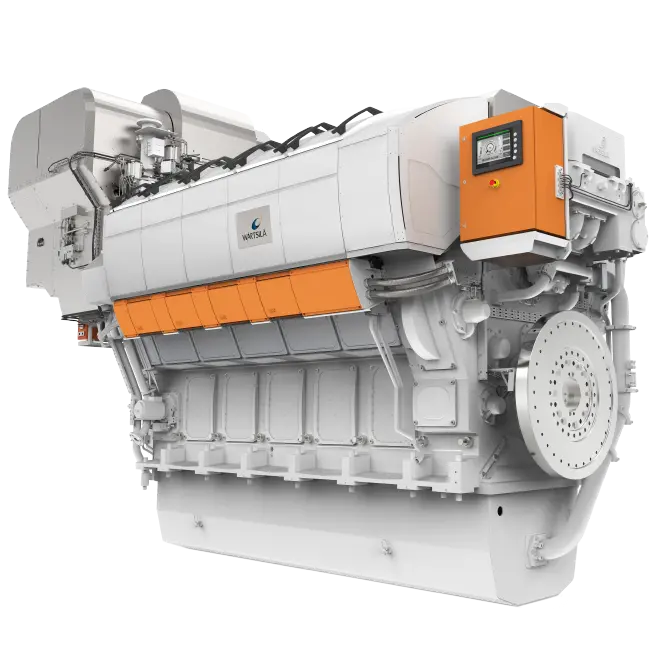
While engine design improvements drag efficiency slowly upwards over the course of years, new control systems and strategies can have a dramatic and instant impact on fuel consumption and emissions. As controls become smarter and more connected, their potential to save ship owners money and ensure environmental compliance will only grow.
Two-stroke engine designer Winterthur Gas & Diesel (WinGD) is acutely aware of the rising demands on engine control systems not just to enhance control aspects but also to deliver ever greater diagnostics and optimisation capabilities. This is the rationale behind the recent development of a new engine control architecture, known as WinGD integrated control electronics (WiCE). The new controls are being tested and will soon replace the 20-year-old UNIC and WECS control systems on WinGD’s new engines.
Electronic control of engines – introduced over the past 30 years and now standard on ship engines – has been a gamechanger, agrees WinGD general manager control and automation Wolfgang Östreicher. “The electronic approach has enabled optimisation towards cleaner engines [and] improvements in efficiency. On large two-stroke engines that mainly drive commercial deep-sea ships, a different approach is inconceivable.”
Digitalisation as driver
Now though, as digital technologies mature, demands are rising and complexity is increasing. The need to continuously cut emissions as well as the commercial pressure to further reduce fuel consumption have been joined by increased expectations on the part of ship owners and operators regarding availability, predictability and serviceability of machinery.
These demands will not slow down soon, says Östreicher. “New concepts, with new business models and scenarios especially based on the use of digital technology, are generating a multitude of interconnections and interactions that must be supported and secured, leading to requests for ever higher performance concerning the computation and communication capabilities of electronic control systems.”
These new interconnections and interactions are of critical interest to Wärtsilä, which despite its increasing focus on digital technologies and services remains one of the leading suppliers of four-stroke engine technology to the marine market. In fact, says Wärtsilä general manager, research and technology programs Jonatan Rösgren, engines and in particular sophisticated engine control play a central role in the company’s vision of a ‘smart marine ecosystem’.
“One of [our] main focus areas is to target sources of inefficiencies and waste,” he explains. “For power sources and engines there are important areas of opportunity related to system efficiency, emission footprints, serviceability and autonomous operation. In all of these areas, engine controls play an integral role.”
Like WinGD’s WiCE, the new architecture for Wärtsilä’s UNIC control system – first deployed on its Wärtsilä 31 engine launched in 2015 – is needed to both drive engine efficiency and to improve the integration of the engine with other systems that can add value for ship owners. In the latter category Rösgren puts software that distributes load optimally across engines (or other power sources including batteries) as well as condition-based maintenance programmes. Other concepts will no doubt emerge as the digitalisation of shipping progresses.
More than combustion control
“A modern medium-speed engine control system must first and foremost deliver safe, reliable,” says Rösgren. “Advances in key technology areas enable a step change in engine controls with a focus on combustion control, which continues to push the efficiency of the engine forward. However, in order for the system to be a part of the smart marine ecosystem in a wider sense, increased attention has to be placed on connectivity, cyber security, and integration with other machineries and systems.”
The exponential increase in the demands being placed on engine controls is challenging not just the systems but the system designers, says Woodward Inc product line manager Sai Venkataramanan. He notes the many “lofty goals” that engine designers must today chase with regards to emissions, efficiency and power density.
“Engine calibrators must optimise engine performance over a large variety of operating conditions and fuels,” says Venkataramanan. “The software development team and the controls engineers quickly get overwhelmed due to new expectations for lifetime reliability, safety, security, communication, data logging, and model-based controls.”
With all these challenges, it is little surprise that designers of engines of all sizes are introducing new control systems. WinGD’s WiCE will feature a dedicated communications module, including a firewall, through which the system can link to diagnostics systems and receive software updates. The bus system, which allows communication between modules, will receive a substantial upgrade compared to existing control systems.
The system is fully modular at both software (system and applications) and hardware levels. It will be prepared for future upgrades, with each component being verified and validated separately. This will mean that when adding new modules, only that module and the performance of the system will need to be validated, rather than re-validating all other modules.
Crew operating the engine onboard should not notice a difference between the new WiCE interface and earlier WECS or UNIC architecture, except for a more modern design. WinGD expects crew familiar with two-stroke engines to be able to use the controls after one five-day training period.
Modular approaches
Modularity, enhanced connectivity and stronger cyber security are also key to Wärtsilä’s new system. As Rösgren notes: “As soon as the automation system is connected to its surroundings, one key mandatory building block is cyber security. How can we ensure safe and secure operation while enabling value-added functionality and services, such as remote support and tuning?”
The second generation UNIC comprises a cylinder control module, input/output modules and a safety module as well as a system interface consisting of communication modules and local display units. The system can range from simple, single-module speed or load controller applications up to any number of cylinder configurations. Modularity is carried through to the software side of UNIC, through the proprietary Wärtsilä Modular Application Platform, enabling new functions to be added to the control system in a robust and safe manner.
Even a specialist combustion technologist like Woodward is taking note of the opportunity to market a control concept that goes well beyond its previous niche combustion offering. The fuel injection and control specialist is set to introduce a new integrated engine control system, the large engine control module (LECM). The LECM offers engine makers a single, marine certified, engine-mounted module that can be used to control all aspects of the engine’s operation (along with associated monitoring and alarms) as well as on-board data logging and communications.
“The consolidation of engine control functions and various application needs into one hardware architecture enables OEMs to use a single hardware platform with a single service tool, thereby saving a significant development, training, service and support cost,” says Venkataramanan. “Woodward maintains both the LECM hardware and the software coding packages, freeing the OEM to use their engineering budgets for new engine technologies.”
The LECM platform is not only suited for engine builders looking for turnkey solutions. OEMs wishing to implement proprietary control schemes can also use the module. The software allows control system designers to insert their own control algorithms, thereby retaining their intellectual property.
Efficiency improvements
While engine control architectures like WiCE, UNIC and LECM are built in anticipation of future connectivity, they also offer the opportunity to improve fuel efficiency and environmental performance through increasingly sophisticated control strategies. MAN Energy Solutions head of programme and pre-development Mathias Moser draws a parallel with the control architectures that have been designed over recent years to accommodate technological advances including common-rail injection, dual-fuel engines, exhaust gas recirculation and exhaust after-treatment systems.
“After establishing these technologies successfully on vessels, further improvements can be achieved by enhancing control strategies,” says Moser.
As an example, Moser cites the control strategy recently tested on MAN’s medium-speed dual-fuel engines to improve fuel efficiency at low engine loads by deactivating cylinders. Cylinder cut-out is used to prevent the fuel-air mix from becoming too lean at low loads, when the air intake into cylinders is too high for the fuel gas being injected. Deactivating cylinders leads to an increased proportion of fuel being burned in the remaining cylinders and also shifts turbocharger operation to a higher efficiency.
The effect of cylinder cut-out can be significant. MAN’s tests showed engine efficiency improving by nearly 80% at idle and more than 30% at 10% load. Unburned hydrocarbon emissions were reduced by at least 60% at all load points and by 95% at idle and 10% load. Similarly, CO2 emissions were reduced by more than 95% at idle and 10% load. All without any changes to the engine itself.
In another example, MAN has developed gas-start capability for its four-stroke dual-fuel engines, enabling them to cut emissions by burning gas rather than liquid fuel even in the lowest load range. Previously these engines needed to be started on liquid fuel, meaning that the ports from which vessels departed did not benefit from the full environmental advantages of the gas-burning engines.
Those benefits represent quick wins focused only on the engine itself. As control systems increasingly link engines to other ship- and land-based systems, further gains in efficiency are inevitable. The developments in engine control architecture being laid down today will pave the way for those future advances.
Related Articles
 ENERGY SAVING DEVICES
 LNG
LNG
 ALTERNATIVE FUELS & LUBRICANTS