



GERMAN YARDS INVEST FOR HIGH-END MARKETS
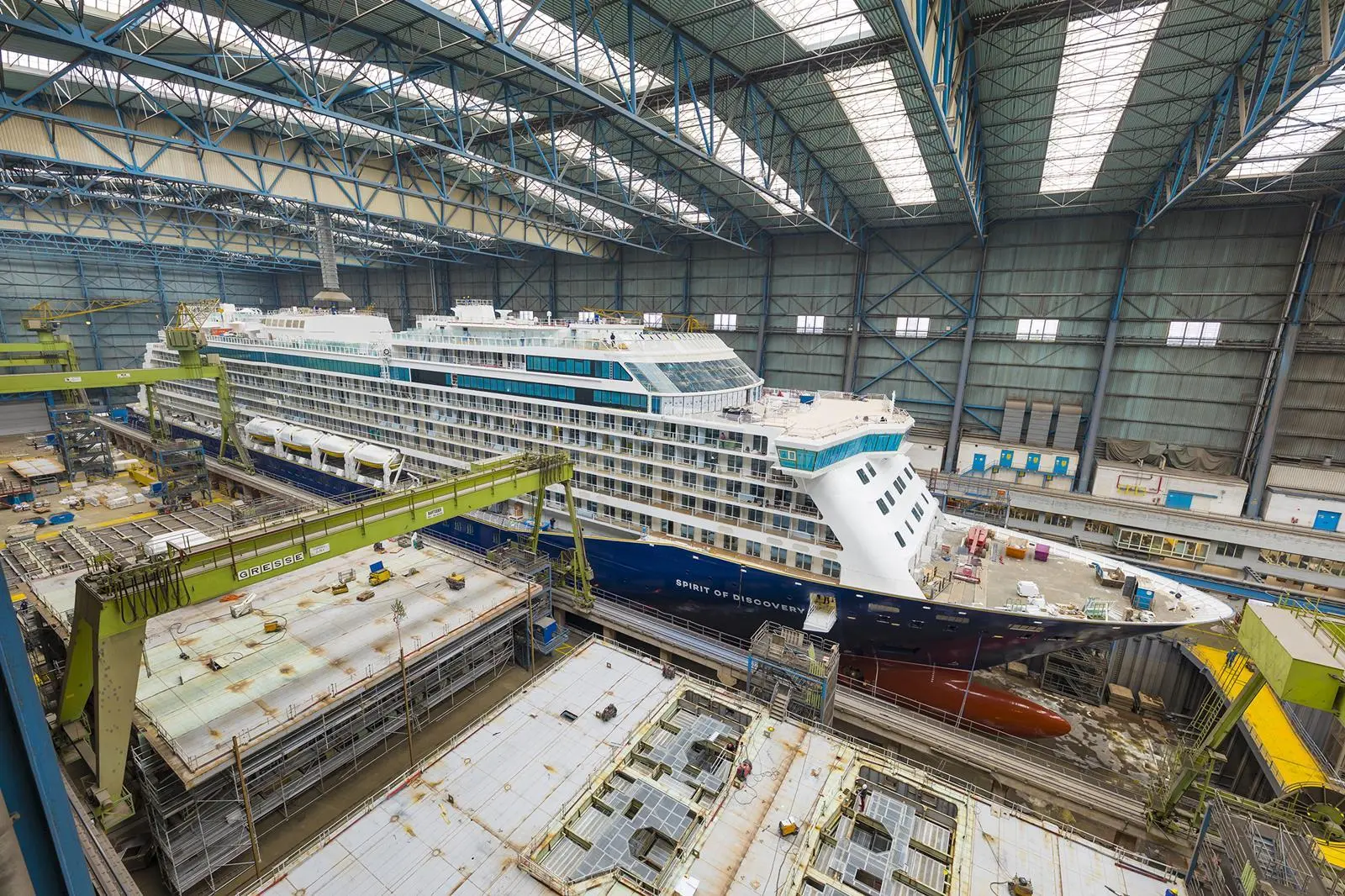
A jewel in the crown of German and European shipbuilding, Meyer Werft is in the vanguard of the industry’s drive for new technological solutions to raise the cruiseship sector’s environmental performance. One element of this strategy is increasing provision for cleaner-burning LNG fuel in large, luxury vessel power and propulsion systems.
The practical result of the shipbuilder’s R&D endeavours is that three-quarters of the orderbook at the headquarters Papenburg yard, and over 90% of that contracted at its Finnish subsidiary Meyer Turku, is composed of tonnage specified with LNG-capable machinery.
Furthermore, the group’s Neptun Werft division in Mecklenburg-Vorpommern has gained considerable know-how in the fabrication of LNG fuel tanks and in its innovative production of floating engine room units (FERUs), for supply to the shipyards at Papenburg and Turku. The latest FERU machine room modules measure 140m in length by 42m width, and have attained a new level of pre-outfitted complexity with the move to LNG powering.
Ranking as the world’s first cruise ship equipped with LNG dual-fuel power plant, based on four German-made MaK engine-driven gensets, the December 2018 service debut of the 184,000gt AIDAnova marked the opening of a new chapter in the sector’s evolution. The deeply-held German political belief in both industry and environmentally-considerate technology is implicit in the backing for the project. Two-thirds of the funding for the innovation costs incurred by Meyer Werft for the development of the LNG propulsion system for the AIDAnova came from the federal government, and the remaining third was provided under the ‘Innovative Shipbuilding to safeguard competitive jobs programme’ of the state of Niedersachsen (Lower Saxony).
Although it is acknowledged in Germany that the ultimate goal must be zero-emission vessels, LNG is regarded as a pragmatic and effective option on the energy transition path. Unlike marine oil fuels, LNG does not create sulphur emissions, while cutting NOx by up to 80%, particulate emissions by approximately 98%, and CO2 by 20-25%.
Meyer Werft’s R&D programme is extensive and its commitments have been longstanding as regards both ship- and production-related topics, thereby intertwining the quality, operating efficacy and environmental standard of the product with the efficiency and productivity of the means of manufacture and construction. Advances in laser technology have been widely embraced by German industry as a whole, and Meyer Werft affords a prime example of its application in shipbuilding. The company operates one of the largest laser centres in Europe, whereby the Papenburg site houses six 12kW systems with CO2 lasers to fabricate modules for cruise liners.
Meyer is party to a German federal government-funded research project, DIOMAR, aimed at developing high-power diode lasers for welding shipbuilding steel plates of up to 30mm thickness. The objective is to reduce costs and raise quality in processing thick plates, and obviate the need for labour-intensive edge preparation and reworking as can be entailed with conventional, submerged arc welding. The shipbuilder is joined in DIOMAR by Laser Zentrum Hannover (LZH), Held Systems Deutschland, and Laserline. The latter is focusing on development of diode laser beam sources with a maximum output power of 60kW in continuous-wave mode.
Lasers introduce heat to metal inert gas (MIG) welding processes, so that the metal melts and completely fills the seam. As well as rendering fast weld times and imposing less thermal stress on components, the keyhole welding method facilitates one-sided welding, so that large elements do not have to be turned and welded a second time.
To meet the group’s rising production of cruiseship tonnage, while better ensuring a competitive cost basis to meet an intensified challenge from China and elsewhere in the future, Meyer has this year formed a joint venture in Lithuania to supply pipe isometrics to all three group yards in Germany and Finland. The Vilnius-based company formed with metal fabricator Stengel is known as Meyer Stengel Tubes.
By 2022, the group’s demand for pipe isometrics is expected to grow by about 60%. Meyer Werft is also investing in new pipe-bending machines at the Papenburg yard, which already possesses one of the most advanced pipe production facilities in Europe.
As a key contributor to German shipbuilding success on export markets, having attained a leading global position in ro-ro and ro-pax technology and construction, Flensburger Schiffbau-Gesellschaft (FSG) is entering a new stage in its long history, having just passed into the 100% control of investment company Tennor Holding.
Contractual performance along with design added-value has long been a strong card of FSG, but problems and delays in building Irish Continental Group’s ro-pax W.B.Yeats have damaged that reputation, and culminated in the shipyard reaching a serious financial situation by the start of 2019. This had had a knock-on effect on subsequent production, most evidently expressed in the delayed completion of the LNG-fuelled ro-pax newbuild Honfleur, which has missed the entire 2019 summer season with Brittany Ferries.
In February 2019, the shipbuilder’s then Norwegian parent, the SIEM Group, sold 76% of the shares in FSG to global investment firm Sapinda Holding, under an agreement whereby the latter would inject EUR33 million (US$36.5m) of new equity into the yard. In September, SIEM’s remaining 24% stake was acquired by Tennor Holding, formerly Sapinda, founded and headed by German financier Lars Windhorst. Tennor operates out of offices in London, Amsterdam and Berlin.
SIEM had been involved in FSG since 2014, having taken over the shipyard when it was experiencing liquidity problems. The move ensured the completion of two well intervention vessels which had been contracted by SIEM Offshore against long-term charters. SIEM subsequently booked a series of ro-ro vessels to its own account at Flensburg, the latest delivery having been the 4,076 lane metre-capacity freight carrier Leevsten, handed over at the end of August this year. One further trailership to the same design is on the books for SIEM, and is expected in early 2020.
Leevsten is based on a highly successful class developed by the yard and built in multiple numbers for deployment by Mediterranean and North European operators. The latest ship will be chartered out but husbanded within the parent group, being the first ro-ro placed with Gdynia-based SIEM Ship Management, which provides technical management and manning for dedicated reefership and pure car/truck carrier (PCTC) tonnage.
Besides Brittany Ferries’ Honfleur, now at an advanced stage of outfitting, plus the sister to Leevsten, the backlog at the Flensburg yard comprises another newbuild for Irish Continental Group, destined to be the world’s largest ro-pax as regards lane-metre capacity (5,615 lane-m), plus two ro-pax ferries specified with dual-fuel electric propulsion for Bass Strait operator TT Line Tasmania.
SIEM Industries’ Annual Report for 2018, published in June 2019, showed that FSG incurred a net loss of EUR111 million (US$122.8m) last year. The Norwegian group, with interests in oil and gas, renewable energy, ocean transportation of vehicles and refrigerated cargoes, and potash mining, stated that “The non-core shipbuilding activities of FSG was affected by management issues, lack of performance by subcontractors to the shipyard, and absence of building financing available to the German shipyard.”
Meanwhile, a star is rising in the east. In Mecklenburg-Vorpommern, MV Werften has been able to consolidate its development plans as a result of an international consortium led by KfW IPEX-Bank having put together a financing package amounting to EUR2.6 billion (US$2.86m) for two exceptionally large cruise ships. The transaction relates to two Global-class newbuilds contracted by Genting Hong Kong, and followed confirmation of export credit and shipbuilding guarantees by the federal government and the state.
MV Werften was formed in 2016 by the Genting Group of Malaysia as the entity for the acquired shipyards in Rostock-Warnemuende, Wismar and Stralsund. Genting’s total expenditure to date, including the costs of purchasing the yards, start-up losses and the subsequent heavy investment in the refurbishment and modernisation of the facilities, is understood to have reached EUR840 million (US$925m). “Due to the lack of cruiseship construction sites, we deliberately chose to invest in MV Werften to get ships in time for our three cruise lines,” said Tan Sri Lim, chairman and chief executive officer of Genting Hong Kong. Proven product quality on the part of the yards involved, resident craft skills, and the extensive network of experienced suppliers and subcontractors, strongly influenced the decision to set up in Germany.
The German affiliate is accordingly tasked with supplying tonnage for the Genting brands Star Cruises, Dream Cruises, and Crystal Cruises, against the backcloth of the expansion of the Asian cruise market. The initial output is to encompass three Endeavor-class expedition-type cruise ships of 200-passenger capacity plus two Global-class vessels, each offering a lower-berth capacity for 5,000 passengers. Subsequent production is to include an 800-passenger series, designated the Diamond type.
Almost exactly 12 months on from the keel laying of the first of the Global duo, the Rostock-Warnemuende yard cut steel for the sister vessel on September 10 this year, with a view to keel laying in December. Deliveries into the Dream Cruises’ operation are anticipated in early 2021 and 2022, respectively.
Keyed to Asian demands and preferences, the accommodation arrangements incorporate the individual cabin size and flexibility to provide for up to 9,500 passengers. In conjunction with a crew complement of 2,200, the potential number of people onboard will exceed that of any passenger vessel to date, while the 208,000gt measurement also sets a new record, denoting the largest-ever passengerships to be constructed in Germany. The level and extent of digital technology incorporated, such as face and speech recognition, and climate control and mood lighting via app, reflects the predilection of the targeted Asian customer base.
Genting Hong Kong recently announced the sale of 35% of its Dream Cruises business to TPG Darting. The rationale for the disposal is to strengthen the group’s balance sheet and ability to continue to expand its cruise fleet.
The Global-class programme optimises across-the-board capabilities of MV Werften. In the case of the second vessel of the 342m x 46m design, up to 30 large sections will be fabricated at the Stralsund yard, for transfer to the main production at Warnemuende, with final newbuild completion at Wismar.
A new construction hall has been established at the Rostock-Warnemunde yard, housing state-of-the-art, automated laser-hybrid, thin steel welding line for block production, plus an outfitting line. Genting has also opened a factory in Wismar dedicated to the production of cabin modules. A 125m-high crane, purchased specifically for the Global newbuilds, is being installed at the Wismar outfitting quay.
The Warnemuende site provides another showcase for advanced shipbuilding technology, whereby automated, laser-hybrid welding stations produce large steel panels of up to 400m2 (25m x 16m). A one-sided butt welding station with a laser-hybrid welding head is supplemented by two-sided fillet welding of profiles and automated profile assembly. The new arrangements at Rostock ally with the strategy to establish Industry 4.0 processes in shipbuilding.
MV Werften is ploughing more than EUR100 million (US$110m) into the new shipbuilding hall complex at Warnemuende, encompassing panel production, section fabrication and pre-outfitting, and profile manufacturing. Mecklenburg-Vorpommern state and the federal government have together granted EUR 6 million (US$6.6m) in support funding for the advanced facilities.
The pronounced increase in orders for the pearls of the commercial shipbuilding business, luxury passenger vessels, has sustained the industry in Germany at a time of collapsing production of containerships and most other types of mercantile trader. The work of German affiliates of Dutch shipbuilders is notable in maintaining a presence and competitiveness in dry cargo vessel construction, as currently expressed in a series of 16,800dwt bulkers for Arklow Shipping of Ireland from Ferus Smit’s Leer yard. The wider industry’s orientation to higher added-value production streams is encapsulated by the wealth of smaller yards engaged in bespoke projects for civilian and agency customers, and by the various specialists in surface warships and submarines.
Naval shipbuilder thyssenkrupp Marine Systems has added a new string to its bow by obtaining manufacturer approval from DNV GL for the production of 3D printed parts for maritime applications. The certification covers austenitic stainless steel parts. The company also recently unveiled its fourth-generation fuel cell system for submarines, building on experience gained from 38 FC systems contracted to date with seven customer navies.
German shipbuilding continues to re-establish itself through innovative technologies and processes in high-end markets, and in the face of what it sees as a global market distorted by unfair state intervention. While overall employment has increased significantly over the past year, the various challenges it faces includes attracting professionals and talented young people in an increasingly competitive job market.
Related Articles
 PROPULSION
 GENERAL NEWS
 HYDROGEN