



Major LNG carrier order for Zvezda Shipyard
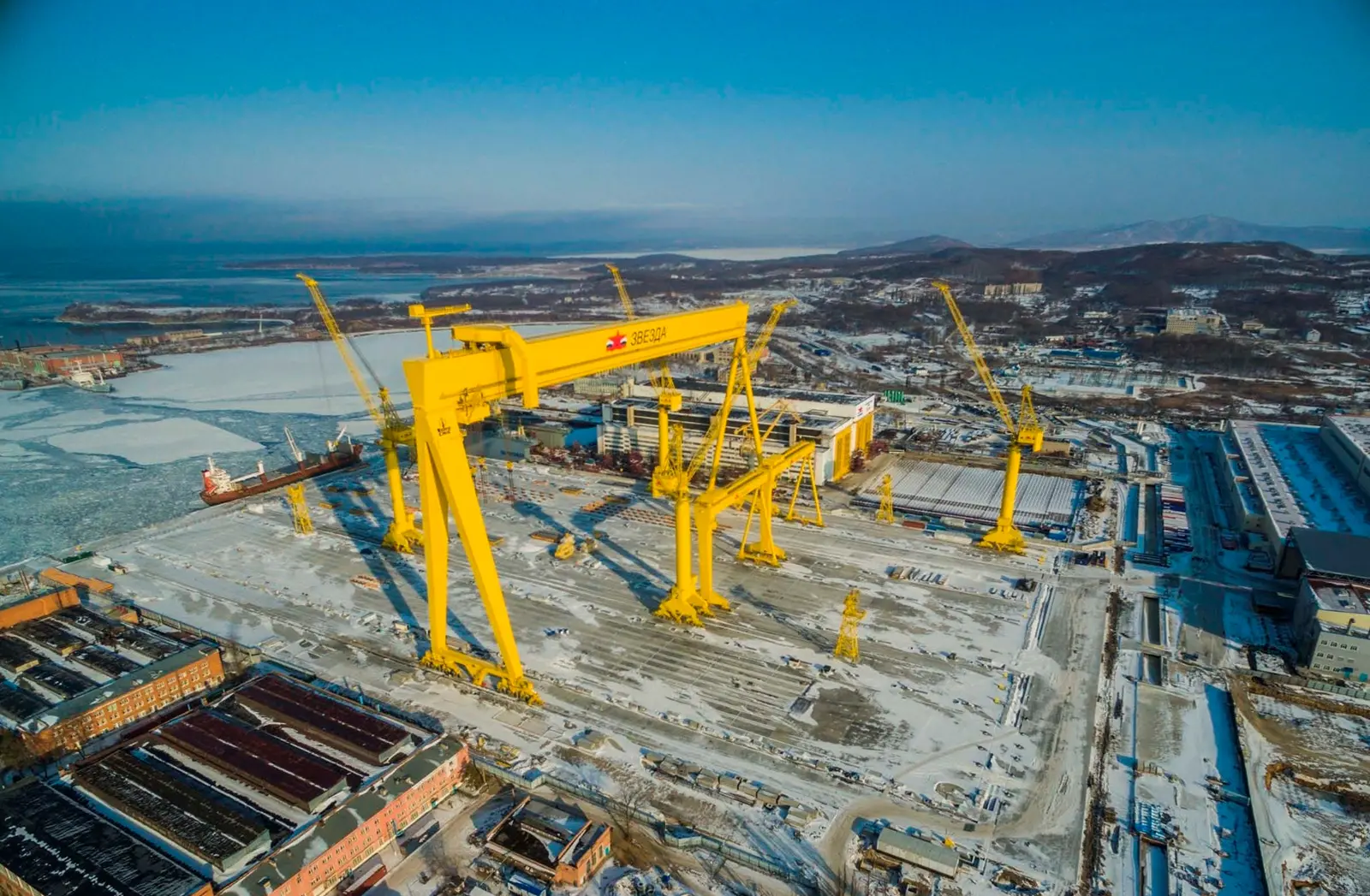
The independent gas producer Novatek announced plans to form a joint venture with Sovcomflot to manage the construction and operation of Arctic ice-class LNG carriers on 5 September 2019.
As part of the announcement, up to 17 next generation dual-fuel Arc7 LNG carriers are to constructed at the Zvezda shipyard in the Russian Far East. The new LNG carriers are expected to operate along the Northern Sea Route (NSR) throughout the year.
Zvezda Shipyard announced that it was selecting Samsung Heavy Industries (SHI) as its partner for the construction of ice class LNG carriers thanks to SHI’s experience of constructing LNG carriers, and its technological expertise.
Updated LNGC design
SHI will cooperate with Zvezda in the design of the updated Arc7 ice-class LNG carriers. Part of the focus will be on optimising the vessel’s hull design in order to improve performance in winter ice along the Northern Sea Route.
The previous generation of LNG carriers featured a moderate ice bow and a heavily reinforced structure and icebreaking profile aft. The design is expected to retain the podded electric propulsion system comprising three, 360-degree steerable Azipod units delivering a combined, maximum 45MW power used in the previous design.
The previous generation of dual-fuel LNG carriers used Wartsila’s dual-fuel 50DF engines. The plant has to cope with the dramatic variations in engine load entailed in ice-forcing and manoeuvring in high-Arctic conditions.
The new design is expected to be able to crush ice up to 2.1m thick, improving its icebreaking capabilities compared with the previous generation of ice class carriers.
The first ship is scheduled for delivery by the end of 2022, while its sea testing should be completed no later than April 2023.
Meanwhile, SHI also announced plans to cooperate with Zvezda in the construction of shuttle tankers. The Korean company has won over 40% of global orders for shuttle tankers, and has expressed its willingness to enter the Russian market.
Northern Sea Route
The NSR is a 2,150 nautical mile shipping corridor along Russia’s northern coastline, through the waters of the Arctic Ocean, comprising the Barents, Kara, Laptev, East Siberian, Chukotsk and Bering Seas. It is the shortest maritime route between the ports of Europe and the Far East, and links the mouths of Siberian rivers into a single transport system.
The vessels are expected to make shipments to Asia by voyaging eastbound from the Gulf of Ob along the NSR and out into the Pacific via the Bering Sea, resulting in substantially reduced delivery times, as well as savings in fuel consumption and lower emissions per cargo tonne.
Sub-contracting
The Russian government has previously emphasised a determination to localise the production of LNG carriers, but domestic shipyards currently lack experience of building of such vessels.
The agreement to collaborate with SHI means that Zvezda is likely to be focused on the construction of hulls, steering columns as well as other less technically challenging equipment and machinery during the first of years of the project.
Nuno Kim, Chief Engineer of South Korea’s DSME, noted that the localisation of the first LNG carriers assembled in Zvezda was almost 10%, while this had risen to 30% with the second vessel.
The slow pace of localisation has been criticised by Russian analysts, who are sceptical about the degree to which localisation at Zvezda will benefit the shipyard and the entire wider Russian shipbuilding industry.
Subsidies
The opportunity to mitigate the risk of spiralling construction costs and project overruns at Zvezda is one of the advantages of developing closer cooperation with some leading South Korean shipyards.
Some analysts of the Russian Ministry of Industry and Trade believe building such ships “from scratch” at Zvezda will be significantly more costly than their building in South Korean and other Asian shipyards at least during the next 2-3 years.
According to Russian Ministry of Industry and Trade assessments, the cost of building an LNG carrier at Zvezda is estimated at the average of about USD390 million per ship. This compares with the cost of construction of the same ships at South Korean shipyards, which is estimated at about US$324-330 million.
The Russian government regards this project as strategically important for Russia’s civil shipbuilding industry and has committed itself to subsidising the cost of building LNG carriers at Zvezda. Igor Sechin, head of Rosneft, recently said that an estimated RUB 200 billion (US$3 billion) had been invested in the building of Zvezda shipyard.
Zvezda is hoping to receive RUB 53.5 billion (US$900 million) of subsidies from the Russian state during the period of 2020–2023.
The allocated state subsidies are expected to cover about 30% of the cost of the newbuilding, which will reduce their final cost to close to the level of LNG carriers built at South Korean shipyards.
Opportunities
In addition to LNG carriers for Novatek, Zvezda has already collected a portfolio of 37 orders, including 26 ships, ordered by Rosneft itself.
Zvezda already received a contract from Sovcomflot to construct three MR-class 51,000 dwt product carriers in January, while Novatek expects to order at least three product carrier vessels at a cost of about US$325 million each.
The product carriers are expected to handle the condensate export traffic from the Arctic LNG 2 project. Condensate is a mixture of light hydrocarbon oils present in the raw natural gas field and is separated off before the gas liquefaction process. It is used to produce fuels and as a feedstock in the petrochemical industry.
Previous ice class product carriers for Russian LNG projects have been constructed in foreign shipyards. Russian analysts conclude that Sovcomflot and Russian natural gas producer Gazprom are both likely to be interested in building LNG carriers at Russian shipyards if LNG tankers can be successfully delivered from Zvezda.
Related Articles
 PROPULSION
 GENERAL NEWS
 HYDROGEN