



DELAYED GREENING OF THE COSTA FLEET
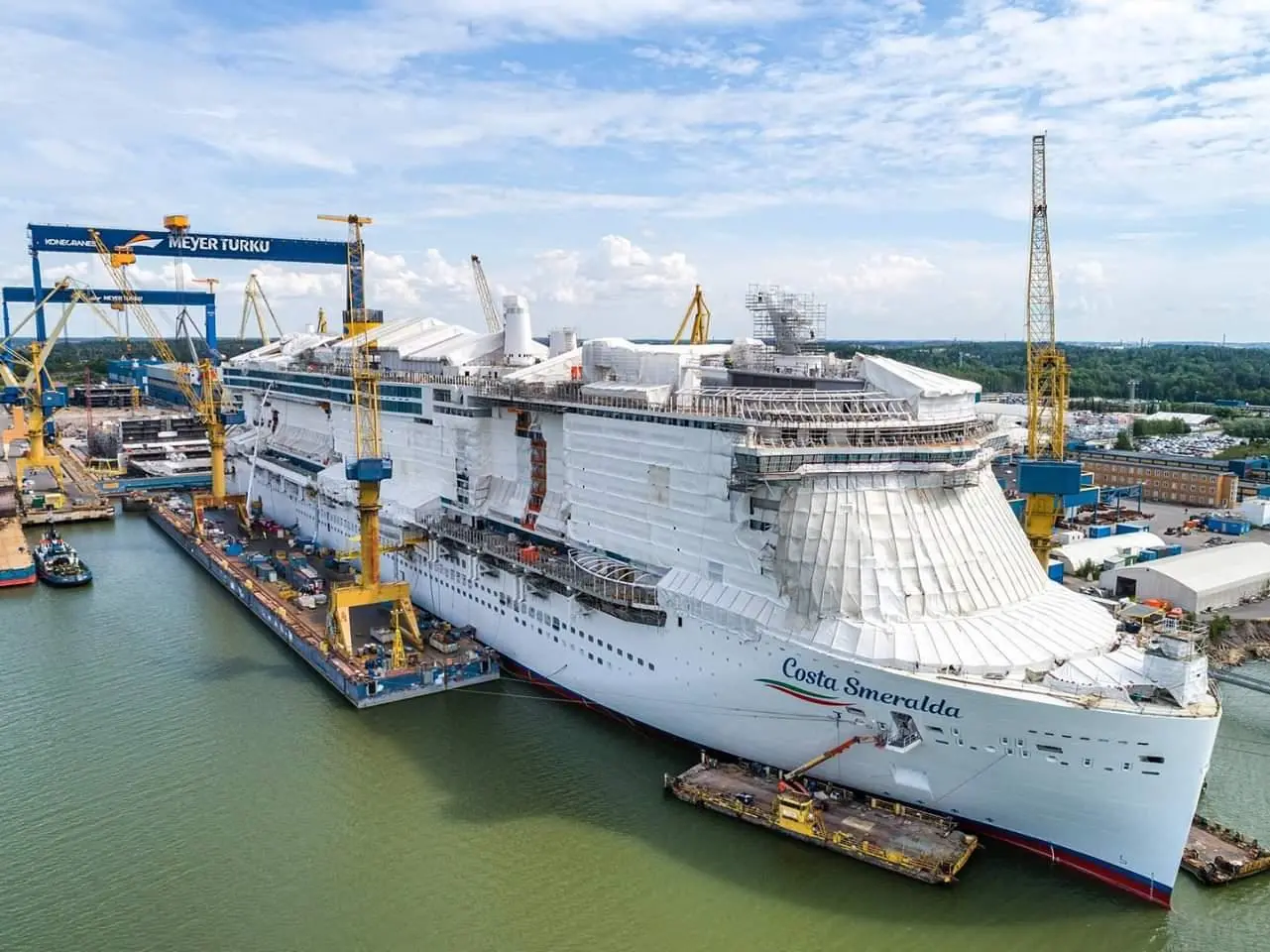
Set to become the first LNG dual-fuel powered unit deployed under Carnival Corporation’s Italian Costa Cruises’ brand, Costa Smeralda had originally been due this October, but completion was put back to mid-November. Now the plan is to have her ready to begin regular weekly sailings from the northwest Italian port of Savona on 21 December.
The newbuild is the first in a series of four booked with Meyer Turku by the Carnival group. Costa Smeralda is to be followed next year by the Mardi Gras, to be deployed in US waters under the Carnival Cruise Line (CCL) brand, with the third and four ships scheduled to enter Costa and CCL operations, respectively, in 2021 and 2022. Each pair of vessels will differ internally as regards styling and passenger facilities in accordance with the separate requirements of their target European and North American markets.
The ship design and technical template for Costa Smeralda and ensuing vessels has been provided by the AIDAnova, delivered from Germany by Meyer Werft towards the end of 2018, and originally dubbed the Helios class. The concept has provided a platform that can be tailored to serve disparate brands and markets encompassed by a major cruise group, affording cost benefits across the fleet.
AIDAnova opened a new chapter in cruiseship propulsion as the sector’s first vessel fitted with all main engines capable of operating on LNG. The outfit is comprised of four 16-cylinder models of the MaK M46DF type, as have also been adopted in the Costa Smeralda, and as specified for the subsequent three newbuilds at Turku.
Through research conducted at its Rostock factory in Germany, MaK brand owner Caterpillar was proactive in demonstrating that its M46DF dual-fuel engine could run efficiently on LNG at less than 20% load, and avoid the risk of visible smoke and soot at start-up and during manoeuvring. As the 460mm-bore medium-speed design is rated for a maximum output in excess of 960kW per cylinder, giving each vee-type 15,440kW, the installation in the Costa Smeralda has a maximum, nominal power concentration of 61,760kW.
Costa Smeralda was constructed at Turku with recourse to a major subcontracted section supplied from across the Baltic by Meyer’s Neptun Werft in Rostock, Germany. Fabricated and delivered as a floating engine room unit (FERU), this incorporates the ship’s main and auxiliary machinery and related systems.
Measuring 140m in length, 42m in width and 15m in height, with a total weight of 11,250t, the unit is the largest FERU produced to date by Neptun, and was towed direct to Turku. The supply of FERUs to both Meyer’s German headquarters yard at Papenburg and to its Finnish affiliate, is an element of group strategy that uses synergies between the three shipyards.
Meyer Turku is one of the leading lights in LNG-fuelled passengership construction, with a track record made up of two Baltic ro-pax ferries, the Viking Grace of 2014 and Megastar of 2017. High capacity, luxury cruise vessels equipped with LNG dual-fuel electrical power and propulsion systems predominate in the orderbook, including Icon-class newbuilds of 200,000gt besides the various Carnival Group commitments.
PRINCIPAL PARTICULARS – Costa Smeralda
|
Length overall |
c.337.0m |
|
Breadth, moulded |
42.0m |
|
Draught, maximum |
c.8.8m |
|
Gross tonnage |
182,700t |
|
Main engines |
4 x MaK 16M46DF |
|
Nominal output |
4 x 15,440kW |
|
Speed, transit |
21.5kts |
|
Speed, economic |
17kts |
|
No. of decks |
20 |
|
Passenger cabins |
2,612 |
|
Balcony cabin ratio |
63.7% |
|
Passenger capacity, lower berths |
5,224 |
|
Passenger capacity, maximum |
6,522 |
|
Crew |
1,678 |
|
Class |
RINA |
|
Flag |
Italy |
Related Articles
 PROPULSION
 GENERAL NEWS
 HYDROGEN