



VERSATILITY THE WATCHWORD FOR NEW RO-RO SERIES
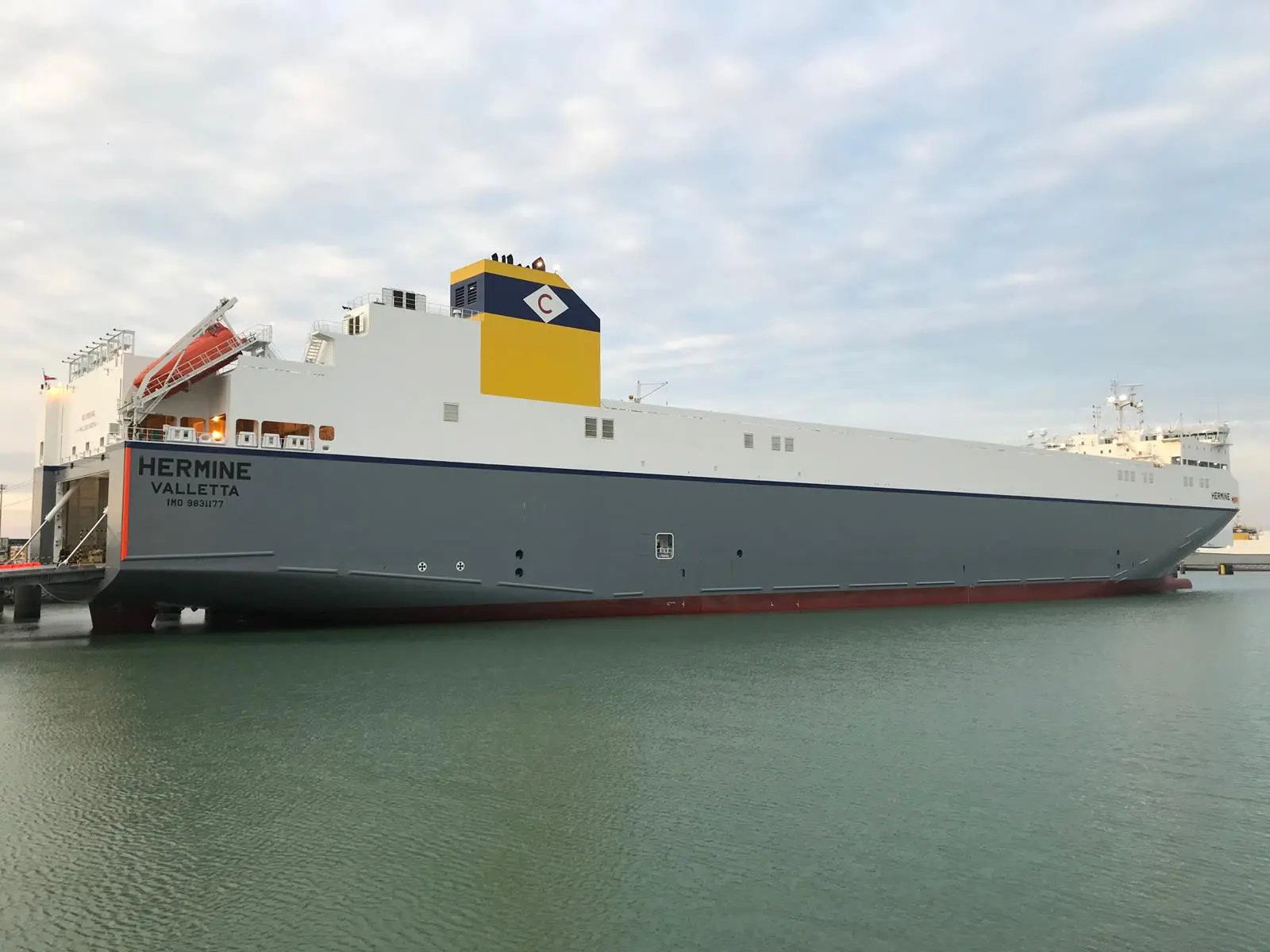
Expansion-minded, Luxembourg-based shortsea operator CLdN is introducing a highly versatile class of ro-ro freight ship to its northwest European network. The fourth and latest newbuild in the Laureline series, the 50,443gt Hermine, has been phased into service after delivery from South Korea.
The ship’s multi-deck layout affords a minimum capacity of 5,051 lane-metres and the capability to accommodate a broad payload mix, including unaccompanied trailers, rolltrailer-borne freight, double-stacked containers on cassettes, factory-new cars, vans and other vehicles and equipment, as typifies manifests on the through-transport carrier’s various routes. With dedicated laneage for automotive clients and use of internal ramps as standing area for cargo, maximum ro-ro capacity is approximately 5,400 lane-metres.
The new generation made its debut in January this year through the commissioning of the Laureline, followed by the Ysaline and Sixtine in April and July, respectively. Fourth-of-class Hermine arrived in Zeebrugge during early October, for initial assignment to the route connecting the Belgian port with the Irish Republic via Dublin.
Shipbuilding contractor Hyundai Mipo Dockyard (HMD) was entrusted with fifth and sixth newbuilds in July, and options were taken out on seventh and eighth vessels. The newly-ordered tonnage has been specified with LNG dual-fuel main machinery, whereas each of the four diesel-engined ships delivered so far has been conceived and certificated to facilitate future conversion to dual-fuel power.
HMD’s business links with the shipping company have embraced two ro-ros of record-breaking capacity in the shortsea domain, the 7,970 lane-metre Celine and Delphine, handed over in 2017 and 2018.
Viewed as game-changers in the intra-European shortsea business, the 74,000gt, 235-metre Celine and Delphine offer unsurpassed scope in cargo range on CLdN’s longer routes. Configuration and capacity confers the ability to switch from a 100% dedicated cargo type to any degree of mix, from new cars to double-stacked boxes or project consignments. The Laureline class affords a similar degree of flexibility at a smaller size, dimensioned for shorter-haul trade throughout the network, but with the same technology and design advances.
The new ships thereby follow CLdN’s proven methodology of combining high-headroom trailer and container decks with special provision for automotive industry clients, and are expected to become the ‘workhorses’ of the growing fleet, responding both to the demands of the differing trades and enabling effective response to changes in client needs and market conditions.
The Laureline-class vessels are designed for all cargo handling to be effected by way of a 20m-wide, 18m-long stern ramp, strengthened to take a maximum load of 180t. Each ship has seven cargo deck levels, of which five are fixed and two are hoistable decks. Four of the five fixed decks afford the headroom and wherewithal for trailers and containers, and one is specifically for cars. The inter-deck ramp system reflects the design’s guiding principles of flexibility for rolling cargo and point of stow in conjunction with expeditious and safe ship turnarounds.
Hermine is powered by a seven-cylinder model of the MAN S50ME-C engine, an electronically-controlled, 500mm-bore two-stroke diesel, producing 12,460kW at the nominal maximum continuous rating (MCR) in its C9 version. Drive is direct to a 6m-diameter, Kongsberg controllable pitch propeller.
An in-line shaft generator of 2,200kW provides at-sea electrical energy, supplying and augmenting the auxiliary outfit comprised of aggregates manufactured by Hyundai Heavy Industries and sold under its HiMSEN brand. The onboard electrical demand is substantial, arising from the reefer container/trailer cargo as well as the hotel load, plus manoeuvring power for the array of thrusters. The three main diesel gensets are driven by HiMSEN 8H25/33 engines, each of approximately 2,300kW output. The harbour set is from the same source, being based a 5H21/32 unit of 900kW. The Nishishiba shaft generator incorporates a power take-in (PTI) function, acting as an electrical motor energised by the gensets to render an auxiliary propulsion capability.
The vessel is necessarily highly manoeuvrable, to ensure efficient working to tidal and wind-prone berths without having to call on tug assistance in all but the most adverse conditions. To achieve the requisite self-sufficiency, she is fitted with two 2,000kW tunnel thrusters at the bow and two 1,500kW stern thrusters, flap rudder and Promas rudder bulb and hub cap.
As with the preceding ships in the series, Hermine is not equipped with an exhaust gas treatment system, CLdN having otherwise addressed emission directives by nominating ultra-low sulphur bunkers. However, the vessel has been laid out to facilitate future conversion to LNG-fuelled propulsion, and in accordance with criteria stipulated for DNV GL’s gas-ready notation.
Although CLdN is by no means alone in adopting single-screw, two-stroke propulsion for ro-ro tonnage, the solution chosen for Hermine and her consorts is still significant in a field where twin or multi engine, geared medium-speed plant typically applies. The company has built experience with low-speed, single-propeller arrangements, and took the mode to a new level with the 9L60ME-C installation in the flagships Celine and Delphine.
In the next phase of the fleet development strategy, the fifth and sixth vessels of the Laureline series will be powered by MAN dual-fuel propulsion machinery of the 500mm-bore ME-C-GI gas-injected type. The lane-metre intake may differ somewhat from the four ships completed to date, in accordance with the siting and capacity of the LNG fuel tank.
Each of the forthcoming newbuilds will have 320m3 of LNG fuel storage. The supply infrastructure in northwest Europe has been substantially improved and extended over recent years, and bunkering of future LNG-capable CLdN ships is likely to be focused on Zeebrugge and Rotterdam, the company’s two continental hub ports serving its routes to Britain, Ireland, Scandinavia and the Iberian peninsula. The terminals at Zeebrugge are adjacent to the Fluxys LNG complex in the outer harbour.
Technical husbandry for the Hermine has been placed with AW Ship Management of London. The latter’s activities include technical and crewing management for the four ro-ro cargo vessels operated by Foreland Shipping, a 100% subsidiary of the Hadley Shipping Group. The latter is one of the few remaining, family-controlled British shipping firms. Five years ago, Hadley entered into a joint venture pact with former management of Andrew Weir Shipping to provide third party services under the guise of AW Ship Management.
CLdN’s newbuild programme target is 12 vessels. With the six ships handed over to date (Celine, Delphine, Laureline, Ysaline, Sixtine and Hermine), plus the two newly-ordered dual-fuel versions, the tally currently stands at eight, and would be brought to 10 on declaration of the options. Terms relating to the seventh and eighth ships call for deliveries in 2022. The group’s ports division has committed around EUR200 million(US$222m) on terminal extensions and adaptations to the new-generation vessels and emerging trade needs. Part of the outlay includes value-added services tailored specifically to the automotive industry, whose requirements are evolving at a rapid pace.
Capacity development within the fleet has also entailed the addition of a fourth freight deck to the 2009-built con-ro Mazarine, raising cargo intake from 2,907 to 3,678 lane-metres, and a similar rebuild specification has been drawn up for sistership Palatine. The vessels were constructed by Flensburger Schiffbau-Gesellschaft in Germany, with the recent upscaling awarded to Remontowa Shiprepair Yard at Gdansk.
CLdN, whsoe identity derives from Compagnie Luxembourgeoise de Navigation, is part of the Belgium/Luxembourg group owned by the Cigrang family. Operational flexibility and control of key elements of the transportation chain is fundamental to the Cigrang philosophy, and has a signal bearing on the organisation’s success in the intensely competitive shortsea arena. Other components of the shipping and logistics group are Cobelfret Ferries, C.RO Ports, CLdN Road, CLdN Cargo and Cobelfret Waterways.
PRINCIPAL PARTICULARS – Hermine
|
Length overall |
216.5m |
|
Length bp |
204.0m |
|
Breadth |
32.3m |
|
Depth to main deck |
12.2m |
|
Draught, design |
7.4m |
|
Draught, scantling |
8.2m |
|
Gross tonnage |
50,443t |
|
Deadweight |
20,615t |
|
Freight capacity |
5,051 lane-m |
|
Main engine |
12,460kW |
|
Auxiliary gensets |
3 x 2,300kW |
|
Shaft generator |
2,200kW |
|
Manoeuvring thrusters |
2 x 2,000kW + 2 x 1,500kW |
|
Class |
DNV GL |
|
Class notations |
1A Ro/Ro ship, BIS, CLEAN, Container, DG(P), E0, Gas ready(D, MEC, S), LCS, NAUT(AW), TMON(oil lubricated) |
|
Flag |
Malta |
Related Articles
 PROPULSION
 GENERAL NEWS
 HYDROGEN