



HANDYSIZE LAKERS BOOST FEDNAV FLEET
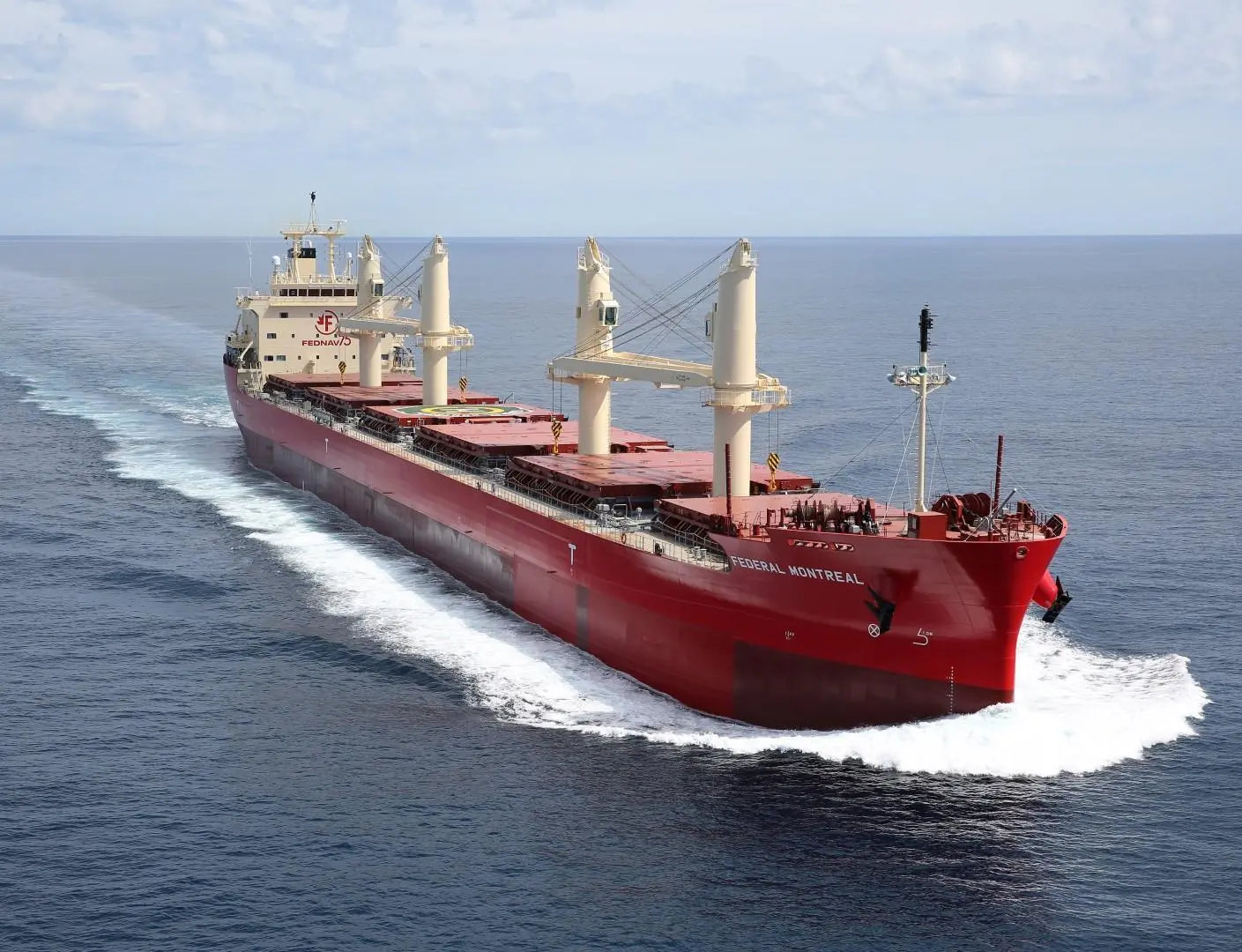
Canada’s pre-eminent operator in the international bulk trades, Montreal-headquartered Fednav, took delivery of two further geared handysize units from Oshima Shipbuilding in 2019. The 34,500dwt sisters Federal St Laurent and Federal Montreal are testament to a longstanding and productive business relationship with the Japanese shipbuilder. The vessels are the latest embodiments of a design that combines trading versatility with significant advances in efficiency and environmental performance.
At a time when many in the shipping community advocate an asset-light approach, Fednav has continued to champion large-scale asset ownership and control as a strength, maintaining a vigorous and extensive fleet renewal and development strategy.
Oshima has been central to the current programme, whereby construction of 22 examples of Fednav’s third generation of Great Lakes-dimensioned, handysize deepsea bulkers has been assigned to the yard at Saiki, near Nagasaki in western Japan.
Federal St Laurent and Federal Montreal, completed at the end of June and August 2019, respectively, are the 17th and 18th vessels in the programme, and replicate the design employed in the Federal Dart quartet brought into service over the course of 2018. Four further sisterships are due to be delivered in 2021. The first 12 ships of the series, incorporating some differences in technical specification, were commissioned in 2015 and 2016, starting with the Federal Baltic.
Besides the 22 orders for the 3rd generation handysize tonnage, the link between the Canadian owner and Japanese builder has also encompassed the preceding handysize generation, plus supramax and Panamax bulkers, such that a total of 40 deliveries have been made to Fednav between 1999 and 2019.
Fednav’s scrupulous approach to the efficacy of ship design and cargo carrying arrangements, coupled with the prowess of Oshima, as with other members of the Japanese shipbuilding industry, in continually refining vessel types conceived for serial or batch production, have clearly borne fruit in the 3rd-generation Lakes-suitable class. Particular consideration has been given to the optimisation of the entire propulsion configuration and hydrodynamics.
The handysize breed of ‘salties’—Great Lakes/St Lawrence Seaway-suitable ships built for deepsea deployment—consumes about 25% less fuel relative to similar capacity vessels built 15-20 years ago, with a corresponding reduction in greenhouse gas emissions and a decrease of more than 15% in NOx. Those earlier ships from Oshima were considered to be among the most energy-conservant of their era.
The environmental level of the new series meets DNV GL’s requirements for the CLEAN notation. The two latest ships are fitted with Optimarin ultraviolet ballast water treatment systems.
Fednav has been a lead player in the uptake of ballast water treatment technology, and began testing systems in 2001. 12 of the 3rd generation handysize bulkers from Oshima are equipped with BallastAce plant from JFE Engineering of Japan. The Norwegian-developed, chemical-free Optimarin solution adopted for the Federal St Laurent and Federal Montreal uses a combination of automatic back flushing, self-cleaning filters, and powerful UV irradiation to neutralise all potentially invasive species in the water.
Whereas the first 12 vessels are powered by MAN five-cylinder S50ME-B9.3 two-stroke diesels, the subsequent six ships, including Federal St Laurent and Federal Montreal, are installed with a five-cylinder S50ME-C9.5 engine, manufactured under licence at Mitsui’s Tamano factory. The power map for the latest model covers outputs up to 8,900kW at 117rpm, at the L1 nominal maximum continuous rating point. Direct drive is to a Nakashima fixed pitch propeller.
The transition from ME-B to ME-C machinery realises operating benefits attributable to the latter’s broader adoption of electronics. The electronic control of the ME-C type embraces flexible control of the cylinder process, i.e. fuel injection timing and actuation of exhaust valves, starting valves, and cylinder lubrication. While the ME-B engine uses electronically-controlled pressure boosters for the fuel injection, actuation of exhaust valves is camshaft-operated.
Fednav’s data sheets for the latest vessels indicate a daily consumption of 21.1t of intermediate fuel oil(IFO) sailing in laden condition at 14 knots, dropping to 19.2t/day in ballast at the same speed.
The auxiliary outfit comprises three Daihatsu GDK-20e diesel gensets, manufactured at the company’s Moriyama division, and a bow thrusters assists with manoeuvring and berthing.
Fednav has one of the world’s largest fleets of ice-class tonnage, capable of navigating in demanding winter conditions along the St Lawrence River, in the Baltic and in Arctic and sub-Arctic latitudes. Three icebreaking cargo ships service mines in the Canadian Arctic on a year-round basis. The Federal St Laurent and Federal Montreal, as with the sisterships, are strengthened to 1C ice class standard. The refined hull form includes energy-saving aft-end appendages and has been treated with low-friction antifoulings.
These true maids-of-all-work are laid out with six holds plumbed by four deck cranes mounted on high pillars along the centreline, each affording a maximum lift capacity of 35t. As opposed to the more conventional, hopper-sided hold construction, the holds of Fednav’s new handysize units are box-like in shape, to facilitate and maximise stowage of cargoes such as steel products and project consignments. The design’s scope otherwise spans the gamut of bulk commodities, industrial and forestry goods.
The tanktop length varies from 20.4m to 28.3m, the longest and most capacious holds being Nos 3 and 5. Folding hydraulic hatch covers are used throughout, and cement holes add to the transportation scope. The holds are strengthened for heavy cargoes, CO2-fitted, and equipped with Australian Rules ladders.
Husbandry of the latest ships has been contracted to Anglo-Eastern Ship Management of Hong Kong, and registry has been placed in Majuro under the flag of the Marshall Islands.
PRINCIPAL PARTICULARS – Federal St Laurent/Federal Montreal
|
Length overall |
199.98m |
|
Length bp |
195.50m |
|
Breadth |
23.76m |
|
Depth |
14.85m |
|
Draught(summer) |
10.83m |
|
Deadweight(summer) |
34,492t |
|
Gross tonnage |
20,763t |
|
Holds |
6 |
|
Cargo capacity(grain/bale) |
41,651/41,498m3 |
|
Cranes |
4 x 35t |
|
Main engine |
MAN 5S50ME-C9.5 |
|
Speed |
14kts |
|
Class |
DNV GL |
|
Class notations |
1A1 Bulk Carrier, BIS, BWM(T), Clean D G(B, P), DK(+), E0, HA(+), Holds(2,5 or 3,5, or 3 or 4) may be empty, IB-3, Ice(1C), Nauticus(Newbuilding), Recyclable, TMON |
|
Registry |
Majuro, Marshall Islands |
OSHIMA-built FEDNAV 3rd Generation Lakes-dimensioned handysize bulkers—delivery programme:
2015: Federal Baltic, Federal Barents, Federal Beaufort, Federal Bering, Federal Biscay, Federal Bristol;
2016: Federal Caribou, Federal Cedar, Federal Champlain, Federal Churchill, Federal Clyde, Federal Columbia;
2018: Federal Dart, Federal Dee, Federal Delta, Federal Niagara;
2019: Federal St Laurent, Federal Montreal;
2021: 4 x newbuilds.
Related Articles
 PROPULSION
 GENERAL NEWS
 HYDROGEN