



BOOST TO NORTH SEA FREIGHT CAPACITY
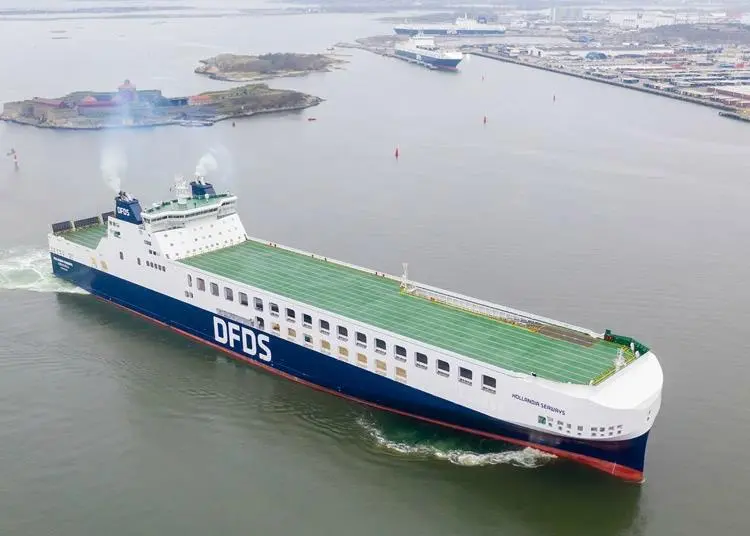
The 237-metre vessel is the third in a series of six ordered for the expanded European short-sea network of the Copenhagen-based transport and logistics group, and ranks among the largest ro-ro trailerships worldwide by virtue of a 6,695 lane-metre capacity. A five-deck configuration has been adopted, together with an exceptionally wide beam of 33 metres.
The advance in productivity is implicit in the vessel’s capability to maintain an equivalent turnaround time to that provided by the 290-trailer vessel superseded on the route, while offering a 55% greater intake of 450 units. The connection between Gothenburg and the Belgian port sustains a multifarious traffic in ro-ro consignments of industrial and consumer goods, steel, forestry products and factory-new vehicles.
The design was developed by Danish consultancy Knud E.Hansen, and the ever-growing prowess of Chinese builders coupled with the benefits of serial construction is evident from the fact that the latest ship was completed in October only 11 months after keel-laying.
As a champion of two-stroke machinery in ro-ro ferries, DFDS nominated a pair of MAN eight-cylinder S50ME-C diesels for each of the new generation, giving direct drive to controllable pitch propellers for a 21-knot service speed capability. The new freight ferries are reckoned to offer a 25% reduction in energy consumption per trailer unit relative to existing vessels, reflecting economy of scale in combination with the power and propulsion system layout and technological standard. The specified maximum continuous rating (SMCR) of each engine is 11,800 kW.
The vessel is equipped with an exhaust gas aftertreatment plant so as to meet sulphur emission controls and is also fitted with the means of ‘cold ironing’, drawing on electricity from the landside grid while in port. The two diesel gensets of approximately 2,000 kW are complemented by shaft generators of 2,350 kW on each driveline.
Unassisted berthing and manoeuvring in port and on the Ghent-Terneuzen Canal is facilitated by a pair of 2,350 kW bow thrusters.
The design features a high-throughput stern-only loading and unloading system whereby trailers and other wheeled cargo can be worked simultaneously across three independent, hydraulically-operated ramps at the main deck threshold to and from the five decks.
The initial two vessels in the series from Jinling, the Ephesus Seaways and Troy Seaways, were handed over in February and May 2019, respectively. Both were immediately assigned to the trailership route between Turkey and northeast Italy, following the acquisition by DFDS in 2018 of the leading Turkish operator UN Ro-Ro.
Third-of-class Hollandia Seaways is expected to be joined on the Gothenburg/Ghent run by the sixth ship in the series, while the fourth and fifth vessels are to be allocated to the service connecting Rotterdam with the company’s Immingham complex on south Humberside. Keel-laying for the fourth ship took place in March this year.
PRINCIPAL PARTICULARS – Hollandia Seaways
|
Length overall |
237.4m |
|
Breadth, moulded |
33.0m |
|
Depth, to main deck |
9.3m |
|
Depth, to weather deck |
29.1m |
|
Draught, scantling |
7.5m |
|
Deadweight, maximum |
c.17,000t |
|
Trailer linear capacity |
6,695 lane-m |
|
Trailer unit capacity |
450 |
|
Main engine power |
2 x 11,800kW |
|
Service speed |
21kts |
|
Class |
Lloyd’s Register |
|
Class notations |
+100A1 Ro-Ro Cargo Ship, ShipRight(SDA, CM, ACS[B]), IWS, L1, Eco(BWT), Ice Class 1C, LMC, UMS, NAV1, IBS |
|
Flag |
Denmark (DIS) |
Related Articles
 PROPULSION
 GENERAL NEWS
 HYDROGEN