



The Marine Fuels for the Motorships of the Future
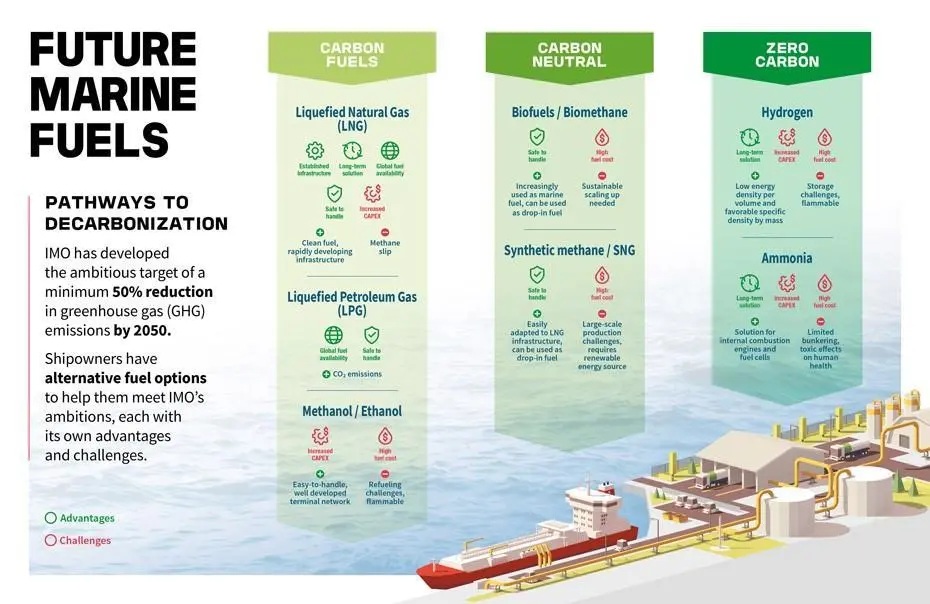
Some 90 percent of seaborne trade is related to cargoes carried by motorships with slow speed diesel engines: bulkers, tankers, containerships, and gas ships. The foreseeable future will also see a requirement for motorships. Nearly all of the motors in these ships are two-stroke engines – the most efficient main drivers available for large ships needing long range performance. Until these engines are replaced by alternatives the focus will be on new fuels. Batteries and hybrid systems are most suitable right now for short-range, smaller vessels. Both may have applications for deep sea motorships, but the real focus right now is on alternative fuels to replace high sulphur fuel oil (HSFO).
The Alternative Fuels Frontrunner: LNG
Liquefied natural gas (LNG) is now a well-known alternative fuel within the shipping industry. Producing almost no sulphur oxide or particulate matter emissions, it also boasts low nitrogen oxide emissions and GHG emission reduction benefits (from fuel tank to stack) of between up to 22%, dependent on engine type. Looking ahead, LNG – in combination with a combined cycle diesel/carbonate fuel cell – could reduce CO2 emissions by up to 80%.
Despite these advantages, ships won’t achieve zero CO2 emissions with LNG alone. LNG is still a fossil fuel, posing the additional challenge of methane slip. Caused by incomplete LNG combustion in the ship engine, methane – a potent greenhouse gas – is emitted into the atmosphere, partly offsetting the CO2 emissions reduction. This is a key area for technological development, as experts are working to improve the design of engines to limit methane slip.
Another challenge with LNG has been limited bunkering infrastructure and higher CAPEX requirements. However, thanks to huge investment in global LNG bunkering facilities, in particular outside the North European LNG supply stronghold and favorable OPEX conditions, the price of LNG is falling, making it increasingly competitive with HSFO. This trend is set to continue as global build-up of LNG bunkering infrastructure progresses.
As LNG gains traction as a clean fuel solution, greater numbers of LNG-powered vessels are being built; the global order book for 2019 lists 17% of newbuild orders (in gross tonnage) as LNG-powered.
Bunkering Challenges for LPG, Methanol and Ethanol
Liquefied petroleum gas (LPG) is one possible alternative to LNG. LPG is both widely available and easy to handle as well as store, leading to lower CAPEX than its LNG counterpart. Still, LPG presents a familiar problem: although it limits carbon output, it does not eliminate CO2 emissions, and while LPG terminals are operational worldwide, bunkering infrastructure is notably lacking. Although current levels of LPG production are insufficient to make this alternative fuel a catch-all solution for shipping, it will certainly be a part of the larger solution, starting with LPG carriers.
Methanol and ethanol, on the other hand, present other alternatives to LNG, with similar profiles to LPG. As drop-in fuels, they are easier to handle in comparison to LNG, and benefit from a well-developed global terminal network. At the same time, bunkering facilities are limited, with methanol- and ethanol-fueled ships needing to be designed and operated with special care, given that their gases are toxic and maintain a flammable nature. To use them safely, additional CAPEX is required for storage and handling. While the CAPEX gap is smaller than that of LNG, fuel costs are far less favourable.
Moving towards Carbon Neutrality: Bio and Synthetic Fuels
Biofuels are a carbon-neutral solution becoming increasingly available as a marine fuel. Major maritime players have been testing them in response to growing social pressure to reduce shipping CO2 emissions. However, for the time being, mass-scale production of biofuels is not a sustainable solution, particularly since other industries already using biofuels. Leaving them in a similar position to that of LPG: a good partial solution, but not entirely a viable panacea.
Synthetic methane / substitute natural gas (SNG) and bio-methane are another set of attractive options. Compatible with current LNG propulsion technologies, SNG and bio-methane can (in theory) be carbon-neutral alternatives when used in tandem with carbon capture and fuel cell technology, ensuring that existing LNG fuel infrastructures can be easily repurposed to source both fuels. However, making SNG carbon neutral depends on the availability of renewable energy, with production remaining costly in the short term.
Hydrogen and Ammonia: a Carbon-Free Future
Further down the line in the world of clean fuels are hydrogen and ammonia. Intrinsically carbon free, these fuels produce zero CO2 emissions if they can be sourced renewably – this is the premise on which they are currently being discussed. Both are clean fuel solutions for internal combustion engines and fuel cells, although it is to be noted that both fuels have a much lower energy density than traditional fuel oils; this needs to be accounted for in ship design and will impact costs. While hydrogen has a favourable specific energy (about three times higher than that of high sulphur fuel oil) its energy density is four to eight times lower, depending on the hydrogen’s state. Ammonia, on the other hand, weighs twice as much as fuel oil, but requires only three times the space to contain the same amount of energy.
The long-term, long-distance onboard storage of liquid or compressed hydrogen remains a technical challenge that will be expensive to solve in the short-term. So, despite the possible applications of pressurised or liquid hydrogen for transport, ammonia – which acts as a hydrogen carrier – currently shows greater promise as a zero-carbon fuel for shipping.
For ammonia, the processes for storage and transport are well established. Moreover, it is one of the most widely used chemicals in the world, with global production levels of around 190 million tons per year. It is therefore more widely available, although marine bunkering infrastructure would need considerable development to accommodate to ammonia’s corrosive nature amongst its other qualities. Safety issues associated with ammonia’s toxicity and caustic properties will also have to be addressed, creating the need for careful storage and handling so that crew and other workers are not put at risk of harm – ultimately, this will be achieved through thorough regulation and certification. In addition there are technical aspects related to the combustion process to be assessed.
Providing Guidance to the Industry
As the clock keeps ticking, stakeholders are seeing a growing need to develop solid infrastructures and supply chains for clean fuel solutions. Bureau Veritas is playing a significant role in supporting the development of International Maritime Organisation (IMO) regulations, most notably the International Code of Safety for Ships using Gases or other Low-flashpoint Fuels legislation or IGF code, as well as industry standards for design, operation, and bunkering. We are involved in various joint industry projects (JIPs) to assess technical feasibility and safety risks of alternative fuels, considering both thermal engines and fuel cells as viable options. We also support early adopters in the development and completion of various projects. We cannot predict the future, but we are well on the way to understanding the options posed and what will be required in the fields of innovation and energy for shipping.
Related Articles
 ALTERNATIVE FUELS & LUBRICANTS
 ALTERNATIVE FUELS & LUBRICANTS
 ALTERNATIVE FUELS & LUBRICANTS