



AIR LUBRICATION ENDORSED BY LNGC SECTOR
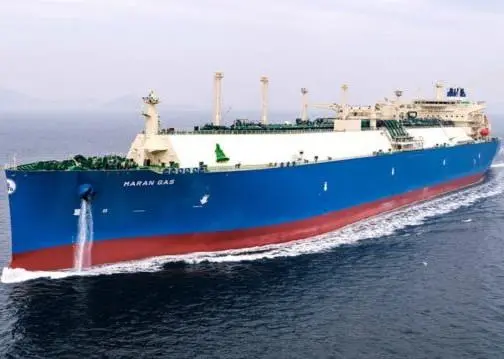
The first reference was achieved by the application of a South Korean-developed system to the 173,600m3-capacity Maran Gas Andros, writes David Tinsley.
Delivered by Daewoo Shipbuilding & Marine Engineering (DSME) into the expanding fleet controlled by Greek company Maran Gas Maritime, the vessel employs dual-fuel, two-stroke machinery and incorporates membrane-type cargo containment.
The air lubrication system (ALS), devised by DSME, injects air under the ship to create a continuous layer between the hull and seawater, improving fuel efficiency by reducing frictional resistance on the voyage. An integrated control system monitors and adjusts the ALS in real-time so as to optimise its efficiency.
Under-hull air lubrication has found favour with an increasingly wide range of vessels, including containerships, bulkers, LPG carriers, tankers, cruise vessels and ferries, and Maran Gas Andros takes the technology into a new market. The Greek-flag LNG tanker is expected to cut its fuel consumption by around 5% compared to similar vessels, on similar trading profiles, that do not use the energy-saving method.
It is understood that early performance results with the ALS have been such that the Greek operator is considering the system for its subsequent 12 LNG carrier newbuilds ordered from DSME. The programme of vessels of 173,400-174,000m3 for the company, part of the Angelicoussis Shipping Group, extends into 2022.
Further indication that the concept is gaining momentum and credibility among the LNGC community as a means of conserving fuel and reducing emissions has recently been expressed by an initiative taken by Shell International Trading & Shipping Company. The tanker and gas carrier operator has signed a framework agreement with UK-based Silverstream Technologies to retrofit the latter’s solution to an unspecified number of LNGCs in the Shell fleet.
Hyundai Heavy Industries is also preparing to launch the first reference of its own Hi-ALS system. The Korean shipbuilder is installing its ALS system aboard seven 174,000m3-capacity LNG carriers that is constructing for Capital Gas Corp. The seven LNG newbuilds are scheduled for delivery in 2020 and 2021.
The nominal maximum continuous rating (MCR) for the engine model is 18,200kW at 83rpm, inferring a potential power concentration of 36,400kW. However, the specified MCR for the Maran installation could be substantially less, possibly keeping the normal, continuous service rating to 10,700kW at 65.5rpm. Four four-stroke auxiliary generators cover the onboard electrical load.
Membrane tanks of the No96-series design developed and continually refined by GTT provide the cargo carrying wherewithal of the Maran Gas Andros, and will also be incorporated in the sister vessels under construction and on order at DSME’s Okpo complex.
PRINCIPAL PARTICULARS – Maran Gas Andros
|
Length overall |
294.9m |
|
Length bp |
288.5m |
|
Breadth, moulded |
46.4m |
|
Depth, moulded |
26.5m |
|
Draught, maximum |
12.5m |
|
Cargo capacity |
173,608m3 |
|
Gross tonnage |
113,793t |
|
Deadweight |
94,638t |
|
Main engines |
2 x 5G70ME-C9.5-GI |
|
Speed |
19kts |
|
Class |
LR |
|
Flag |
Greece |
Related Articles
 PROPULSION
 GENERAL NEWS
 HYDROGEN