



VIRGIN BRAND ARRIVES ON HIGH SEAS
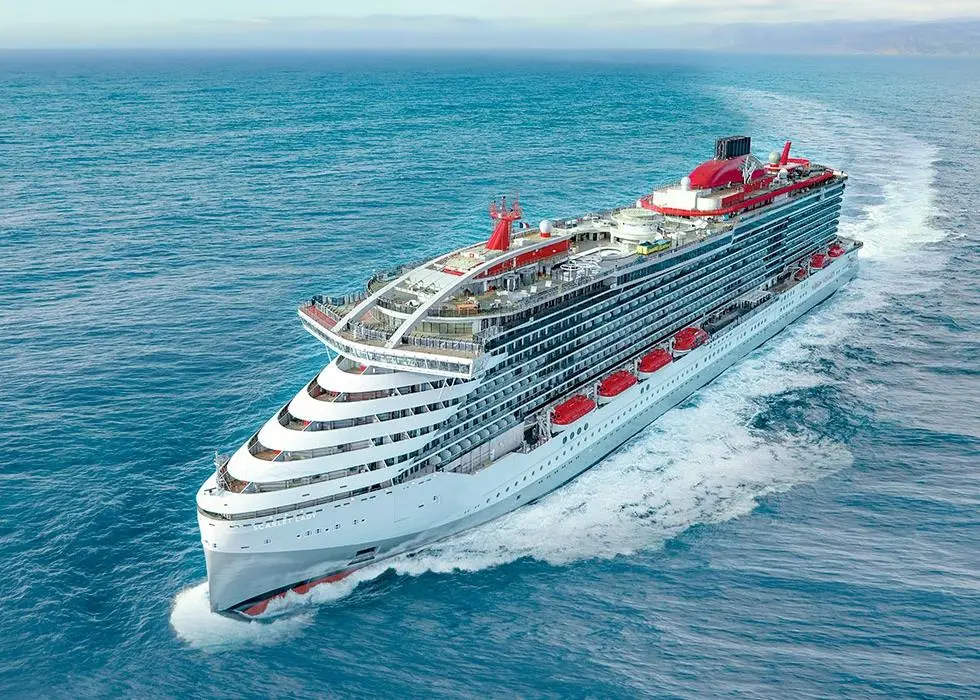
The 110,000gt Scarlet Lady leads a series of four ordered from Fincantieri, blending the expertise of the world’s senior cruiseship producer with a fresh and innovative approach by Virgin and its contractors.
Jointly owned by the Sir Richard Branson-headed Virgin Group and Bain Capital of Boston, Virgin Voyages is introducing a distinct business style and brand so as to achieve competitive differentiation. The enterprise is geared to providing stylish travel experiences to an adult(18-plus) customer base and its focus on applying principles of environmental responsibility is central to its promotional activities as well as engineering design.
The company is looking to break the industry’s dominance by a few key players and deliver strong investment returns.
The diesel-electric Scarlet Lady, whose name was inspired by an early Virgin Atlantic plane, has just over 1,400 cabins for about 2,800 passengers, and will carry a maximum crew complement of approximately 1,150. The ship was constructed at the Sestri-Ponente yard in Genoa, where second-of-class Valiant Lady is taking form. The capital intensity of each is indicated by the value of around EUR 700 million (US$790m) commanded by the fourth sister ordered in October 2018.
Scarlet Lady will be homeported at Miami, and will sail a mix of Caribbean voyages, gravitating on Havana(Cuba), Costa Maya (Mexico) and Puerto Plata (Dominican Republic), respectively.
While incorporating readily available and commercially viable measures and solutions to reduce environmental impact and raise energy efficiency, the company said that it had purchased “high quality carbon offsets” against the new ship so as to give immediate effect to its emission reduction strategies. It is also committing resources to the long-term drive towards a “net-zero” future by pioneering new technologies on board and working with the industry to advance R&D in zero-carbon fuels.
Virgin Voyages is among the first cruise lines to use Climeon’s Heat Power Module system, which utilises heat from the ships’ engines to generate electricity, thereby reducing the demand for fuel. Incoming waste heat converts the working medium from liquid to gas and the pressurised gas is passed through a turbine to produce ‘clean’ electricity. The gas is subsequently cooled, returning to a liquid state, which is pumped again to the waste heat side to sustain an efficient, closed-loop cycle.
Moreover, at the time of the keel-laying of the Scarlet Lady in November 2017, Virgin entered into an agreement with the Norwegian firm Scanship to jointly develop an innovative method to transform shipboard waste into energy. The technology is based on microwave assisted pyrolysis (MAP), whereby rapid heating using microwave power converts organic waste to syngas.
The shipowner’s investment in environmental care evidently reflects corporate culture: “The ocean is our home and we are on a mission to protect it. The single biggest threat facing our ocean is climate change, and we want to be part of the solution,” stated Tom McAlpin, Virgin Voyages’ CEO and president.
The diesel-electric installation combines an ABB electrical power and propulsion package with Wartsila, wide-bore four-stroke machinery, emission abatement, automation and control equipment.
Rather than taking up the LNG dual-fuel option for main generator prime movers, diesel engines of the Wartsila 46F type were nominated in conjunction with exhaust gas treatment systems and selective catalytic reduction (SCR) technology.
At a nominal maximum continuous rating (MCR) of 1,200kW per cylinder, the 46F offers favourable power-to-weight and power-to-space ratios and among the best-in-class fuel economy. Scarlet Lady is fitted with two eight-cylinder and two 12-cylinder models, giving a total primary power concentration of 48,000kW on the basis of the design’s R1 top rating.
The Wartsila hybrid scrubber uses seawater to remove SOx from the exhaust, and provides the flexibility for operation in low-alkaline waters as well as in the open sea. In addition, significant reductions in NOx and particulates will be achieved by means of a proprietary SCR system.
The Wartsila-driven gensets provide electrical energy for a pair of Azipod XO podded propulsors which have a combined propulsive effect of 32MW. Besides the azimuthing pods and alternators, ABB’s delivery included the main switchboards, distribution transformers, and remote propulsion controls. The Azipods ensure a level of manoeuvring precision which increases the ship’s accessibility to restricted berths and harbours without reliance on tug assistance, and also minimise onboard noise and vibration to the benefit of passenger comfort and crew habitability.
Sister newbuild Valiant Lady is scheduled to be deployed on seven-night Mediterranean cruises out of Barcelona on her May 2021 debut. The third and fourth ships are due to follow in 2022 and 2023.
PRINCIPAL PARTICULARS – Scarlet Lady
|
Length overall |
277.2m |
|
Breadth |
38.0m |
|
Draught, design |
8.1m |
|
Gross tonnage |
110,000t |
|
Passenger capacity |
c.2,800 |
|
Passenger cabins |
1,408 |
|
Crew/crew cabins |
1,160/813 |
|
Propulsion system |
Diesel-electric |
|
Propulsion motors |
2 x 16,000kW |
|
Main generator power |
2 x 14,400kW + 2 x 9,600kW |
|
Speed, maximum |
22kts |
|
Speed, service |
20kts |
|
Class |
LR |
|
Flag |
Bahamas |
Related Articles
 PROPULSION
 GENERAL NEWS
 HYDROGEN