



Flapping-wing solution at heart of next-gen efficiency project
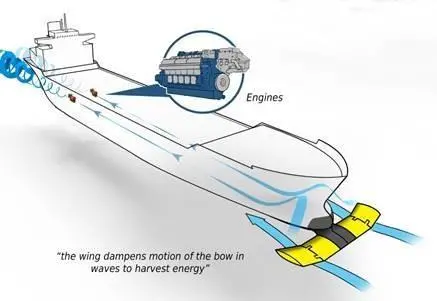
The three-year SEATech project intends to develop an operational version of an oscillating flapping-wing propulsion device, and to test the energy saving device aboard short-sea vessels. The project builds on existing designs has been tested in flow tanks but have not yet been undergone full-scale tests.
Flapping wing solutions have been long regarded as a potential energy saving solution within the shipping industry, but the complexity of modelling the kinematic interaction of the wing with waves and currents and developing dynamic control systems for the flapping wing, have complicated efforts to commercialise them previously.
The biomimetic energy saving device uses active pitch control to maximise the energy and thrust generated from the waves. As the levels of thrust and energy generated by the device fluctuate, the device poses a wider integration challenge.
“The heart of the system is how we can maximise the amount of energy generated by the wing”, said Anders Öster, Senior Project Manager, Research & Technology Development at Wärtsilä and overall Project Coordinator for the SeaTech Consortium.
The solution being explore by the EU-funded SeaTech project is to integrate the wing with a separate Wärtsilä innovation in dual-fuel engine operation, which will lead to a significant increase in efficiency. By combining the flapping-wing solution innovation with improved dual-fuel engine efficiency, the project intends to deliver a 30 percent reduction in fuel consumption.
The project envisions such a symbiotic relationship would permit 99 percent reductions in sulphur oxides (SOx) and nitrogen oxides (NOx), a 94 percent reduction in particulate matter (PM) emissions and a 46 percent reduction in CO2 emissions.
The development of a symbiotic relationship between the bow-mounted flapping-wing and the engine management system lay at the heart of the project, Öster said.
“Without modifying the engine management to respond more quickly to the constantly varying dynamic energy produced by the wing, you could not achieve the sort of savings we are aiming to achieve,” Öster said.
“We want to let the wing generate as much energy as possible, and to maximise the amount of thrust the system can generate.”
Improved energy conversion
The second aspect of the project is a proposed engine power generation innovation, built around achieving ultra-high energy conversion efficiency.
Anders Öster confirmed that precise control over the engine’s combustion process would help to achieve radical reductions in exhaust emission levels.
“The development represents an evolution in our control over the combustion process, rather than a radical change in combustion chamber design or the elimination of camshafts,” Öster said. The range of fuels that Wärtsilä’s dual-fuel engines can handle would not be limited by the development, he added.
By improving the overall energy efficiency of Wärtsilä’s engines, and lowering the overall emissions from the engine, the development might lower the methane emissions emitted by Wärtsilä’s four-stroke dual-fuel engines.
Öster firmly declined to reveal more about the proprietary technological development, noting the three-year research project only began work in 2019.
Retrofit possibilities
The project was intended to provide practical solutions for existing tonnage, rather than just introducing a new solution for newbuilds. One of the project’s criteria was that it could deliver solutions that could be applied to existing short-sea tonnage, as well as to newbuildings, Öster noted.
The innovation was intended to be suitable for retrofit to existing vessels equipped with Wärtsilä engines. While it was intended to be launched in the European and Asian short-sea markets by 2025, the solution was also likely to offer efficiency gains for deep-sea vessels.
With the extremely high fuel efficiencies offered by the solution as well as operational cost reductions from improved engine operations, the return on investment (RoI) for owners was expected to be around 400 percent.
SEATech consortium
The SEATech Horizon2020 project consortium includes Wärtsilä, Huygens Engineer BV from the Netherlands, the Estonian company Liewenthal Electronics, Utkilen AS from Norway, the National Technical University of Athens, UiT The Arctic University of Norway, and the UK’s University of Southampton. Wärtsilä is the coordinator of the 3-year project, which will run until 2023.
The National Technical University of Athens and the University of Southampton have specialisms in the design and modelling of flapping-wings and other propulsion devices.
The consortium participants’ expertise extends from technical design and production, and modelling of the kinematic properties of biomimetic devices, through to optimising the engine response of Wärtsilä’s dual-fuel engines at partial loads to integrate the variable amounts of thrust generated by the wing.
Related Articles
 ENERGY SAVING DEVICES
 ENERGY SAVING DEVICES
 AMMONIA