



MAN-ES backed OEM data collaboration platform gains momentum
The rapid evolution of data visualisation software and analytical tools is paving the way for rapid advances in performance analysis. Improving communication between different systems has also led to improvements in fuel and lubricant consumption leading to better emissions, with knock-on benefits in terms of opex and capex costs.
Dr Alan Atkins, the CEO of a not-for-profit organisation mýa Connection GmbH, has seen improved cooperation between different component suppliers lead to tangible benefits for customers in the Marine, Energy generation and the oil and gas sectors.
Having developed significant expertise in the Internet of Things (IOT) area, he was recruited by MAN Energy Solutions to head up a development project focused on launching a data collaboration platform, open to all and in parallel to CEON, a performance related maintenance solution for MAN ES’s business in Augsburg.
Atkins cited the example of oil refineries or petrochemical plants where different OEMs collaborated to achieve incremental operational improvements.
“In some ways, the oil and gas sector realised the potential benefits of greater data availability and operational synergies between different OEMs earlier than the marine business,” Dr Atkins noted.
A single interface for OEM data
One of the ways that OEMs could be encouraged to share data was through the development of a robust secure common data collaboration platform, Atkins suggested.
At present, solutions providers offer digital technologies and services which allow the optimisation of the performance of their systems using real time data and analytics derived from data from the application or sensor layer.
However, Atkins noted that owing to the number of OEMs and proprietary systems aboard a vessel, operators are faced with a complicated and uncoordinated view of the various equipment that they operate and maintain, with numerous logins and views.
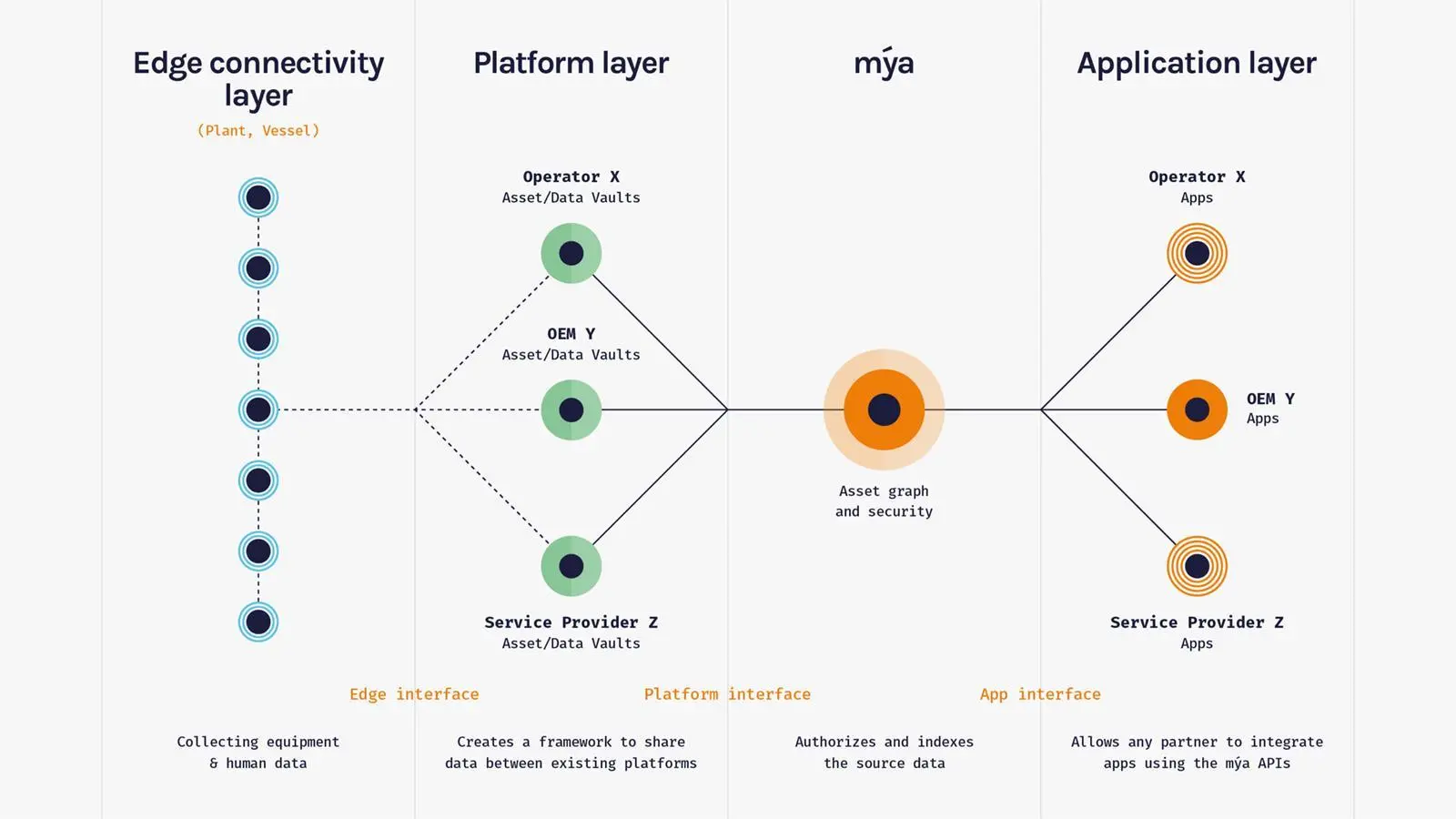
The mýa platform was intended to sit between the OEMs data vaults/platforms and the application layer, providing a single interface that integrates all the OEM data streams to provide a complete system view and facilitating analytical investigations on the total or part system so inter-equipment relationships can be understood and optimised.
It would also strongly contribute to ensuring that data from the application or sensor layer complied with OT cybersecurity requirements that are due to enter effect in 2021. mýa is also able to work in line with data conforming to the standard ISO 19848.
Ensuring data integrity
However, the real advantage of the system is not from the development of a single user interface, or even from cybersecurity advances. Atkins admitted candidly that other solutions providers are also seeking to develop unitary interfaces.
“mýa allows OEMs to agree on common standards, which in turn allows standardisation and compatibility,” Atkins said. The platform applies a common metadata structure to data supplied by different OEM systems, and also aligns common time stamping system.
One of the key advantages of the platform lay in the control over data that the platform architecture introduces.
The key to the system is that it relies on permissions from clients, and from collaborating OEMs, before data can be shared. “All data exchanges are strictly subject to permissions and contracts given by the respective users and members. You can only see what you are authorised to see.”
The security of the system is an integral part of the solution, which has been installed on every new MAN engine over the course of the past year.
“We have demonstrated the system’s integrity over the past year, including data streams from other assets.”
Atkins stressed that the integrity of the granular data from the application level is ensured as it is saved within the secure OEM data vaults, rather than within the mýa system.
A unique structure
While MAN ES had played a leading role in establishing mýa, the common platform was intended to benefit asset owners, OEMs as well as the industry overall.
“By coming together and agreeing common data standards, we can facilitate integration,” Atkins noted. The mýa platform is open to all, collaborating and competing OEMs alike as well as the asset owners. The system itself was not intended to be linked to any specific engine or equipment manufacturer, Atkins stressed.
“We are not a commercial operation and expect to be able to provide the interface to users at a minimal cost.” Atkins noted that he expected the cost of developing the platform and commercialising it to be borne by the founder members of the project. MAN ES was the first founder but soon to be joined by others in the project. “We are looking for between 5 -10 founders to take a place at the governing table, giving direction and development options for the future.”
Atkins also noted that the development of a common data sharing infrastructure was expected to significantly assist a number of smaller and medium-sized ship owners and operators who were undertaking the development of vessel optimisation programmes.
“mýa is intended to remove friction points and help the industry to operate more efficiently, and move faster towards realising the full potential of digital technologies,” Atkins concluded.
Related Articles
 ENERGY SAVING DEVICES
 LNG
LNG
 ALTERNATIVE FUELS & LUBRICANTS