



CHARTING A NEW COURSE FOR SCOTTISH FERRY PROJECT
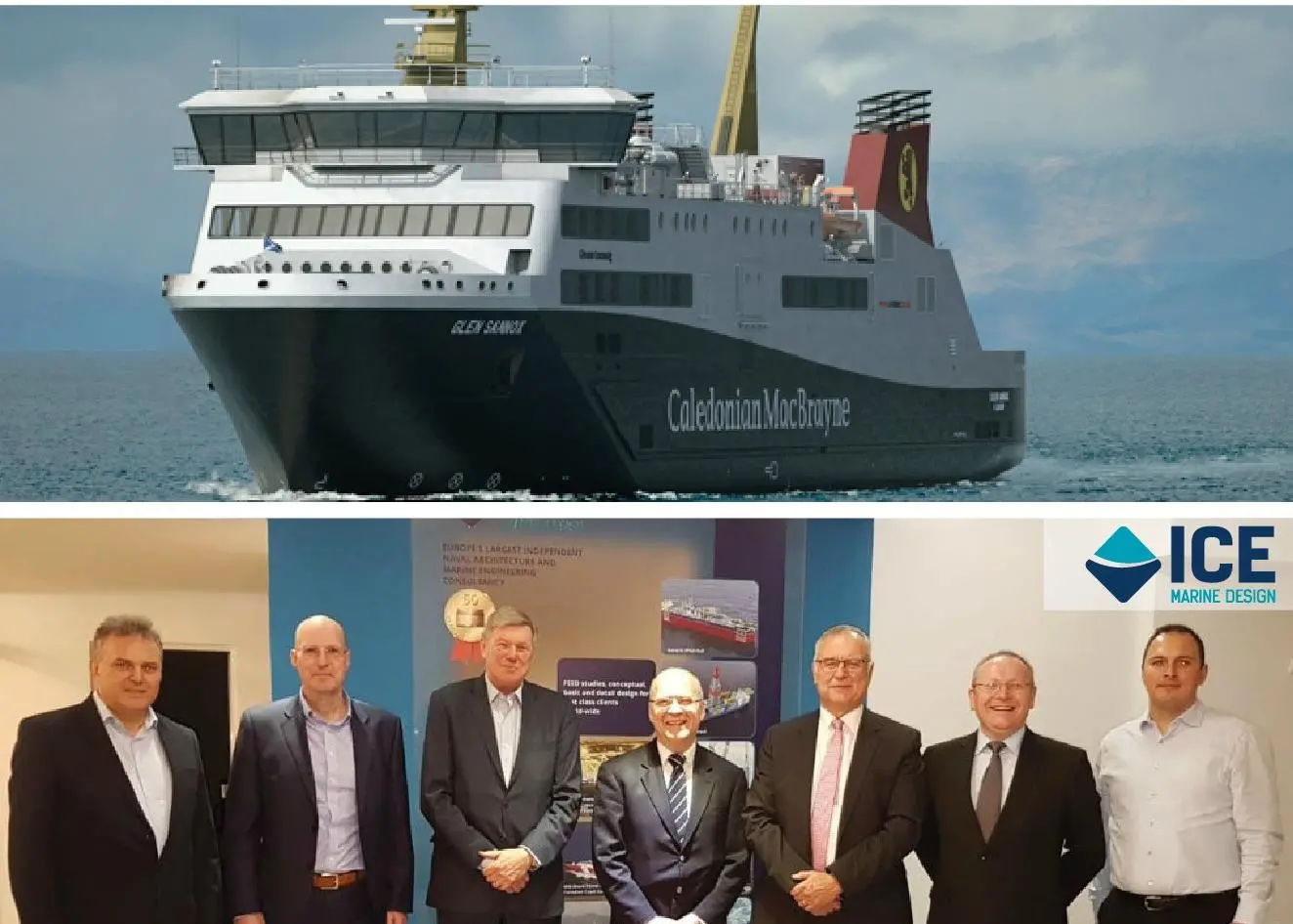
International Contract Engineering (ICE) has been awarded a services contract described as “relating to the supply of engineering for revision to basic design, and completion of the detail design and production information for CalMac ferry hull 801.”
The vessel was launched as the Glen Sannox into the Lower Clyde in November 2017, and remains uncompleted after continual delivery postponements by the Port Glasgow yard. She is the first of two 102-metre sisters ordered in October 2015 by Caledonian Maritime Assets (CMAL) for deployment on CalMac’s Scottish west coast route network. The project signified a technical milestone in the UK through the specification of LNG dual-fuel main machinery.
In close cooperation with the new management team appointed at Ferguson Marine, and after a detailed investigation of the status of the partly-constructed ferry, which included a laser scanning survey of the ship’s technical spaces, ICE mapped out the design work and deliverables to be revised, updated and completed.
ICE is headquartered at Douglas, on the Isle of Man, and its main design engineering facilities are in Romania, where the parent group acquired the country’s Icepronav ship research and design institute 20 years ago.
Robert Swann, president and chief operating officer of ICE, said “We are delighted to be able to assist this well-known Scottish shipyard with our extensive ship design experience. ICE maintained for many years an office in Glasgow and we have been providing design services for several ships being built in Scotland for the Royal Navy. Having spent five years myself in shipbuilding on the Clyde, I know what the excellent tradesmen there can achieve under good leadership and with the right planning, tools and technical information.”
ICE Group chairman Steinar Draegebo also has a track record that includes Scottish shipbuilding, having been brought in to run the loss-making Govan yard soon after it had been sold by state-owned British Shipbuilders to the Kvaerner Group of Norway in 1988. In his role as chief executive of Kvaerner Govan, he is credited with having turned around the business.
The ro-pax ferries had been ordered on the basis of entry into service during 2018, but a recent Scottish parliamentary enquiry into progress on construction indicated that the first ship was unlikely to be ready before the end of 2021 and the second by October 2022.
The tangled web of recriminations, claims and counter-claims on all sides, and underlying project management and Scottish political issues, make for dangerous ground in trying to identify the root cause or causes of the project’s disastrous course. One thing for sure is that the original, overall contract price of £97m (US$119m) will bear no relationship to the cost of getting the ships built, with indications that the final bill could reach or even exceed £200m (US$245m).
The Scottish government had reportedly loaned Ferguson £45m (US$55m) in a bid to guarantee completion of the ferry contract, but a worsening situation led to the decision in 2019 to take the ailing yard into public control.
Meanwhile, CMAL has entrusted a Danish firm with the design, manufacture and delivery of the LNG bunker stations to serve the two ferries. Kosan Crisplant (KC) LNG of Randers will provide the facilities at Ardrossan, on the Firth of Clyde, and at Uig, on the Isle of Skye. The installations will be fully automated and remotely monitored, and will each have a 150m3-capacity tank with the capability of bunkering at up to 100m3 per hour.
The ships have been specified with Wartsila medium-speed, dual-fuel propulsion and auxiliary engines and proprietary LNGPac storage and supply system.
Indicative of a degree of production continuity at Port Glasgow, Ferguson handed over a 21-metre support vessel for the Scottish salmon-farming sector during January this year to Inverlussa Marine Services, a family-owned business on the Isle of Mull.
Related Articles
 PROPULSION
 GENERAL NEWS
 HYDROGEN