



ANOTHER RO-RO WORKHORSE FROM FLENSBURG STABLE
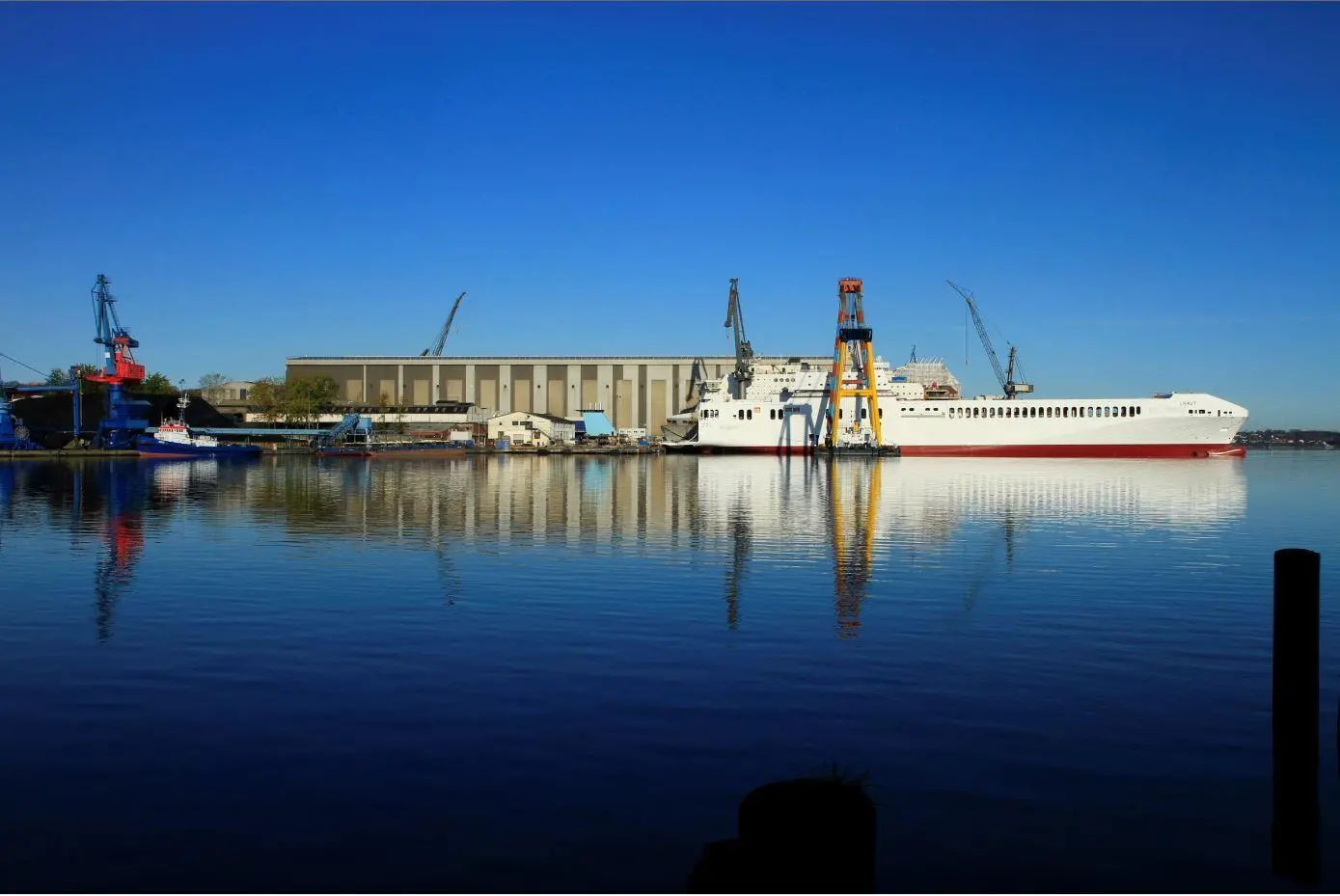
The 33,000gt Liekut, the eighth in a series of 4,076 lane-metre trailerships built to the account of the German shipyard’s former owner SIEM Europe, was delivered towards the end of March.
Liekut is the first delivery since the Norwegian-controlled SIEM Group sold its remaining shares in the loss-making shipbuilder last September to global investment company Tennor Holding (formerly Sapinda Holdings). Headed by German financier Lars Windhorst, Tennor operates out of offices in London, Amsterdam and Berlin, and has committed a capital injection of EUR33 million (US$36m) into the yard as part of the acquisition plan.
SIEM’s eight, Flensburg-built trailerships are controlled from the UK by SIEM RoRo. As with the preceding vessel in the series, Leevsten, the Liekut has been placed under the husbandry of the Norwegian parent group’s Polish affiliate SIEM Ship Management, based in Gdynia. Apart from the Liekut, which remains idled at Flensburg, all the previous tonnage has attracted charters from Danish, Turkish and Italian operators.
The 283-trailer Liekut generation is a derivative of a highly successful class developed by the yard and built in multiple numbers over the past 20 years, primarily for deployment in the Mediterranean and North European shortsea trades.
In the latest iteration, the trailer payload is distributed over four decks, whereby the two uppermost levels have the highest individual intakes of 86 and 84 trailers, respectively, with the main deck being laid out for 73 units, and the lower hold (tank top) accommodating a further 40 trailers.
Indigenous wide-bore, medium-speed diesel machinery is the power plant of choice for the Flensburger series. Thus, Liekut is equipped with two MAN eight-cylinder 48/60CR engines, each turning out 9,600kW, driving twin controllable pitch propellers through reduction gearboxes. The installation provides for a service speed of 21.3 knots, and manoeuvring and assistance-free berthing is facilitated by a pair of 1,500kW bow tunnel thrusters.
When a temporary cessation of production at the yard was imposed on 19 March, work in hand had come down to a single vessel, Brittany Ferries’ long-delayed ro-pax Honfleur, destined to become the first LNG-fuelled ferry on the English Channel routes.
The only other declared order entails a ferry for Irish Continental Group, specified with a record-breaking 5,615 lane-metre capacity. Australian company TT Line’s contract for two Bass Strait ro-pax ferries was cancelled by mutual agreement in February this year.
PRINCIPAL PARTICULARS – Liekut
|
Length overall |
209.79m |
|
Length bp |
197.74m |
|
Breadth, moulded |
26.00m |
|
Depth, to main deck |
8.60m |
|
Depth, to upper deck |
17.00m |
|
Draught, design |
6.45m |
|
Draught, scantling |
6.82m |
|
Deadweight @6.80m draught |
11,930t |
|
Gross tonnage |
32,887t |
|
Freight decks |
4 |
|
Ro-ro freight capacity |
4,076 lane-m |
|
Trailer-equivalent |
283 |
|
Main engine power |
2 x 9,600kW |
|
Service speed |
21.3kts |
|
Bow thrusters |
2 x 1,500kW |
|
Flag |
Malta |
SIEM Ro-Ro series
|
Name |
Delivery |
|
Meleq |
Apr 2017 |
|
Gardenia Seaways |
Jul 2017 |
|
Tulipa Seaways |
Sep 2017 |
|
Fadiq |
Jan 2018 |
|
Alf Pollak |
Oct 2018 |
|
Maria Grazia Onorato |
Dec 2018 |
|
Leevsten |
Sep 2019 |
|
Liekut |
Mar 2020 |
Related Articles
 PROPULSION
 GENERAL NEWS
 HYDROGEN