



MAN ES TO DELIVER FIRST ME-GA ENGINE BY END-2021
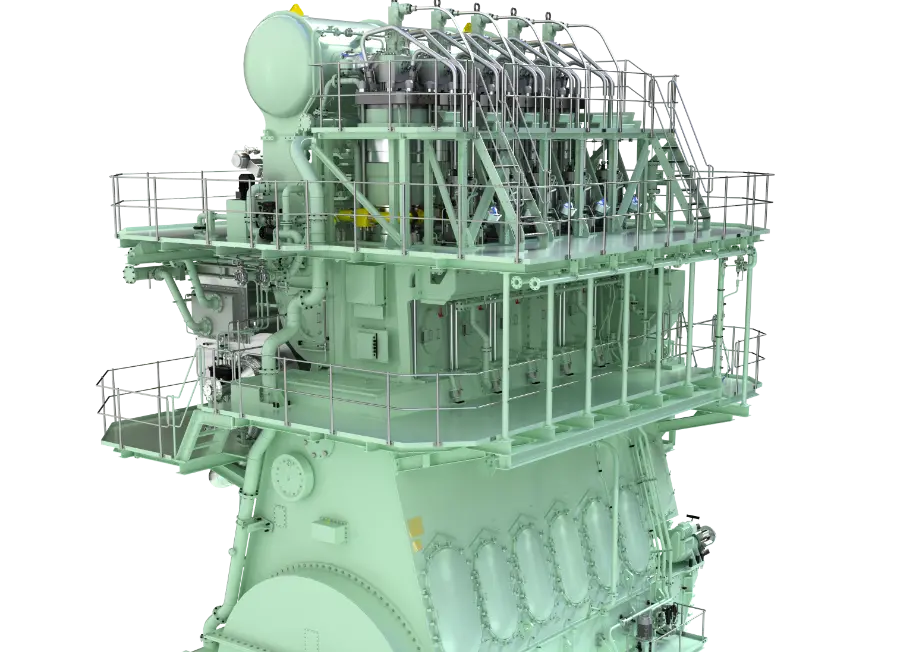
As previously reported, the company was developing five and six cylinder variants of a 700mm-bore size engine. It would also be ready to deliver a 600mm version subject to customer demand to the same timescale.
Demonstration tests
The new engine had been subject to the most intensive testing programme in MAN’s history, undergoing over 600 tests at Research Centre Copenhagen since 2019.
It had been added to the company’s engine programme this year, and was proceeding on schedule towards class type approval. However, the Covid-19 pandemic had forced the MAN to reschedule a public demonstration test previously scheduled for September 2020. This was now likely to occur in a different format in early 2021.
New EGR variant
However, the main talking point of the presentation was the revelation that MAN ES would be offering an EGR version of the low pressure engine that would ensure IMO Tier III compliance in diesel mode as well as gas mode.
The high-pressure EGR version, an SCR version and the basic version of the engine without aftertreatment would all ensure compliance with IMO Tier III in gas mode. The SCR version would also ensure IMO Tier III compliance in diesel mode as well as gas mode.
However, Thomas S. Hansen, Head of promotion noted that the EGR version would also offer “significant” performance improvements, reducing the new engine’s specific gas consumption by around 3 percent, and lowering the specific fuel oil consumption in diesel mode by 5 percent. This would also significantly lower the EGR version’s expected methane slip, he added.
The solution drew on the company’s long experience of developing EGR solutions, Hansen noted, adding that the company had over 200 orders for EGR solutions, in addition to 30 versions in service.
The high-pressure EGR version would also be delivered on the same timescale as the basic MAN B&W G70ME-C10.5-GA design.
Gas system
Aside from the EGR variant, Hansen unveiled a number of additional features of the ME-GA design in the presentation.
As befits a design that is intended to deliver lower CAPEX costs for ship owners in the LNG carrier sector, the ME-GA version includes a low-pressure compressor which successfully lowers the design’s up-front costs.
Hansen outlined the design of the engine room and fuel gas supply concept.
The Gas Valve Unit (GVU) was available in two different versions (wall-mounted and skid-mounted), and could be installed outside the gas safe area, freeing up space in the engine room.
The bypass system and gas regulating valve enable depressurisation of the system without blow-off piping.
The design also includes a number of solutions that have been applied from the ME-GI platform.
“We applied the purging concept from ME-GI Mark II. Rather than purging the entire system with nitrogen, we applied nitrogen from the engine end and simply reversed the flow.”
The simplified solution reduced the amount of pipework and components, and lowered the volume by 50 percent, Hansen noted.
A similar focus on reliability was seen in the design of the Safe Gas Admission Valves, each of which incorporates a window valve. The double safety function was expected to significantly lower the risk of gas leaks in the case of a component failure.
Piston ring concept
The engine design also employs the standard 3 piston-ring package that has been used on ME-GI engines.
The rings have met performance targets during the ME-GA tests, and have a proven service record in ME-GI engines.
“We have recently extended the recommended Time Between Overhaul for ME-GI engines by 50 percent,” said Kjeld Aabo, Director New technologies.
In addition, he maintained that the gas tight bottom ring is less susceptible to contamination than alternative designs.
Adaptive Cylinder Control
The design also includes a new algorithm, adaptive cylinder control, that ensures that each individual cylinder operates at its optimal cylinder pressure.
The new concept has been successfully deployed on ME-GI engines, and is now being added to all new dual-fuel engine orders.
Hansen noted that the solution operated automatically, improving efficiency without increasing monitoring requirements for the crew.
Fuel Ratio Control
Hansen also discussed how MAN ES had delivered a solution to ensure that the Otto cycle ME-GA engine’s lean air-fuel mix does not get close to ‘knocking’ (self-ignition before pilot fuel injection) or ‘misfiring’. Knocking is a particular challenge for vessels operating at high engine loads, or in high ambient temperatures, or on LNG with low calorific values.
MAN ES was offering one solution, Fuel Ratio Control, which changed the ratio between gaseous and liquid fuel injection. Such a solution was not necessary for vessels with the new EGR solution, Hansen added.
Related Articles
 ALTERNATIVE FUELS & LUBRICANTS
 ALTERNATIVE FUELS & LUBRICANTS
 ALTERNATIVE FUELS & LUBRICANTS