



New Project Joins the Race for the First Onboard CO2 Capture Installation
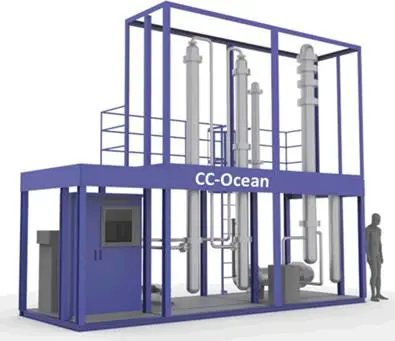
The Carbon Capture on the Ocean (CC-Ocean) project got underway in August, and in mid-2021 the five-ton demonstration system is expected to be land-tested ready to be fitted on the thermal coal carrier Corona Utility operated by K-Line for Tohoku Electric Power Co. Inc.
The demonstration will see the design of an existing CO2 capture system converted for marine use by Mitsubishi Shipbuilding, part of Mitsubishi Heavy Industries Group. The company will build the system and conduct a safety assessment on factors such as ship movement and the sulphur content of the exhaust gas which differs from land-based applications. Based on onboard experience with the demonstration plant, Mitsubishi will determine the necessary system specifications and consider how to make the plant more compact.
The design is based on the technology of Mitsubishi Heavy Industries Engineering and Kansai Electric Power’s existing land-based KM-CDR Process™. Exhaust gas containing CO₂ is cooled in an exhaust gas cooling tower. It is then exposed to an alkaline absorbent liquid (KS-1™) in an absorption tower. The absorbent liquid containing high concentrations of CO₂ is then sent to a regeneration tower where it is heated with steam to release and regenerate the CO₂. The absorption liquid is then returned to the absorption tower where it is reused. On land, this process can recover more than 90 percent of the CO₂ contained in the target gas with a purity of more than 99.9 percent by volume.
The captured CO2 is anticipated to be used in applications such as enhanced oil recovery (EOR) or as raw material in synthetic fuel.
ClassNK will verify the HAZID analysis and use the outcomes of the project to develop its standards related to CO2 capture technology. The two-year project is being supported by the Maritime Bureau of Japan’s Ministry of Land, Infrastructure, Transport and Tourism.
Other Projects Already Underway
There are other CO2 capture project already underway. Late last year, a group of shipping companies including NYK, Sovcomflot, Knutsen OAS, Ardmore, DSME, and the mining company Vale, teamed up with Denmark-based Maritime Development Center to develop an onboard carbon capture and storage solution in a project named decarbonICE.
This project involves capturing CO2 from ships’ exhaust using a cryogenic process and turning into dry ice. This would then be discharged from the vessel: once the dry ice reached the seafloor, it would form liquid CO2 and CO2 hydrate with the sediment. The project to prepare a feasibility study started in October 2019 and will run through 2020.
Another project has evaluated the feasibility of CO2 capture on three vessel types: a sea-river cargo ship concept, a dredger and a cruise ship. The CO2 capture, storage and transfer in shipping (CO2ASTS) project, aiming to develop technology for CO2 absorption and subsequent liquefaction and storage on board LNG-fuelled ships, includes a consortium of German and Dutch organisations including MARIKO, FME, Conoship International, TNO and Meyer Werft.
In the evaluated technology solution, the heat of the exhaust gas and the cold of the LNG vaporisation would be used in the process to reduce operational costs. The heat would be applied in the solvent regeneration step, and the cold in the CO2 liquefaction step. The capture rates, determined for the reference cases studied, are likely to be between 50 and 89 percent, so the solution does not lead to zero emissions but was considered economically competitive at lower CO2 prices than many zero emission vessel technologies.
Related Articles
 CARBON CAPTURE
 CARBON CAPTURE
 ALTERNATIVE FUELS & LUBRICANTS