



PLEDGE TO LNG REINFORCED BY NEW RO-PAX
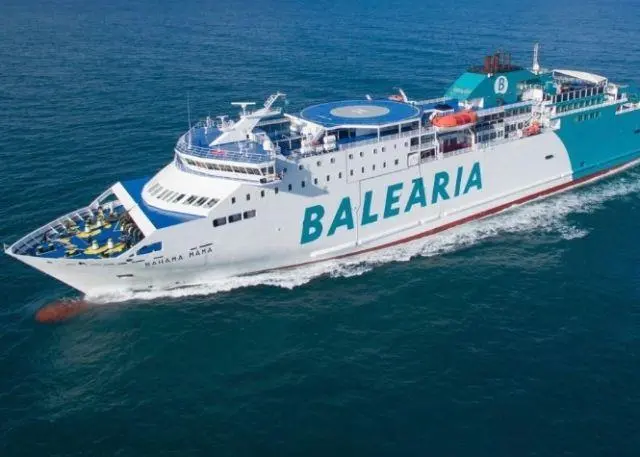
Scheduled to enter service during the opening quarter of 2021, the 123m catamaran ro-pax ferry Eleanor Roosevelt will provide a showcase for LNG-fuelled, four-stroke engine propulsion in the high-speed vessel sector.
Spanish-built to an Australian design, the Eleanor Roosevelt will rank among the world’s largest twin-hulled ferries, potentially taking the crown among such vessels with a dual-fuel reciprocating main engine plant.
While the Buquebus-owned, 99m wavepiercer Francisco heralded the opening of a new chapter in fast ferry powering in 2013, by employing a dual-fuel gas turbine installation, the impending entrant to the Balearia fleet signals a further important stage in the uptake of LNG by way of her multi-engine, DF medium-speed machinery.She incorporates Incat Crowther catamaran technology for a top speed of 40 knots.
Based in the Mediterranean port of Denia, in Alicante province, Balearia has to date amply demonstrated its commitment to the LNG option through conversion projects involving six existing vessels, plus three DF newbuilds. Eleanor Roosevelt is the third new ship, and follows the two Visentini-type, conventional ro-pax ferries Hypatia de Alejandria and Marie Curie, commissioned last year. Hypatia de Alejandria was the first LNG-powered ferry to enter service in the Mediterranean.
Total investment in the programme for nine LNG-capable vessels to date amounts to EUR362m (US$422m). The strategy does not end there, however, as the company expects to have all its fleet running on LNG within the next eight years.
While Balearia has received a measure of subsidisation from the EU for the power conversion projects, the scale of its expenditure in LNG powering is scarcely matched anywhere worldwide. The endorsement of LNG on mainly environmental grounds not only reflects the increasing legislative pressures on the industry but also corporate goals as to social responsibility and economic profitability.
Albeit a hydrocarbon fuel, use of LNG implies a reduction of CO2 by 30%, NOx by 35%, and the elimination of sulphur and particles, having an immediate effect on air quality and greenhouse gas creation.
Commanding a contract price of around EUR90 million (US$90m), Eleanor Roosevelt was launched during September from the Gijon premises of Astilleros Armon. Capacity for 1,200 passengers is complemented by vehicle deck space corresponding to a ro-ro payload of 450 cars, or up to 500 lane-metres of trucks plus 250 cars.
The newbuild is a testament to the versatility of the productive shipbuilding and allied sector in northwest Spain, drawing on outside fields of particular expertise, not least Wartsila’s engineering and propulsion technology and Australian designer Incat Crowther’s know-how in fast, lightweight forms. Inputs from the domestic cluster have included engineering support by Cotenaval of Valencia and architectural and interior work by Oliver Design of Madrid.
Eleanor Roosevelt provides a further reference for the Wartsila 31 four-stroke, medium-speed engine platform, distinguished by its class-leading fuel efficiency rating, modular design and availability in diesel, dual-fuel and pure gas versions. While the diesel yields the highest cylinder power in its segment, at 610kW, the dual-fuel variant still gives a relatively potent 550kW per cylinder at the crankshaft speed of 750rpm.
The adoption of four 16-cylinder models in the Balearia cat, at 8,800kW per unit, thereby makes for a primary power concentration of 35,200kW, transmitted through four Reintjes SLVJ850 gearboxes to a corresponding number of Wartsila waterjets of the LJX1500SR type.
In gas mode, the W31DF installation ensures IMO Tier III compliance, and the proprietary Wartsila LNGPac system’s storage tanks give the ferry a range of 400 nautical miles sailing only on natural gas. The reach is increased to 1,900 nautical miles with switchover to diesel, conferring both deployment flexibility throughout Balearia’s route network and service dependability in the event of any fuel supply issues. As a long-term contingency, the engine type lends itself to ready adaptation to pure gas operation, if required, or to the ingestion of renewable fuels.
The integrated power and propulsion system provides for schedules requiring laden service speeds of 35 knots, and a top speed in the order of 40 knots.
The isolated superstructure lessens transmission of noise and vibration to the passenger areas, while the latest iteration of Incat Crowther’s proven hull form, application-specific centreline bow, and retractable centre T-foil are designed to enhance comfort in difficult sea conditions. Hydrodynamic modelling and testing was carried out in Norway by Marintek-Sintef.
Certain features of the passenger spaces and seating layout have been adapted in light of the ongoing health crisis. On a fleet-wide basis, the company has taken an initiative that puts it in the vanguard of the industry for pandemic protection measures. Bureau Veritas (BV) certification to the society’s Global Safe Site Covid 19 criteria confirms that Balearia has implemented specific procedures, cleaning plans, organisational and personnel measures to combat Covid 19 aboard its ships and at terminals under the company’s management.
The level of certification, designated Excellence, means that periodic testing will be carried out for the presence of the virus on surfaces, using laboratory analysis.
While EUR290m (US$338m) of capital expenditure is encapsulated in the Italian-built sisters Hypatia de Alejandria and Marie Curie plus the Eleanor Roosevelt, the EUR72m (US$84m) commanded by the LNG dual-fuel retrofits to six of the existing fleet has attracted 20% in grant aid under the EU’s Connecting Europe Facility (CEF) provisions. Engine refitting began with the Napoles in 2019, followed by the Abel Matutes and Bahama Mama later that year, the Sicilia and Martin i Soler in 2020, with work on the Hedy Lamarr scheduled for next year.
Towards the end of last December, Balearia introduced the Multi Truck to Ship (MTTS) bunkering method at the port of Valencia. With MTTS, using Kosan Crisplant’s Y-piece solution, LNG can be supplied to the ship from two road tankers simultaneously. This raises the transfer speed of fuel to between 80 and 120m3/h, depending on the size of the trucks’ onboard pumps.
By comparison, the more usual way of bunkering from the quayside from a single tank trailer at a time typically means a transfer rate of some 30-50m3/h. The MTTS modus operandi thereby expedites the whole process, and does not entail high investment relative to the efficiencies gained. At Valencia, the initial fuelling was made to the Hypatia de Alejandria, engaged at the time on the Valencia/Ibiza/Palma run. Balearia signed a 10-year LNG supply agreement with Naturgy (formerly Gas Natural Fenosa) in January 2018.
Balearia’s traditional sphere of influence lies in the routes linking the Spanish mainland with the Balearic Islands (Majorca, Minorca and Ibiza). The company also connects Andalucian ports with northern Africa and the Canary Islands, and runs a service between Fort Lauderdale and the Bahamas. Expansion in foreign markets is a key goal, such that new connections are planned to North Africa and in the Caribbean.
PRINCIPAL PARTICULARS – Eleanor Roosevelt
|
Length overall |
123.3m |
|
Beam |
26.0m |
|
Depth |
7.8m |
|
Draught |
3.4m |
|
Passenger capacity |
1,200 |
|
Ro-ro capacity(cars) |
400 cars |
|
Ro-ro capacity(mixed) |
500 lane-m(trucks) + 250 cars |
|
Propulsion machinery |
LNG dual-fuel medium-speed |
|
Main engine power |
4 x 8,800kW |
|
Propulsors |
4 x waterjets |
|
Speed, service |
35kts |
|
Speed, maximum |
40kts |
|
Generators |
2 x 210ekW + 2 x 236ekW |
|
Class |
BV |
|
Flag |
Cyprus |
Related Articles
 PROPULSION
 GENERAL NEWS
 HYDROGEN