



HYDROGEN-POWERED CONTAINER SHIP READYING TO SAIL THE RHINE
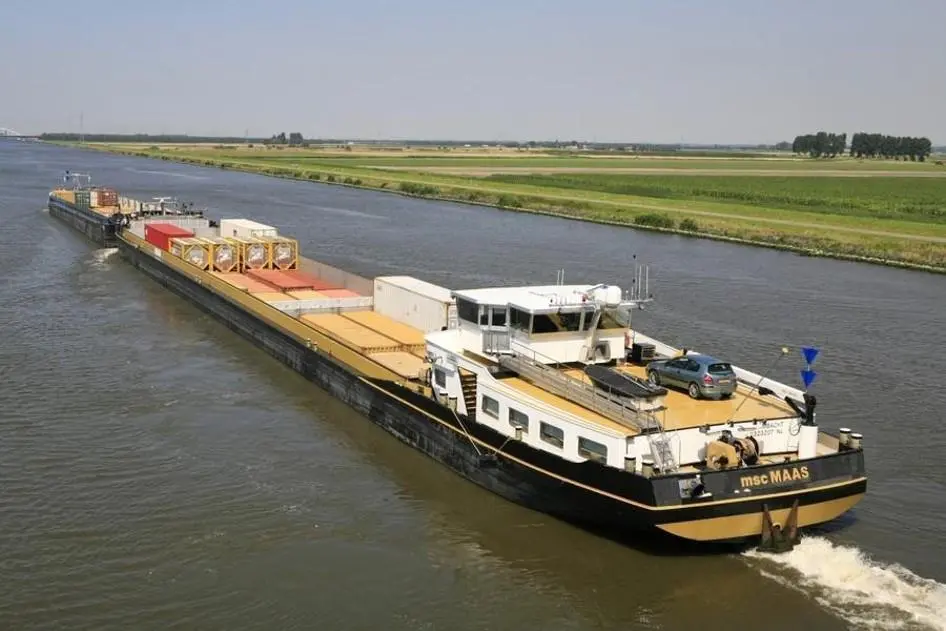
The retrofit project is being led by Netherlands-based zero-emissions marine transportation service provider Future Proof Shipping (FPS) in partnership with terminal operator BCTN and Holland Shipyards Group.
FPS has trialled the technology and benchmarked energy consumption as the 110-metre Maas carried containers along the Rhine River between Rotterdam and Belgium. The old diesel engines will be removed and the new zero-emission propulsion system design finalised ready for full-time operation in 2021.
The modular propulsion system consists of electric motors, hydrogen tanks, a PEM fuel cell system and a battery system. The hydrogen tanks, fuel cells and battery system are separate units that can be removed for maintenance or replaced as upgraded equipment comes to market.
“For now, we are looking at swappable compressed hydrogen containers that are placed on the deck,” says FPS Senior Integration Advisor Milinko Godjevac. “Based on future developments, we might choose liquid hydrogen or other hydrogen carriers, but at the moment, there is no infrastructure for bunkering in place, and swappable containers provide sufficient fuel with minimal loss of space.”
The hydrogen and fuel cell system is installed in the cargo space of the vessel, with the hydrogen being placed above the fuel cell system in two 40ft containers (approximately 900kg at 300 bar). The fuel cell system will have a triple redundant 825kW installed fuel cell capacity to provide propulsion and auxiliary power and a 504 kWh lithium ion battery pack for peak shaving, secondary and bridging power. The system includes a 750V DC bus bar, e-motor for propulsion and additional sensors.
Hydrogen has low volumetric energy density and therefore requires more storage space than diesel fuel. It is also highly flammable, and in combination with high pressures has the potential to explode. This has called for additional safety measures in the design of ventilation, leakage detection, fire detection and fire suppression systems. Natural ventilation is being used where possible, but, for example, while the vessel’s old diesel engines required one air inlet and one exhaust, three separate inlets and three separate outlets are required for the fuel cell room. The battery system also needs additional routes for ventilation and air conditioning.
“Besides these implementation challenges, we have faced challenges related to the technological and legislative readiness,” says Fokke van der Veen, Director Operations at FPS. “For many of the project components it has been necessary to work closely with the equipment suppliers, classification societies and legislative authorities.”
Hazard identification analysis has been conducted with Lloyd’s Register, and as regulatory requirements for hydrogen propulsion systems are not yet fully defined, FPS is using a derogation of inland waterway rules for low flash point fuels.
Over the next five years, FPS aims to build and operate a fleet of 10 zero-emission inland and short-sea vessels based on long-term time charter contracts with operators, logistics service providers and cargo owners/shippers. The company provides advisory and project development support via its integrated management, technical, financial and commercial services.
“We will retrofit existing diesel-propelled ships in partnership with other investors or current owners of the vessel who are looking to adopt a zero-emission business model,” says Prasanna Colluru, Director Corporate Strategy at FPS. “The vessels could also be newbuilds and will be owned by FPS, or in partnership with other investors. In addition to demonstrating that zero-emission propulsion is technically and commercially feasible, we are also a tonnage provider, offering zero-emission inland and short-sea vessels for charter.”
Related Articles
 ALTERNATIVE FUELS & LUBRICANTS
 ALTERNATIVE FUELS & LUBRICANTS
 ALTERNATIVE FUELS & LUBRICANTS