



Zero-emission can be a reality today
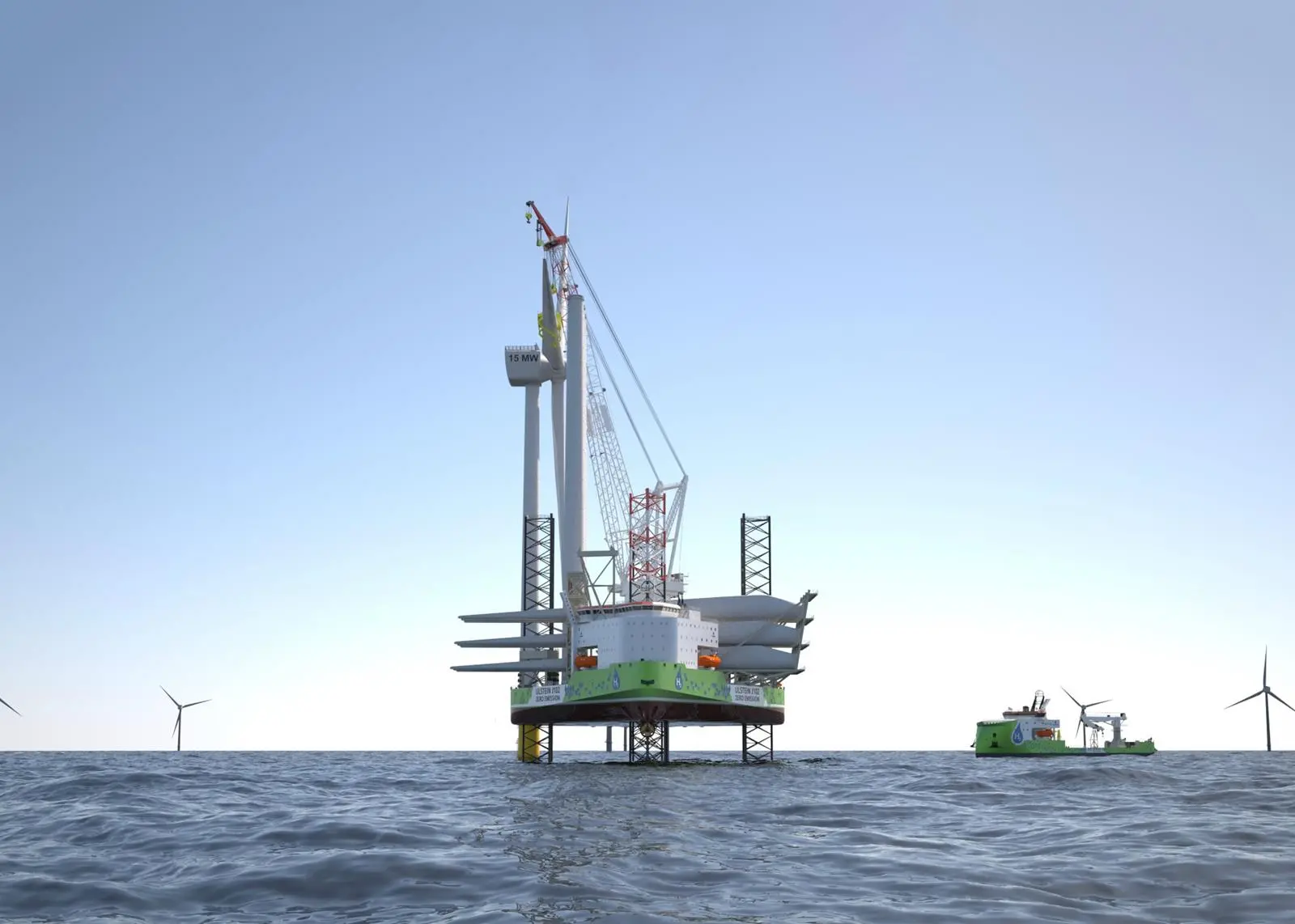
The company’s second hydrogen hybrid design for the offshore wind industry, the Ulstein J102 zero-emission wind turbine installation vessel (WTIV), can operate 75% of the time in zero-emission mode.
Most new jack-up designs feature a battery hybrid system in addition to diesel gen sets. This is not optimal for a WITV design, where weights savings are essential, owing to the heavy weight and cost of a high-power battery energy storage system.
Rather than make a design that is prepared for future hydrogen powered fuel cells, Ulstein has taken a pragmatic approach. “We have carefully analysed the operational cycle of WTIVs and looked at the power demand in the various modes of operations,” said Ko Stroo, product manager at Ulstein.
“This analysis showed that around 75 per cent of its time, a WTIV is in jacked-up position performing crane operations. Using a combination of a hydrogen fuel cell system and a relatively small battery energy storage system is sufficient to meet the overall power demand on board and crane peak loads,” he added.
The hydrogen hybrid system of the Ulstein J102 design has been developed so that future developments in hydrogen technology can easily be fitted into the vessel without major modifications.
Related Articles
 ALTERNATIVE FUELS & LUBRICANTS
 ALTERNATIVE FUELS & LUBRICANTS
 ALTERNATIVE FUELS & LUBRICANTS