



TURBOMACHINERY SPECIALIST ENOGIA ENTERS MARINE FUEL CELL MARKET
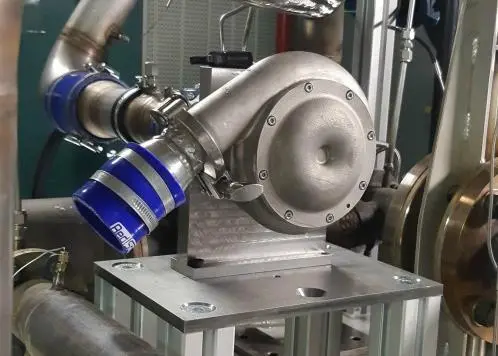
The technology is suitable for any type of hydrogen fuel cell, including the PEM and SOFC systems used in the stationary, mobility and marine markets.
Feed Air Delivery Compressors are required because while hydrogen is stored at high pressures, the air needed by a fuel cell to generate power is sourced from the atmosphere and needs to be compressed prior to injection inside the stack.
Recirculation Anode Blowers are optionally used because some residual hydrogen is usually lost at the fuel cell outlet, reducing efficiency. Blowers give integrators the option of recirculating this residual hydrogen back into the stack. Enogia’s hermetically sealed blowers are built with robust and corrosion resistant materials that are able to withstand gas temperatures up to 800°C.
“Enogia’s turbomachinery is designed specifically for each system so that integrators achieve better efficiency than obtained from off-the-shelf components”, says Pierre Marty, Hydrogen Business Developer at Enogia. He cites the superior performance/volume ratio and the low power consumption. Both are proven by an independent testing laboratory.
The compressors are optimised for a wide operating range. “This is the main advantage of our technology; we optimize our turbomachinery by keeping fluctuating design conditions so that our products have a wide operating range. Except in some specific cases, a fuel cell is not always delivering constant power. Enogia’s technology is fully adaptive and therefore enables the fuel cell to run with the best efficiency at all times and with any stack load,” says Marty.
The turbomachinery components also adapt to the life status of the stack, he says, whether it is Beginning of Life or at its End of Life, as the aging of the stack also imposes variation of operating conditions.
The choice of single or twin stage compressor is a design decision based on a compromise between rotation speed and pressure ratio. “For lifetime and maintenance reasons we tend to lower the rotation speed. Therefore, depending on the pressure ratio needed by the stack manufacturer, we will design a single or a multiple stage system,” says Marty. “Our patented architectures result in very compact turbomachinery components, even for a twin-stage compressor, which is crucial for embedded applications, for example.”
The turbomachinery has also been adapted to fuels other than hydrogen as regeneration compressors working on gas mixtures such as hydrogen, carbon monoxide, carbon dioxide and water.
Karl Terral, Marine Applications Business Developer at Enogia, anticipates great potential for hydrogen propulsion in coastal passenger ships and short route passenger vessels, and sees Europe as a first mover as a result of wide-spread government support. “River transportation is an excellent candidate for hydrogen propulsion; we have high hopes this sector will develop some great projects. Also, with the will to develop bigger fuel cells of several MW, hydrogen stacks will soon be integrated on cargo ships.”
At this stage, details of orders are being kept confidential, but Terral says that the company is working on a demonstrator for a 50kW SOFC stack, on the supply of components for 100kW and 200kW PEM stacks, as well as other very specific projects.
Terral says it is important that clients receive optimized turbomachinery components that meet their specifications. Enogia uses a standard performance model to produce the design with a very short lead time. Enogia also has the capacity to supply in series production once the prototype has proven satisfaction.
Related Articles
 ALTERNATIVE FUELS & LUBRICANTS
 ALTERNATIVE FUELS & LUBRICANTS
 ALTERNATIVE FUELS & LUBRICANTS