



COMPRESSED H2 CARGO SHIP DESIGN
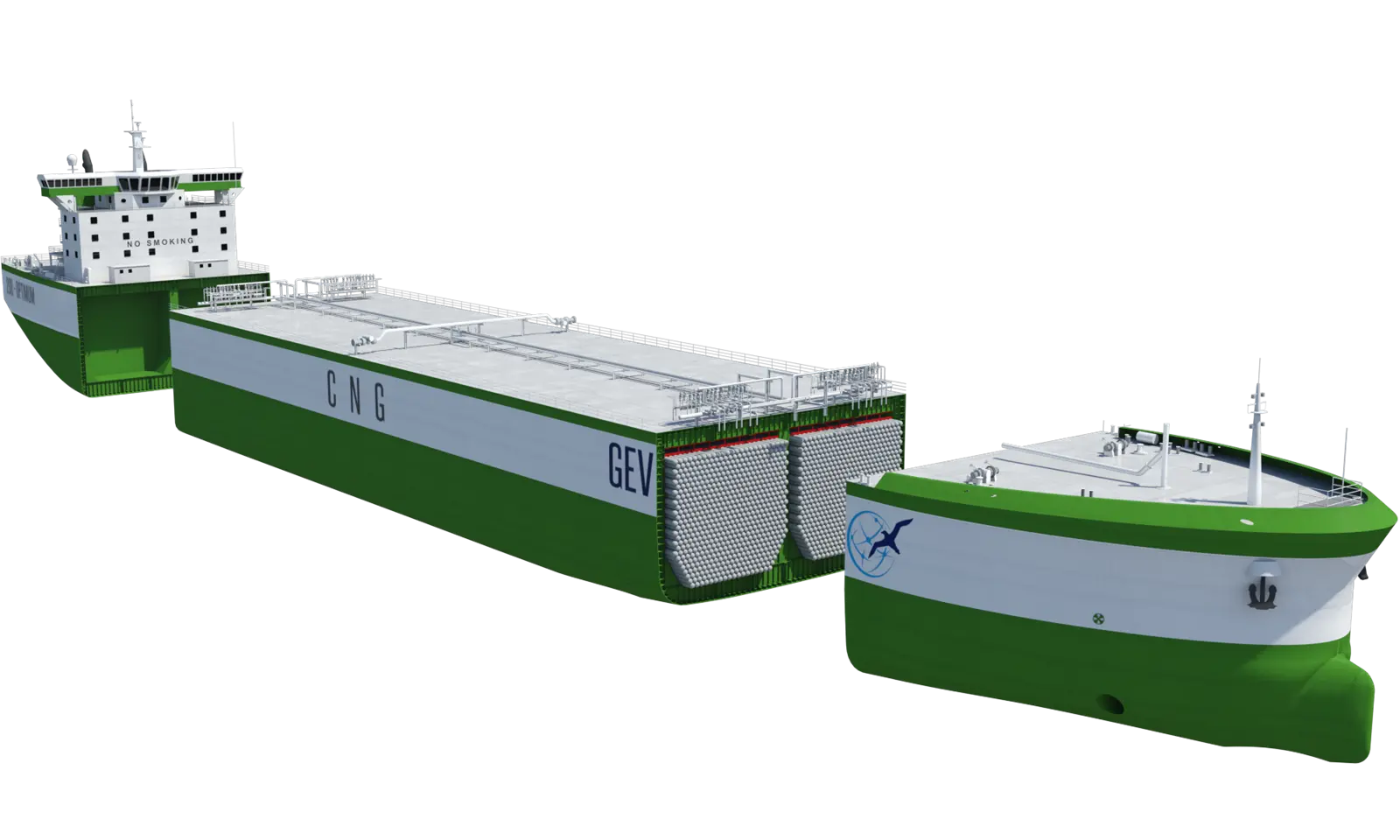
Martin Carolan, Executive Director, Corporate & Finance of Global Energy Ventures (GEV), says he anticipates the specialised vessel will be able to transport 2,000 tonnes (23 million cubic metres) of hydrogen economically over a range of 4-8,000 kilometres, for example from Australia’s Pilbara region to Singapore, South Korea or Japan, depending upon the market price of hydrogen.
“Over the course of 2020, the company has been closely monitoring the growing support for hydrogen as a clean energy source. In our view, the application of GEV’s compressed hydrogen vessel will be very competitive against other marine transport options, particularly to Australia’s regional Asia Pacific customers.”
Australia has a national hydrogen strategy focussed on building hydrogen supply chains and large-scale export industry infrastructure, and its National Hydrogen Strategy, released in 2019, is supported by $500 million in funding. Australia also has a track record for developing major energy infrastructure projects, an abundance of cheap renewable energy and a technology road map aimed at creating an industry to ship hydrogen to Asia Pacific customers who are already building a new hydrogen industry to replace natural gas. This year, the government announced a commitment to spend $1.9 billion on renewable R&D over 10 years.
“There is a growing list of Australian hydrogen projects moving through successful pilot and into domestic scale-up phase that have export plans,” says Carolan. “GEV recognises the key to driving down the economics of hydrogen production will be scale, and the key to scale will be developing an export industry.”
He says that the advantage of compression for the regional transport of hydrogen is the simplicity and energy efficiency of the supply chain, particularly when compared with the energy intensive nature of liquefaction, ammonia or chemical carriers for the hydrogen.
Patent pending compressed hydrogen containment
The ship’s containment system will store ambient temperature hydrogen at a target pressure of 3,600 psi (250 bar). Details of the system are yet to be made public as a patent application is pending, but Carolan says it will not be the same pipe structure as the company’s compressed natural gas (CNG) carrier design that received full design class approvals for construction in 2019. The CNG Optimum ship design has a capacity of 200 million standard cubic feet, with the containment system constructed using hexagonal close-packed, high strength pipes that run the entire length of the cargo hold. The simplicity of the design and the invention of a mechanism to clamp the gas storage pipes so tightly together that they become locked together as one allows the design to meet all classification requirements.
This is not an efficient design option for hydrogen storage, as the potential for embrittlement of the pipes would require lining the 130 kilometres of pipe inside CNG Optimum’s containment system – an expensive option, says Carolan. The loading and unloading process could, however, involve a similar pipe-to-pipe approach with equipment suppliers already looking at hydrogen capable solutions. “The company’s hydrogen ship design will optimise the volume of hydrogen that can be stored in the hull of a ship utilising compression in order to achieve the capacity of 2,000 tonnes (23 million cubic metres),” said Carolan.
GEV has appointed Capilano Maritime Design as naval architects and ABS for class approvals required for the hydrogen ship and expects to receive Approval in Principle for the design in the first half of 2021.
Related Articles
 ALTERNATIVE FUELS & LUBRICANTS
 ALTERNATIVE FUELS & LUBRICANTS
 ALTERNATIVE FUELS & LUBRICANTS