



FIRST NAVAL ORDER FOR HULL VANE SETS SIZE RECORD
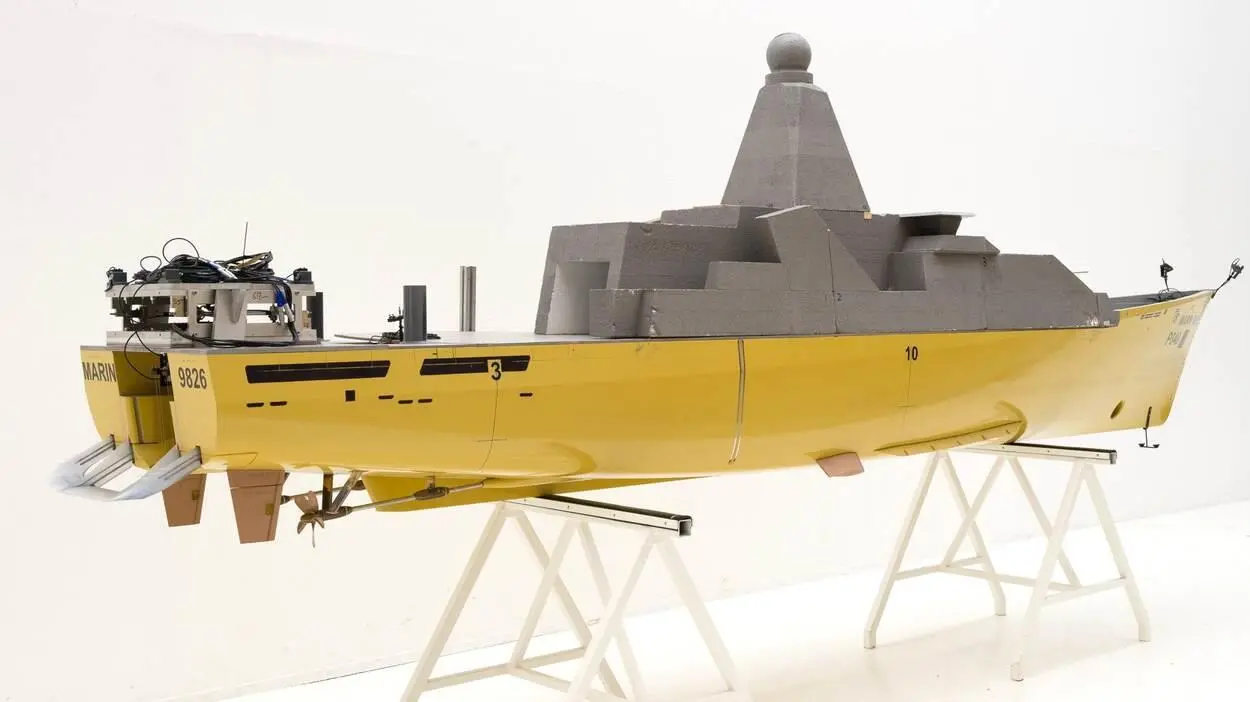
The horizontal wing will convert energy from the ship’s stern wave into forward thrust. It creates an accelerated flow of water over its upper surface, producing a low-pressure region behind the vessel that supresses its stern wave similar to the way a bulbous bow suppresses a vessel’s bow wave. The wing’s hydrodynamic profile has been designed so that the thrust it generates is greater than the drag it creates.
The Hull Vane will be made of high-strength shipbuilding steel. “This material has the best strength, stiffness and fatigue properties for this application,” says Bruno Bouckaert, Sales Director at Hull Vane. “Most of our Hull Vanes are built of steel, but we have built five of aluminium and one of composite (full carbon).”
The Dutch Defence Materiel Organisation confirmed the Hull Vane order after an extensive research project during which the Hull Vane was first optimised using Computational Fluid Dynamics (CFD) and then tested extensively at MARIN.
Its main benefit is a reduction in fuel consumption, expected to be at least 10%. This reduces emissions and operating costs and is potentially a tactical advantage if fuel becomes scarce. The vessel’s top speed will increase, and the reduced stern wave will lessen the vessel’s visibility from aircraft and satellites.
As the Hull Vane dampens the ship motions in waves, the helicopter deck will move less, making it easier to land in rough weather. This is also the case for the slipway in the stern, making the launch and recovery of the Fast Riding Interceptor Special Craft (FRISC) easier. Model tests have also indicated a significant reduction in bow slamming, leading to improved comfort on board.
“In heavy sea states, there is an additional benefit, because the Hull Vane reduces the pitching motions, which leads to less added resistance from waves (the bow is buried less in waves), and because of what we call the “pumping effect”. We know from model tests with force measurements on the Hull Vane and from CFD that when the ship is pitching, it gives an angle-of-attack variation on the Hull Vane which makes it produce more forward thrust. You can compare this effect with the ‘Aquaskipper’ or with the way hydrofoil surfers ‘pump their foil’ to go back outside. Hence the name ‘pumping effect’: the ship pumps the Hull Vane.” Sailing astern, there is no noticeable difference, as the angle of attack on the foil is zero.
The Hull Vane is passive and requires no interaction from the crew. It has no effect on the vessel’s propulsion or steering systems either. “The length-over-all will be increased by a few meters, and during the retrofit, the ship’s trim wedge will be removed for the most part,” says Bouckaert. The ship’s weight will be increased by less than one percent. It is anticipated that the ship will carry less fuel onboard to cover the same range at the same speed as before, which will be a weight saving.
An evaluation study of a prototype Hull Vane, before optimisation, predicted that total resistance will be reduced by 15.3% when sailing at the speed at which most fuel is consumed annually (17.5 knots). The study predicted an increased range from 5,000 to 5,850 nautical miles at 15 knots and an increased top speed from 21.5 knots to 22.1 knots. However, Bouckaert says precise figures for the optimized system won’t be made public until after sea trials.
The study also predicts that the results of installing a Hull Vane would be significantly more favourable if fitted to the OPVs as newbuildings. If planned for at the design stage, hull lines could be optimised and propulsion power and fuel tank capacity could be reduced.
Hull Vane has been on the market since 2014, and the project marks the company’s 40th order. In addition to patrol vessels, the device has been installed on superyachts, naval ships, fast supply vessels and passenger ships. The company says that energy savings of between 5% and 20% are typical.
“Most large cargo ships (tankers, bulk carriers, large container ships) sail too slow for Hull Vane to be effective, especially since slow-steaming and super-slow-steaming has been implemented the last 10 years,” says Bouckaert. On large ships such as a 300-metre container ship, Hull Vane would be effective at the design speed of 24 knots but not at their current operating speed of 18 knots. It would, however, be effective on small or medium sized container vessels and roro and ropax vessels of 100-200 metres in length.
Related Articles
 PROPULSION
 GENERAL NEWS
 HYDROGEN