



LEADING LIGHTS BACK FUEL CELL RESEARCH
Research into fuel cells for marine applications has been largely inspired and underpinned by publicly-funded schemes, at both national and EU levels, and has provided a considerable knowledge base. But as yet negligible use of fuel cells in commercial shipping belies the extent of R&D resourcing of the technology. A recent acceleration in projects initiated by the industry, and in some cases without a call on public financial sponsorship, has strengthened the prospect of a take-up of viable systems.
Of course, the environmental case for such alternatives or supplements to time-served marine power plant has to be balanced by both efficacy and affordability, albeit on the basis of a longer-term and highly circumspect assessment of cost effectiveness.
As well as producing fewer or no missions (zero emissions if fuelled by hydrogen), and minimal noise and vibration, fuel cells are claimed to offer efficiency across the load profile. The absence of moving parts implies reduced maintenance and fewer points of potential failure, and the modularity favours decentralised power output and thermal energy management, plus more freedom as to shipboard location.
Nonetheless, the initial investment cost is high in relation to conventional systems. Many issues as to the availability and cost of fuel, procedures for fuel handling and bunkering, and regulatory aspects have still to be fully addressed, approved and set in place. Much of the activity has been focused around South Korea, which has embraced fuel cell technology for stationary applications, and is currently the world’s largest market for the technology.
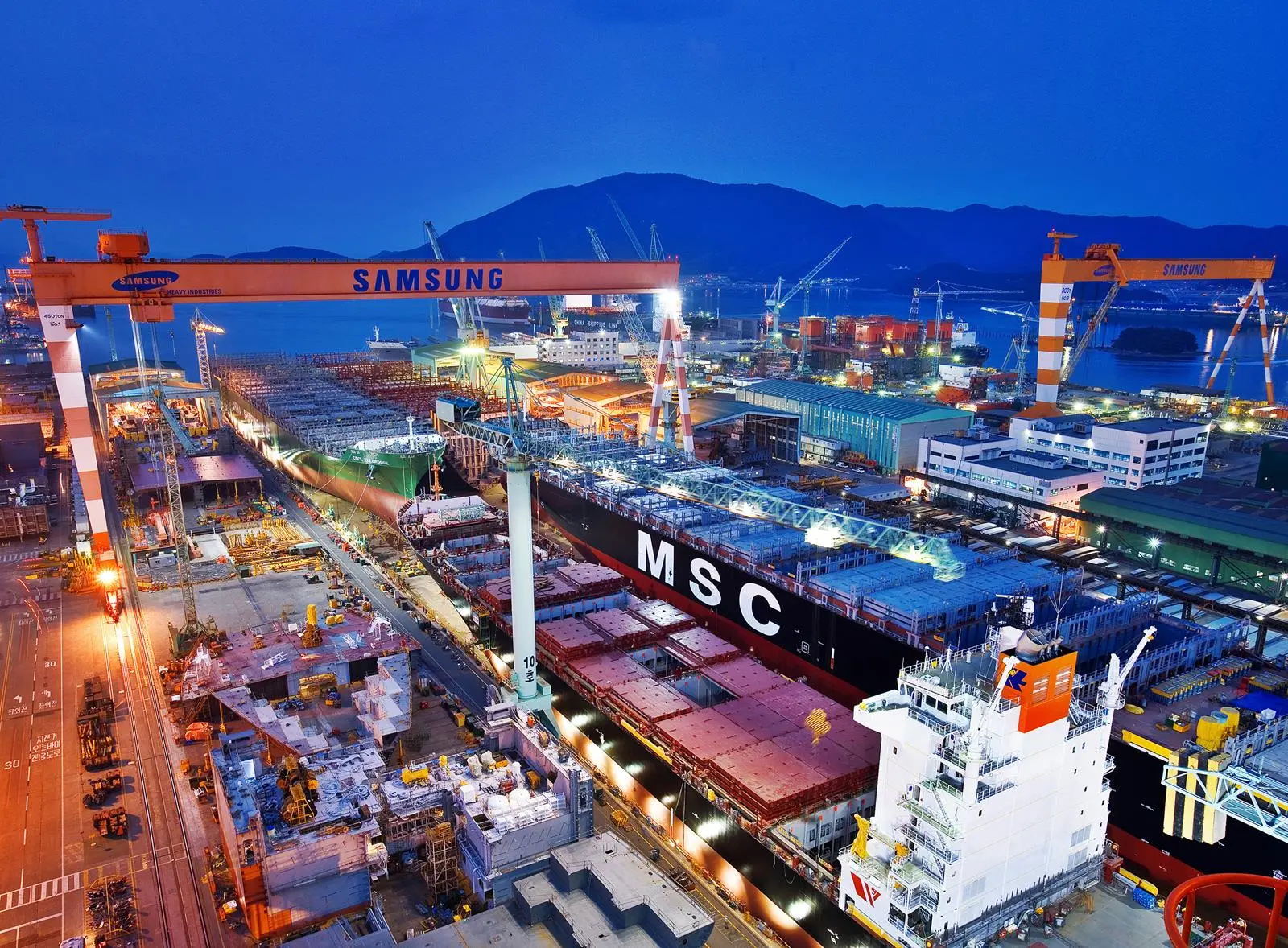
The Motorship reported in September that Samsung Heavy Industries was planning to launch a 174,000m3 LNG carrier new building by the end of 2022 powered by 30MW of LNG-fuelled solid oxide fuel cells, based on US developer Bloom Energy’s technology.
The world’s largest, independently-owned tanker pool operator, Singapore-based Navig8, has given extra weight to endeavours to bring fuel cells into the mainstream powering scenario by entering into an agreement with Doosan Fuel Cell Co. Building on the South Korean firm’s prominent role in stationary FC systems, joint development work will be implemented to devise solutions suited to the merchant shipping industry.
A prototype installation of a solid oxide fuel cell (SOFC) is provisionally planned for a 50,000dwt petrochemical tanker ordered by Navig8. The plant would serve as a technology demonstrator. LNG is likely to be the fuel of choice in the first phase of development, to be followed by investigations into ammonia and hydrogen.
In a newly-signed joint development project, Daewoo Shipbuilding & Marine Engineering will review the feasibility of substituting one of three diesel gensets typically found on a VLCC by an SOFC. As a further endorsement by influential South Korean shipbuilders of the scope offered by fuel cells in combating greenhouse gas (GHG) emissions, Samsung Heavy Industries has obtained approval in principle from DNV GL for an Aframax crude carrier type in which the characteristically high auxiliary power requirement is met not by gensets but by SOFCs running on LNG.
Hydrogen-fuelled development
A number of European developments are focusing on hydrogen-fuelled technologies. There surely has hitherto been no marine fuel cell project as ambitious as the recently announced collaboration which foresees a hydrogen PEM FC installation producing 23,000kW to propel a Nordic ro-pax ferry by 2027. The power rating is around five times greater than the largest PEM FC systems currently available. Implementation of the scheme is contingent on the Danish-led partnership securing financial support from the EU Innovation Fund, such are the development cost implications of the upscaling and fast-track timeline.
Adopting a compressed hydrogen fuel system reduces the potential range of the vessel compared with liquefied systems, but sidesteps technological, safety and regulatory challenges around cryogenic containment and innovative bunkering infrastructure. The proton exchange membrane (PEM) FC system would be sufficient to power a vessel dimensioned for 1,800 passengers and 120 trucks or 380 cars on a single Copenhagen/Frederikshavn/Oslo rotation. ‘Green’ hydrogen would be bunkered in Copenhagen, produced by electrolysis using offshore wind energy.
DFDS has already this year obtained a grant from the Danish Maritime Fund to test fuel cell technology aboard one of the fleet’s ro-ro freight vessels, the 195m Ark Germania, during the course of her regular North Sea schedule. The ship’s electrical infrastructure will be upgraded for the evaluation of plant of up to 1MW. Containerised plant will be carried on the weatherdeck, plugged into the ship’s net, and connected to the fuel source.
EU money from Horizon 2020 coffers has been allocated this year to a collaborative R&D study, the HySHIP project, to promote hydrogen as a fuel for merchant shipping. A key element of the endeavour will be the design and construction of a demonstration ro-ro vessel fitted with a 3MW PEM hydrogen fuel cell and 1,000kW battery bank, to be operated by Norwegian company Wilhelmsen. Horizon 2020 funding has also been approved for the cross-industry ShipFC project, whereby the world’s first ammonia-powered fuel cell will be installed on a Norwegian offshore supply ship.
Salient to the group’s prolific construction of luxury cruise ships, Fincantieri is constructing an experimental vessel of about 25m in length embracing a hydrogen FC system. Giving form to the Zeus project involving Italian industry and academia, and co-funded by the Ministry for Economic Development, the nascent vessel will be fitted with two diesel generators and two electric propulsion motors, supplemented by a 130kW FC system and battery pack to render a zero-emission sailing range of eight hours at up to 7.5 knots. Applying technology already used in submarines, the hydrogen fuel will be contained in multiple hydride cylinders.
The power rating is similar to that of the hydrogen PEM FC which Royal Caribbean has nominated for its Icon-class generation of 200,000gt cruise ships, the first of which is due to be handed over by Meyer Turku in 2023. Viking Cruises also has the goal of adopting a hydrogen fuel cell on a newbuild similar to its Fincantieri-built Viking Star class.
The flurry of investments in demonstration projects illustrates continuing interest in exploring the possibilities of different fuel cell technologies. The demonstration projects themselves do not guarantee feasibility for maritime applications as the rejection of molten carbonate fuel cell (MCFC) as a potential technology demonstrated. Commercial prerequisites for the uptake of the technology in commercial shipping, and most especially so as to propulsion applications, include a far more extended product range as regards potency, lower capital cost, increased compactness, and ready availability of the energy carriers (fuel).
Related Articles
 ALTERNATIVE FUELS & LUBRICANTS
 ALTERNATIVE FUELS & LUBRICANTS
 ALTERNATIVE FUELS & LUBRICANTS