



Germans double up on hydrogen testing
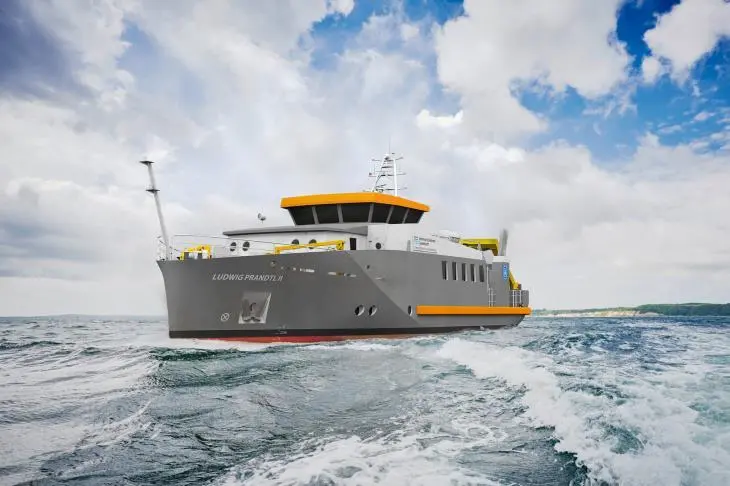
Parliament’s Budget Committee approved €13.5 million for a new 30m coastal research ship called Ludwig Prandtl II for the Helmholtz Centre for Materials and Coastal Research (HZG) in Geesthacht.
The German Government’s Maritime Industry Co-ordinator Norbert Brackmann said Ludwig Prandtl II “will be used for the flexible testing of new energy systems with a focus on hydrogen technology”. A separate special laboratory was planned on the ship to test components and their integration into the ship’s energy systems, he said.
Brackmann declared that Ludwig Prandtl II “will be not only a new research ship but at the same time the world’s only research ship with hydrogen propulsion and one which will also be a research project in itself”.
He added: “A new propulsion concept is planned for this ship which has never been realised in this form before and which provides for the combining of fuel cells and membrane modules developed in-house”. And he revealed that engine builders had already expressed interest in being involved in research into membrane module technology.
Tenders for construction of Ludwig Prandtl 11 have not yet been invited, HZG spokeswoman Gesa Seidel told The Motorship. That is however expected to change soon since keel-laying is planned for as early as 2022/23. First, however, a design bureau with expertise in specialist shipbuilding is being sought to handle the planning of the ship.
Initial tender specifications are for a 9m wide ship drawing 1.5m with a 70m2 working deck, 47m2 of laboratory space and a crew of up to three plus12 scientists. Required engine capacity is put at 750kW and top speed at 12 knots.
Volker Dzaak from the Institute for Coastal Research told The Motorship no specific engines or electric motors had yet been selected but that intensive talks with engine makers would be held during the planning stage. Ludwig Prandtl II will replace its 31m x 6.1m predecessor Ludwig Prandtl, which has served with the HZG since 1983. Drawing 1.65m it has two MAN D2842 LE engines of 730kW providing 12 knots.
Twin-hull research ship
The parliamentary Budget Committee also approved a €36 million investment in the development and construction of a twin-hull research ship for the DLR Institute for Maritime Energy Systems. Created earlier this year, the DLR is on the same Geesthacht site as the HZG. Its new ship will co-operate with Ludwig Prandtl II in coastal waters on the development and testing of energy-efficient and low-emission maritime systems for cargo and passenger ships, including the HZG’s planned hydrogen propulsion system.
Few details of the DLR ship, which Robert Brackmann has said is expected into service in 2022, have so far been released. In comments to The Motorship the Director of the Institute for Maritime Energy Systems Alexander Dyck said that, unlike Ludwig Prandtl II, no design study had yet been carried out on the DLR ship.
He noted however that any requirement profile would need to take into account on-board energy supply containers, which he suggested would indicate a ship of some 30 x 9m drawing about 4m.
Dyck said the newbuild would also require the accommodation and performance characteristics of a seagoing vessel. One design which might meet many of the requirements, he indicated, was the SWATH (Small-Waterplane-Area Twin Hull) ship type built for a wide spectrum of applications including research by German shipyard Abeking & Rasmussen.
Related Articles
 2-STROKE & 4-STROKE
 2-STROKE & 4-STROKE
 2-STROKE & 4-STROKE