



UNIQUE PLATFORM FOR ARCTIC RESEARCH
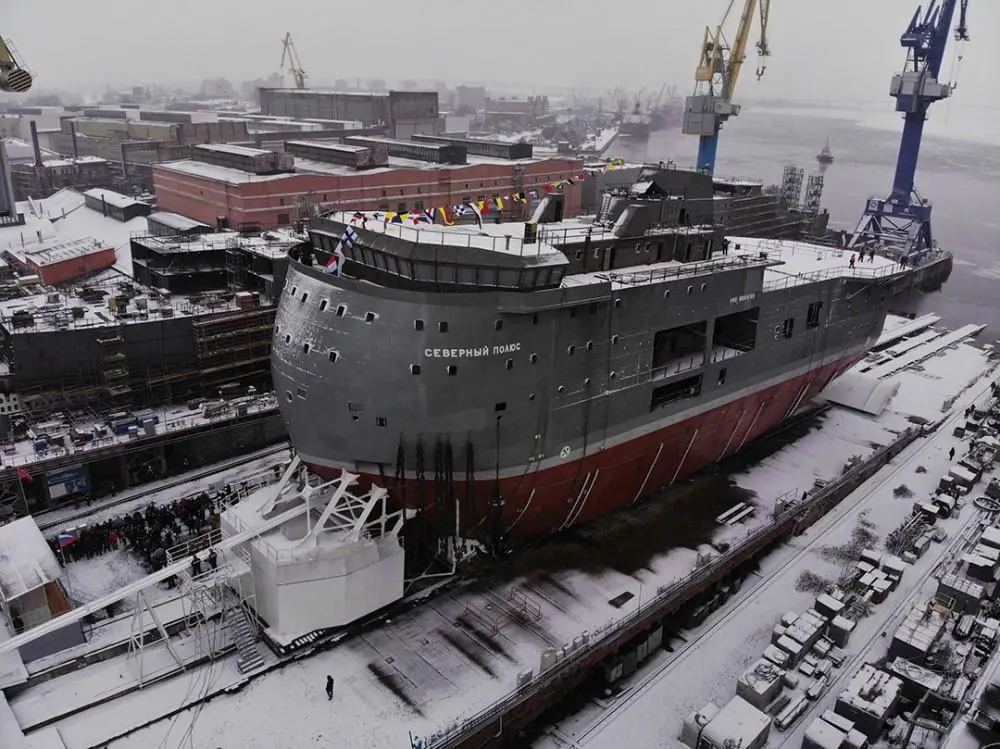
Launched from Admiralty Shipyard’s St Petersburg premises on December 18, the Severny Polyus (North Pole) is described as an ice-resistant, self-propelled platform conceived for long periods of continuous deployment in the Central Arctic.
Built to main dimensions of 83.1m length by 22.5m breadth, the vessel will be operated under joint arrangements between Russia’s Arctic & Antarctic Research Institute and contractual party Roshydromet, the Federal Service for Hydrometeorology & Environmental Monitoring. The extensive outfitting phase of the build project has now begun, with ship commissioning due in 2022.
Severny Polyus is not an icebreaker as such, but has been constructed from special, high-durability steel so as to withstand ice impact and abrasion in normal ‘drift’ mode, conducting research operations while drifting with the polar ice.
The power and propulsion installation will provide for a speed of about 10 knots. Positioning voyages to the drift startpoint will be made during the summer season, when it is anticipated that the vessel will sail independently to the maximum possible extent. However, assistance from dedicated icebreakers will be required in more challenging ice conditions when deploying to and from driftpoints or if switching area of operation.
Propulsion will not be engaged during the long research assignments with the vessel in drift mode. The diesel generator outfit will cover the hotel load and the energy requirement for research work.
The vessel’s endurance will be of the highest order, so as to ensure at-sea service continuity over periods of one to two years, without having to return to port. Re-supply during extended periods of Arctic Ocean duty will be effected by icebreaker, or by transport helicopter of the Mil Mi-8 or Mi-38 type via an aft landing platform.
Severny Polyus will be equipped to undertake oceanographic, sonar, geophysical and geological surveys, and the arrangement will involve a multiplicity of laboratories to cover the range of sciences involved. The platform will also have a hydrometeorological role, to become a key link in the country’s forecasting system for weather and ice conditions, complementing data input from coastal observatories. In addition, the structural performance of the ship herself will feed back into Russian shipbuilding, affording new insights into local and global ice loads on vessels and offshore units.
The design has a displacement of some 10,400t and has been developed by technical bureau JSC Vympel, under the Project 00903 initiative. The result is an unconventional hull form, embodying a rounded foreship, very high freeboard, and enclosed or protected deck areas and passages. The rigid structure features eight transverse bulkheads, and the high-strength hull accords with Arc8 criteria. Acoustic devices are located in an under-keel housing.
Main engine power is 4,200kW, with the installation serving a single, 3,500kW podded propulsor and a bow thruster. Accommodation will be laid out for 14 crew and up to 34 scientific personnel and technicians, and consideration has been given throughout to onboard comfort due to the long duty cycles in driftage.
Severny Polyus will allow the resumption of regular studies of the natural environment of the Central Arctic, suspended in 2013 and hitherto primarily sustained through the longstanding practice of ‘drifting’ ice stations. Climate change, creating increasing difficulties in finding solid ice to bear such stations, coupled with the growing economic, logistic and strategic importance of the Russian Arctic, has promoted the development of the new research solution.
Related Articles
 PROPULSION
 GENERAL NEWS
 HYDROGEN