



CRANE SHIP FOR BIGGEST WINDFARM LIFTS
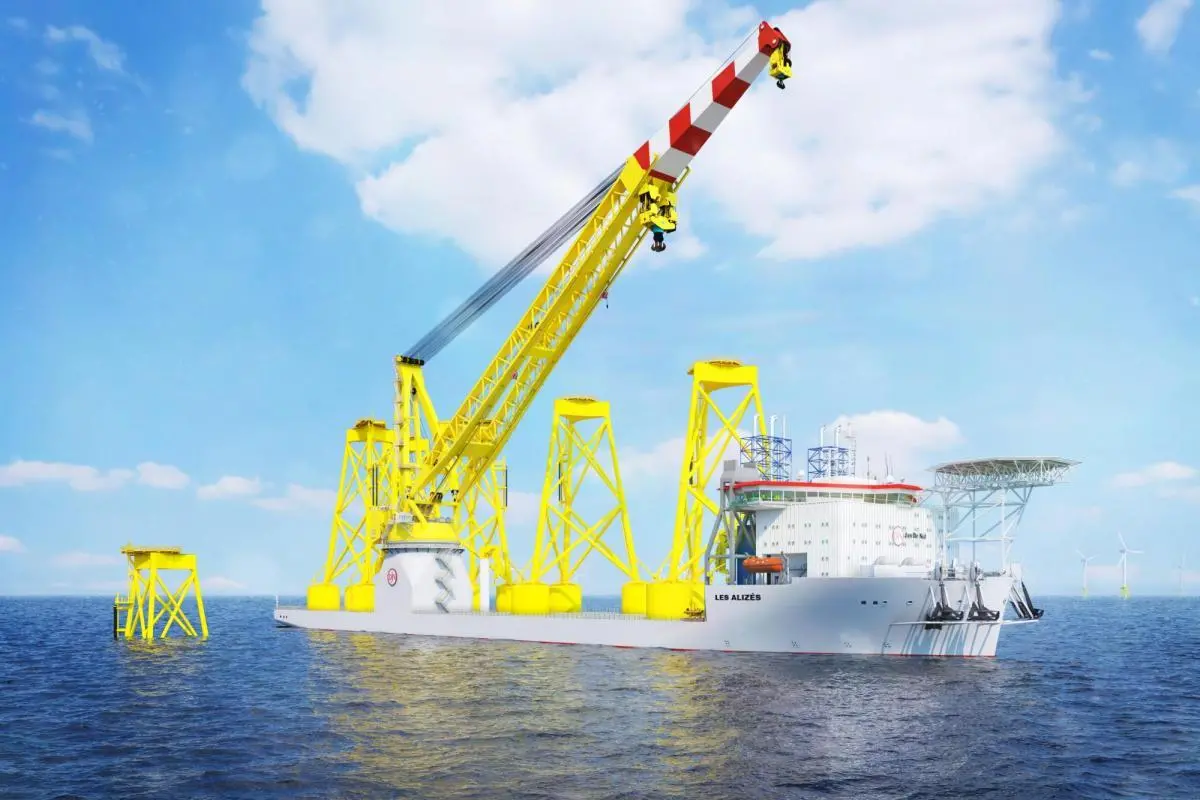
Growing investment in vessels that can meet accelerated and ever-more exacting demand from the offshore renewables market figures prominently in the multi-faceted fleet development and renewal strategy of the Luxembourg-headquartered Jan De Nul construction and dredging group.
A highlight of the programme is a 237m newbuild incorporating a 5,000t lift-capacity crane, and engineered to Ultra Low Emission vessel (ULEv) standard, on which steel cutting commenced during early December. Designed to effect installation work afloat rather than in jack-up mode, the ship is due to enter service in 2022 under the name Les Alizés (Trade Winds).
The project denotes further penetration of the high value-added shipbuilding sector by China, with the contract having been assigned to China Merchants Heavy Industry’s Haimen shipyard, Nantong City.
The rationale for the considerable handling capacity embodied by Les Alizés is the global trend in the offshore wind energy sector towards ever-larger wind turbines. These can stand at heights of more than 270m, carrying blades as much as 120m in length, and mounted on foundations weighing up to 2,500t.
With a cargo deck area of 9,300m2, the newbuild will be able to load out, transport and install multiple units of the heaviest components in one trip, yielding direct benefits in planning, project execution and fuel consumption. As an alternative to a jack-up vessel, the DP2-fitted crane ship will effect installation afloat, extending the operating scope to deeper waters and more challenging seabed conditions.
Besides the capability to build the next generation of wind farms, the ship has the wherewithal and layout to undertake the decommissioning of offshore oil and gas platforms.
Design, engineering and manufacture of the ship’s 5,000t capacity tub-mounted crane (TMC) is the responsibility of Dutch specialist Huisman, which has assigned construction to its Xiamen facility in China. The company said the unit is the largest of its type and application ordered to date for installation on a monohull vessel.
The TMC is designed to allow continuity of operations with both main and auxiliary hoist in extreme weather, and will incorporate Huisman’s dual main hoist system for upending large structures. It will also feature a segmented slew bearing, an electric drive system, and an automation package that will allow for future crane upgrading.
Ingeteam has been appointed as the electrical system supplier and integrator, covering power generation and distribution, propulsion motors, and power management system, plus the alarm monitoring and control arrangements. Primary products from the Indar range will be manufactured at the company’s premises in the Basque region of northern Spain.
The six Indar main generators of 8,640kVA, supplying AC current at 11,000V, have been specified with 12-cylinder MAN medium-speed, common-rail engines of the V32/44CR type, each rated at 7,200kW, giving a primary power concentration of 43,200kW. The Indar 315V AC motors for the multiple, main azimuthing propulsors and manoeuvring thrusters will all be driven by Ingedrive MV100 DFE frequency converters.
Exhaust gas treatment technology employed on the ship has two elements, whereby a diesel particulate filter, claimed to offer a 99% effectiveness in removing nanoparticles, is followed by a tailored MAN selective catalytic reduction(SCR) system. This not only ensures Tier III NOx compliance but also meets the even stricter Euro Stage V limit. The enhanced NOx reduction rate is essential to achieve the Ultra Low Emission vessel (ULEv) categorisation sought by the owner. Furthermore, the arrangements will satisfy Clean Ship ND07 and Green Passport EU certification criteria.
The common-rail system’s flexibility permits the engine to be programmed to run in accordance with different fuel consumption-versus-power characteristics, optimising efficiency at the respective load points. The optional ECOMAP feature that has been chosen applies various engine ‘maps’ to improve fuel economy while meeting IMO emission limits.
The main propulsors are four electrically-driven Schottel rudder propellers of the SRP 610FP type, each rated for an input power of 3,000kW. With this configuration, Les Alizes should be able to make transits at up to 13 knots. So as to ensure precise positioning in DP mode, two retractable SRP 610R units of 3,250kW apiece and two STT 7FP transverse thrusters of 2,600kW will be adopted. The Schottel package also includes the proprietary Leacon sealing system, designed to continuously check the seals for leaks and prevent water from entering the gearboxes.
Jan De Nul also has a jack-up offshore installation newbuild taking shape in China. Ordered from COSCO Shipping Heavy Industry, the Voltaire has been specified with a 3,000t crane and is seen as complementary to Les Alizés.
PRINCIPAL PARTICULARS – Les Alizés
|
Length overall |
236.8m |
|
Breadth |
52.0m |
|
Depth, moulded |
16.0m |
|
Draught, maximum |
10.5m |
|
Deadweight |
61,000t |
|
Main crane capacity |
5,000t |
|
Cargo deck area |
9,300m3 |
|
Propulsion system |
Diesel-electric |
|
Main generator engines |
6 x 7,200kW |
|
Main propulsion thrusters |
4 x 3,000kW |
|
Bow thrusters |
2 x 2,600kW |
|
Retractable thrusters |
2 x 3,250kW |
|
Harbour genset |
1,700kW |
|
Speed |
13kts |
|
Accommodation berths |
150 |
|
Flag |
Luxembourg |
Related Articles
 PROPULSION
 GENERAL NEWS
 HYDROGEN