



OFFSHORE ELECTROLYSER NEXT STEP IN GERMANY’S “HYDROGEN REPUBLIC”
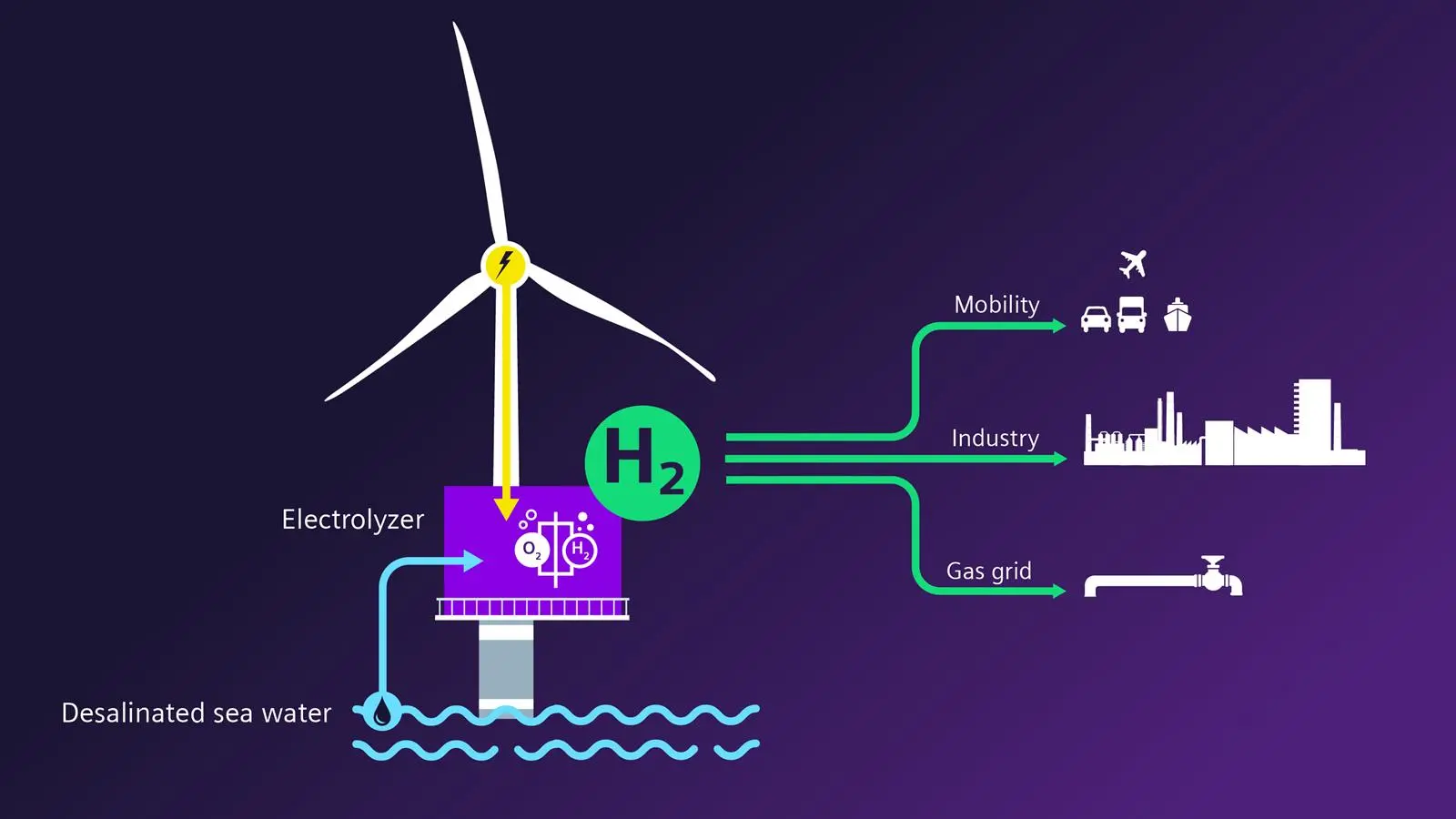
Siemens Energy and Siemens Gamesa are funding the development of a scalable solution that integrates an electrolyser array into the base of the world’s most powerful offshore wind turbine, the SG14-222 DD. The direct-drive, permanent magnet turbine, with a rotor diameter of 222 metres, is expected to be in serial production by 2024.
The direct coupling of the wind turbine and the electrolyser is intended to minimize the costs of hydrogen production by eliminating the cost of connecting to a power grid.
The companies intend to provide a full-scale offshore demonstration of the hydrogen-producing solution by 2025/2026, with Siemens Gamesa investing EUR 80 million and Siemens Energy investing EUR 40 million over the next five years.
Siemens Energy notes that currently 80 million tons of hydrogen is produced globally each year. This is expected to increase by about 20 million tons by 2030. Only 1% is currently generated from green energy sources. The bulk is obtained from natural gas and coal, emitting 830 million tons of CO2 per year. This is more than Germany and more than the global shipping industry.
Replacing this current polluting consumption would require 820GW of wind generating capacity, 26% more than the current global installed wind capacity. By 2050, production will have grown to about 500 million tons, with a significant shift to green hydrogen. This would require between 1,000GW and 4,000GW of renewable capacity by 2050 to meet demand.
The H2Mare initiative, led by Siemens Energy, consists of multiple sub-projects with over 30 partners from industry and academia. Other activities include the development of ways to generate secondary products such as green methanol or green ammonia offshore (offshore Power-to-X). The partners also want to further advance water vapor electrolysis and seawater electrolysis technologies and to produce carbon dioxide and nitrogen from the air or seawater for Power-to-X production.
The Federal Ministry of Education and Research announced EUR 700 million over the next five years for three “Hydrogen Republic” projects: H2Mare, H2 Giga and TransHyDE.
H2 Giga is devoted to technologies supporting the serial production of water electrolysers, a move seen as necessary to make green hydrogen production competitive. Although there are already large electrolysers on the market, they are still mostly manufactured by hand. This is time-consuming, costly and error-prone, says the Ministry. H2 Giga developments will also address recycling and the flexible operation of electrolysers so that they can be stopped and started as quickly as possible and can be operated at different performance levels.
The project aims to make Proton Exchange Membrane (PEM), alkaline electrolysis (AEL) and high temperature electrolysis (HTEL) plant ready for assembly line production. Electrolysis technology using ion-conducting membrane (AEM) will also be further developed.
The TransHyDE project aims to develop hydrogen transport infrastructure. It is anticipated that Germany will require hundreds of millions of tons of hydrogen annually to achieve carbon neutrality, a goal anticipated to be reached by 2050. Although some of this hydrogen will be produced in Germany, much will be imported from regions with more solar and wind resources. The project will test and scale up one transport technology each in four demonstration projects: hydrogen transport in high pressure vessels, liquid hydrogen transport, hydrogen transport in existing and new gas pipelines and the transport of hydrogen bound in ammonia.
Related Articles
 ALTERNATIVE FUELS & LUBRICANTS
 ALTERNATIVE FUELS & LUBRICANTS
 ALTERNATIVE FUELS & LUBRICANTS