



MHIET TESTS GAS ENGINE WITH PURE HYDROGEN
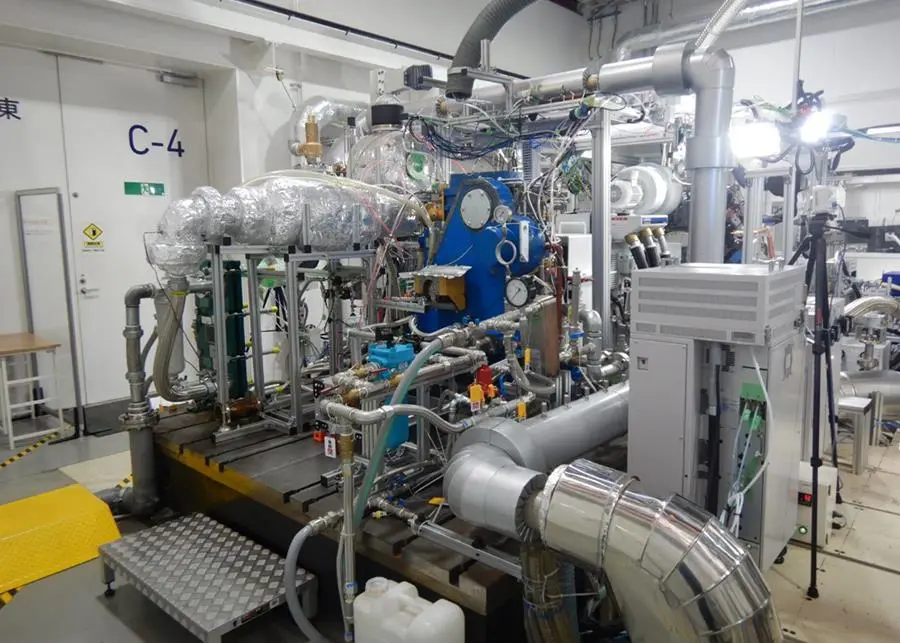
A modified single cylinder gas engine (bore 170mm x stroke 220mm) based on MHIET’s 4-stroke reciprocating gas engine “GSR series” offered in 6 to 16 cylinders was installed at the AIST Fukushima Renewable Energy Institute, and tests were carried out to identify the conditions required to achieve stable combustion of 100% hydrogen, without emitting CO2.
Hydrogen has a wide flammability range and a high combustion wave propagation velocity, making the engine prone to abnormal combustion such as backfire and knocking. Backfiring is the movement of a flame in the opposite direction toward the engine’s intake air passage, which damages the engine intake system. Knocking occurs when the fuel-air mixture self-ignites because the ignition timing is too early or the compression ratio is too high, resulting in a rapid rise in the cylinder pressure and producing a knocking sound, vibration and damage to internal components.
The lean-burn gas GSR series engine was tested with a modified fuel supply method, ignition method, timing of intake air valve closing, and excess air ratio to ensure stable combustion with hydrogen-only firing and premixed firing.
“In order to minimize the influence of backfire, we have adopted a method to inject the hydrogen fuel near the combustion chamber,” said a spokesman for MHIET. “Since the combustion speed of hydrogen is significantly high, the ignition method was optimized in order to control the heat generation period properly. The closing timing of the air supply valve was reviewed to optimize the thermal efficiency within the range of stable combustion.” To ensure stable combustion without abnormal combustion, such as knocking, the excess air ratio was re-examined to the fuel lean side compared to a conventional gas engine.
The maximum output was estimated to be 340kW for a 6-cylinder engine and 920kW for a 16-cylinder engine. MHIET intends to accumulate more test data that will lead to the realization of multi-cylinder hydrogen engines and aims to make the engines available for the introduction of hydrogen economy in the 2030s.
MHIET and AIST began joint research on the combustion of hydrogen in 2019. MHIET and MHI Research and Innovation Center designed and built the hydrogen engine, studied the conditions for optimum combustion and analysed the test data. AIST built and operated the hydrogen supply equipment and the test bench and acquired data using its experience in developing combustion technology for high-power, high thermal efficiency, and low NOx hydrogen engines for large scale power generation.
The development is targeted at power generation applications, but the potential for marine engine usage will be examined in the future.
Related Articles
 2-STROKE & 4-STROKE
 2-STROKE & 4-STROKE
 2-STROKE & 4-STROKE