



CUSTOM-DESIGNED FOR CHANGING RHINE CONDITIONS
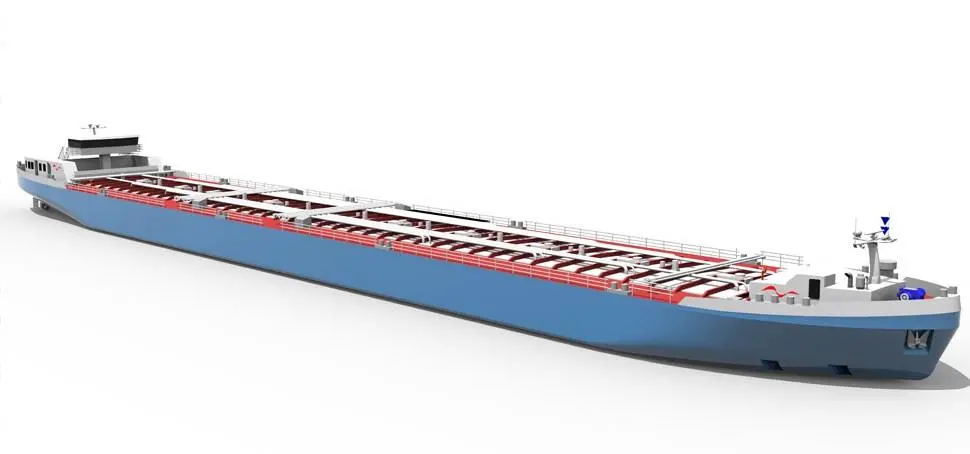
German chemicals and plastics group BASF has commissioned Stolt Tankers to help develop as well as operate a vessel capable of maintaining transport flows in the ever-more unpredictable conditions along the Rhine, particularly when low water events beset the system. Over some years now, periods of very dry weather have led to a barges being unable to take on a full load, or sail at all on certain stretches, increasing transport costs and delaying product and raw material deliveries.
A contract has been placed with the Dutch shipyard of Mercurius Shipping for the construction of a chemical tanker built to main dimensions of 135 x 17.5 metres, substantially larger than the conventional type of 110 x 11.5 metres, but with a shallow draught. At average water depths, the vessel will provide a cargo capacity of around 2,500t, about twice that of comparable tankers on the river. Despite its size, however, the new barge will still be able to pass the critical point on the Rhine near Kaub, Germany, carrying 650t in water as shallow as 1.6m.
BASF’s idea of a special tanker was born of necessity in summer 2018, when record-breaking high temperatures and exceptionally low water levels along Europe’s most important inland shipping artery played havoc with the distribution of chemicals and plastics from its headquarters production complex on the lower Rhine at Ludwigshafen.
The design is the outcome of a collaborative effort between BASF, Technolog Services of Hamburg, Agnos Consulting, and inland and coastal shipping research institute DST of Duisburg, with subsequent technical input from Stolt Tankers, which will run the vessel exclusively for BASF. Delivery is scheduled from Mercurius Shipping of Hendrik-Ido-Ambacht towards the end of 2022.
In conjunction with the much broader beam and increased length, the draught-constrained design achieves the requisite efficiency for the larger payload through a hydrodynamically-optimised hull, including a special bow form, and specially adapted propulsion arrangement. In the context of the inland waterway fleet, another innovative feature is the lightweight construction, ensuring structural stability through the transfer of methods used by builders of sea-going tonnage.
The newbuild has been specified with three propellers aimed at ensuring the best efficiency at any water level and draught. In combination with movable Flex Tunnel flaps, the two smaller, outer propellers are intended to ensure good flow and sufficient thrust even at a draught of just 1.2m and dependable manoeuvring capability at extremely low river levels. The larger, centreline propeller provides additional propulsion at greater depths, for maximum load carrying efficiency throughout the year.
The powering solution is based on three electric propulsion motors fed by diesel generators incorporating exhaust gas treatment compliant with EU Stage V emissions requirements. The design has been prepared to facilitate a switch from diesel gensets to alternative power sources, such as hydrogen fuel cells, once these technologies achieve market maturity.
For maximum flexibility with chemical products, the vessel will embody 10 stainless steel tanks and three separate loading systems, allowing the carriage of mineral oil products, high-grade chemicals, and high-density acids and alkalis.
Shipbuilding contractor Mercurius has a substantial reference list in the production of inland tankers and other vessels. The group also has investments in more than 35 waterway vessels, including double-hulled chemical tankers, container barges and special-purpose units.
Related Articles
 PROPULSION
 GENERAL NEWS
 HYDROGEN