



NEW VERSION OF VERSATILE ECOBOX CLASS
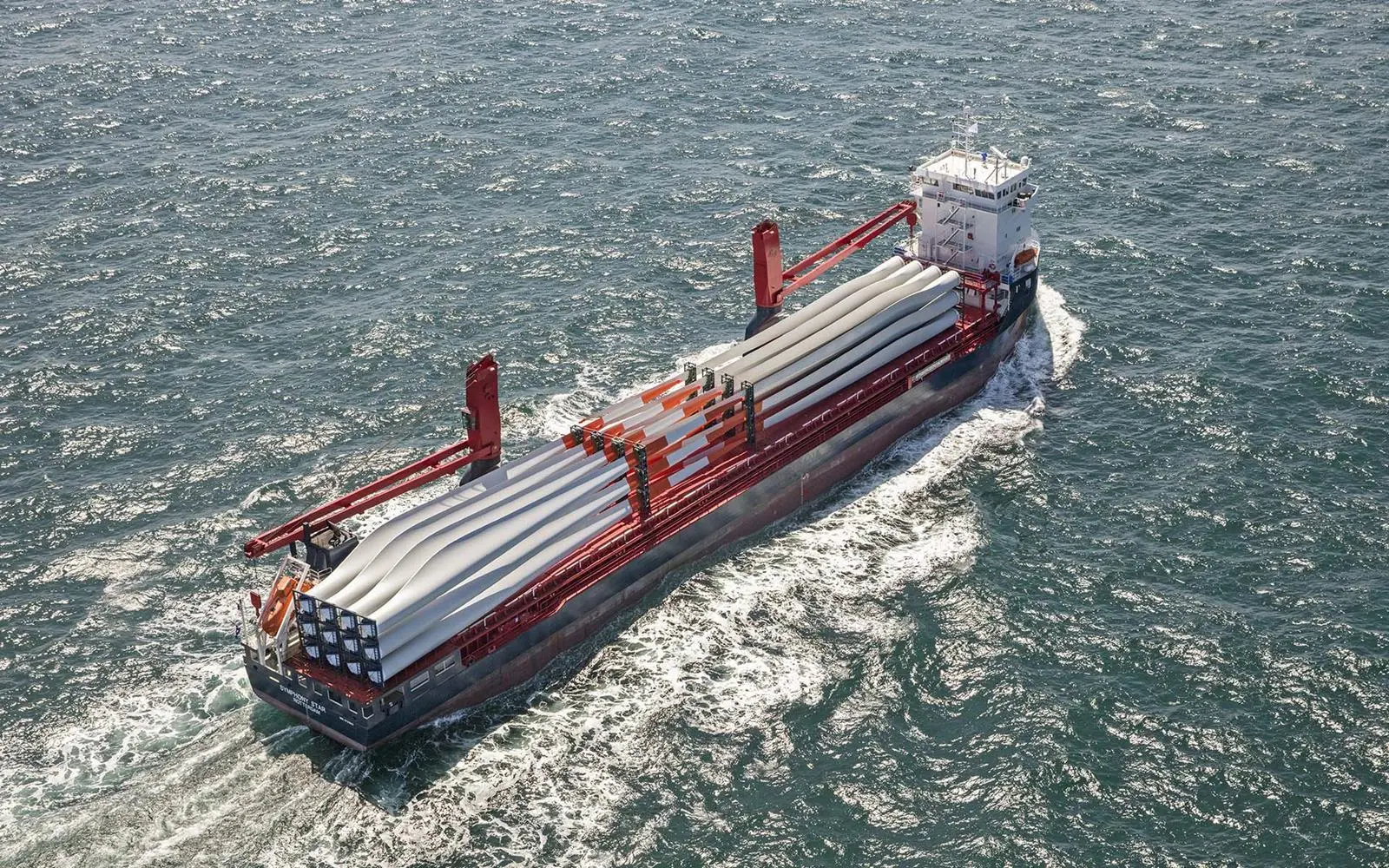
Building on cooperation in two preceding fleet investment phases, Dutch operator Symphony Shipping has awarded Ferus Smit a contract for two 12,500dwt box-hold carriers fitted with heavy cranes and a movable tweendeck. Besides general and unitised freight, the configuration and open-top authorisation will facilitate the handling of extra long items and project cargo shipments.
Ferus Smit, headquartered on the north Netherlands’ waterway network near Groningen, has assigned construction to its German affiliate at Leer, on the River Ems. Delivery slots are towards the end of 2022 and early 2023, respectively.
Designated the Ecobox XL class, the vessels will be an evolution of the Ecobox and Ecobox DP series deployed by Symphony Shipping, and also built by Ferus Smit at Leer. As well as being larger, with a bigger cargo intake, than their predecessors, the prospective fleet additions will have an IMO Tier III-compliant propulsion installation and a waste heat recovery process applying Organic Rankine Cycle (ORC) technology.
Overall enhancements and modifications in hydrodynamics, engineering and operating systems promise an efficiency level and environmental performance that will bring the Ecobox XL’s Energy Efficiency Design Index (EEDI) rating to what the shipbuilder describes as “a new class reference standard.”
Symphony’s original six 10,500dwt Ecobox vessels were completed at Leer between March 2015 and March 2018. Each provides a 12,150m3 underdeck cargo volume within main dimensions of 122.5m and 17m breadth.
The 91m-long single hold incorporates an adjustable tweendeck that can be positioned at three heights, with the panels alternatively used as bulkheads to achieve cargo separation. Two Coops & Nieborg 85t-capacity deck cranes mounted on the portside bulwark and Bureau Veritas open-top certification accentuate the design’s trading versatility. The deckhouse is located forward, to shelter the hold and weatherdeck-borne cargo against severe weather and better enable the handling of oversize freight.
The XL iteration adopts the same concept of the 1A ice-class Ecobox but in extended form for enhanced cargo scope and at a reduced level of energy usage per transported tonne. As a result of the lengthening of the hull by some 20m, the box-shaped hold will be increased to 100m at tank top level, and to 112m at movable tweendeck level. The breadth has been taken out to 18m from the 17m of the existing ships.
The Ecobox XL newbuilds will also incorporate the hydrodynamically beneficial, bulb-less Canoe-type bow. Developed by the shipbuilder, the feature has been shown to be effective in realising reduced fuel consumption while better sustaining speed and seakeeping behaviour in adverse weather and sea state conditions.
Each of the initial Ecobox sextet employs Caterpillar MaK medium-speed power in the shape of a six-cylinder M32C engine at a specified 2,999kW output.
The main machinery for each of the new ships is rated at 3,300kW, as achieved by the German manufacturer’s latest, faster-running M32E version, which meets Tier III emissions criteria with selective catalytic reduction(SCR). The installation will accommodate future use of bio-blend fuels. The drive train will culminate in a nozzled, controllable pitch propeller, operating in fully automatic combinator mode.
A novel and ground-breaking element will be an ORC waste heat generator integrated into the propulsion system, according to Ferus Smit. The initiative will save fuel and contribute to an “ultra low” EEDI. Using a special fluid in a closed cycle, ORC is a solution for converting low-temperature waste heat into useful energy at relatively low pressure.
Located at Breda, in North Brabant, Symphony also owns two vessels based on a dynamic positioning version of the Ecobox design, brought into service from Leer during 2017. The 10,500dwt Ecobox DP duo retains all the cargo handling and hull properties of the original series, but with the propulsion and station-holding installation entailing a much higher power concentration reflecting the DP2 capability.
Related Articles
 PROPULSION
 GENERAL NEWS
 HYDROGEN