



UECC prepared to test new technologies as green drive gathers momentum
Early in 2020, the company appointed Daniel Gent as Energy and Sustainability Manager to add momentum to its green drive. The company’s ambitions to exceed minimum GHG reduction targets have led it to becoming an early adaptor of new technologies, although it means accepting a sharp learning curve that follow from this. Gent added that the greatest change had been in terms of corporate mindset.
“In 2010-12, I would probably have asked how could LNG technology work, it was an oil mindset,” he told The Motorship.
It is unlikely that Gent would have envisaged working with dual-fuel battery-hybrid PCTCs in 2010. However, UECC is waiting to take delivery of the first of a series of three 3,600 car equivalent unit (ceu) capacity LNG-fuelled battery-hybrid PCTCs before the end of 2021. The vessels were ordered in March 2019 at Jiangnan shipyard, and are expected to be delivered by early 2022. “We are investing in the future,” said Glenn Edvardsen, CEO of UECC in a statement at the time, adding: “Our solution will take us beyond IMO’s target for a 40% reduction in carbon intensity by 2030”.
The combination of an energy storage system with WinGD 6RT-Flex50DF main engines offers specific peak shaving efficiency advantages, Gent noted. But extending the use of the battery technology will have to wait for further advances in battery technology in the coming decades. Perhaps a new pack can be installed in the future that can offer possibilities that are not available at the present moment, Gent mused.
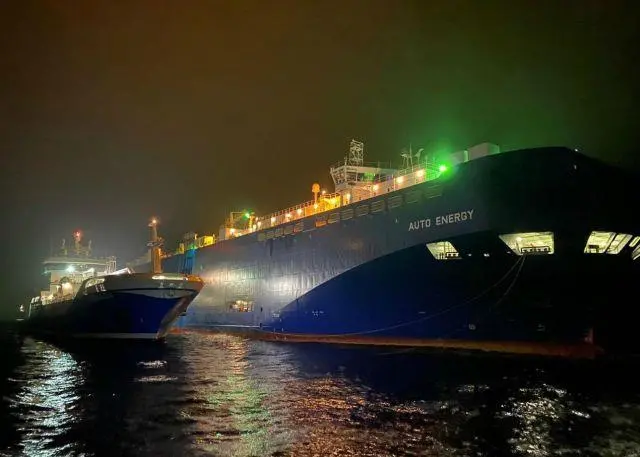
Turning back to the present, UECC has also acted as an early adopter with liquefied biogas (LBG). In December 2020, its Auto Energy, bunkered gas containing 90% LNG and 10% LBG at sea outside Gothenburg from Gasum’s bunkering vessel Coralius.
Dual fuel engines can and have run smoothly on bio oil, bio gas and LNG blends, Gent noted. Finding the supplies of bio oil and gas, however, is an entire different matter. This is sourced from waste treatment plants, mainly in Scandinavia, that produce bio methane or bio oil from discarded cooking oil.
The supplier network is therefore fragmented and localised, which marks a sharp contrast to the historical global supply chain of fossil oil and gas. However, high grade bio gas is very clean burning and, like bio oil, is much greener than fossil fuel sources, which makes the search for supplies worthwhile.
“With green energy, we will see an increasing a shift to local production and relatively local consumption. We look at renewable sources to make bio methane – it can be produced by using green hydrogen and we believe this is an exciting pathway to investigate. It is important to draw on our experiences and to show the market a vision of sustainability,” Gent continued.
Advantages of liner services
The UECC fleet operates in regular liner service in an extensive pan-European network, which is an important and helpful feature of its business. It makes it a lot easier to e.g. look for local suppliers of bio fuels and to set up the necessary infrastructure compared to vessels that operate in tramp trades.
That said, Gent expressed the ease at which the company adapted to using biofuel: “Our seafarers are amongst the best there are and we managed to take a pioneering fuel onboard our vessel and make a success of it. Many of our seagoing personnel have been with us for a long time which adds continuity to the training and high standard we are renowned for.”
“Understanding fuel characteristics and handling them appropriately is key to a successful transition to carbon neutral transport. This can be replicated on any seagoing vessel with the right technical expertise.”
This became apparent in 2016-17, when the company introduced its first LNG power ships. The bunkering infrastructure was not readily available in each port. UECC developed their vessel in parallel with the LNG bunker vessel Green Zeebrugge and as years passed, the infrastructure across Europe has gradually expanded.
EEXI and CII
Despite UECC’s green credentials, Gent noted that the introduction of EEXI (existing ship energy index) and CII (carbon intensity indicator) rules at the IMO poses specific challenges for companies like UECC, whose ships are volume rather than dwt critical in their operations.
“On our vessel Autosky, we have demonstrated that carbon-neutral sea logistics are possible with the implementation of biofuel. Our commitment to biofuel in 2020 saw a reduction of over 20 million kilograms of CO2. We need carbon calculus that accurately capture these remarkable improvements,” Gent said.
“The index as proposed does not work at all for vessel that max out on volume: a brand-new ship can be deemed inefficient due to the current proposed methodology. Using gross tonnage as the base of the index for such ships would make more sense,” he said. “We have seen that exceptions exist in other maritime sectors and we strongly support IMO looking again at ours.”
Gent mentioned a case regarding CII, in which a ship sailing between two ports at 15 knots can perform worse than one that covers ten times the distance at 13 knots, because of the impact of slower speeds on index calculations.
“IMO holds the key and bureaucratic processes are slow. Once legislation has been passed, it has hardly ever been revised, so it is important to get everything as right as possible from the start,” he continued. The planned legislation is due to take effect in 2023 and time is passing quickly.
Any revision to the proposed legislation should really be made this year to take into account the slow decision making at IMO. “We are in the future now. We need to talk,” Gent said.
UECC, which is jointly owned by Wallenius of Sweden and Nippon Yusen Kabushiki Kaisha (NYK) of Japan, regards itself as a pioneer in efforts to make shipping greener and more sustainable. The nature of its business makes it well positioned to explore new technologies, but it is its willingness to make bold investments and to learn from each step that it takes what makes progress on that path possible, Gent highlighted.
Related Articles
 ALTERNATIVE FUELS & LUBRICANTS
 FUELS & LUBRICANTS