



TAIWAN LINE DRIVES BOXSHIP FLEET EXPANSION
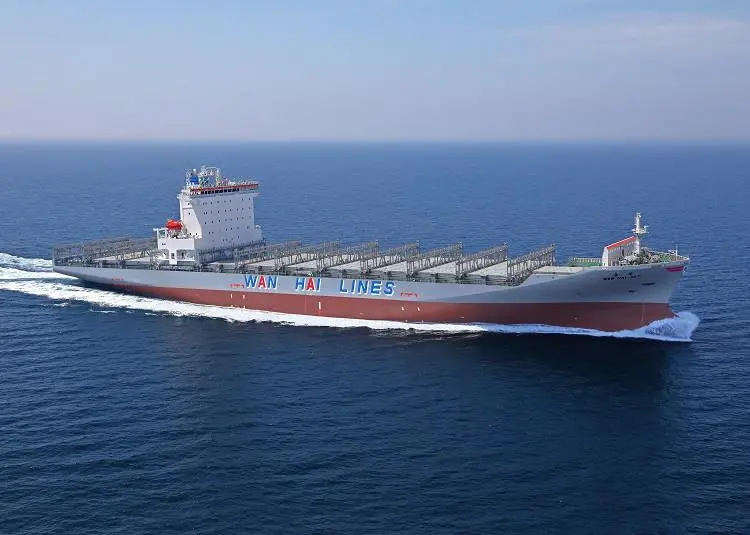
With the completion during March this year of the fifth and sixth cellular container vessels in an eight-ship newbuild series, Wan Hai Lines is nearing realisation of a major phase in its fleet development strategy.
Constructed at the Kure yard of Japan Marine United (JMU) Corporation, Wan Hai 326 and Wan Hai 327 embody an elegant, lower resistance hull form distinguished by an especially wide beam of 34.8m relative to an overall length of 203.5m. Provision has been made for 3,055 TEU boxes in what constitutes one of the most compact designs in its capacity class.
The design has been conceived for medium-distance trade, given the seemingly inexorable growth in the volume of freight exchange within the eastern Asian region, and to provide the operator with a competitive edge in an extensively ascribed sphere of shipping.
Assigned to the Taipei-headquartered company’s liner service linking China, Malaysia and India, Wan Hai 326 and Wan Hai 327 each offer a cargo intake of 12 rows across and six tiers high underdeck, and 14 across and seven high on deck. The bridge and accommodation block are positioned approximately three-quarters aft. A system of lashing bridges affords greater security and more expeditious handling of the weatherdeck stow, given added protection by a wavebreak at the fo’c’sle.
The entire series has been allocated to the Singapore registry, under the ownership of Wan Hai’s local subsidiary. While the two latest additions to the fleet are under Nippon Kaiji Kyokai (ClassNK) classification, the four preceding sisterships completed at Kure between September and December last year(Wan Hai 321/322/323/325) are entered with DNV. The array of DNV notations attached to the lead quartet includes the society’s SmartShip OE (operational enhancement) and PE (performance enhancement) descriptive accreditations.
The Mark 10.5 version of MAN’s electronically-controlled S70ME-C diesel, in its seven-cylinder model, powers each of the new vessels. The engine design was developed with feeder and intra-regional boxships among its target markets. Manufactured at Hitachi Zosen’s Ariake works, the installation turns out 20,000kW at 91rpm crankshaft speed in the Wan Hai application, enabling the ships to sustain some 21 to 22 knots. The barred speed range is 25-32rpm, and close-quarter manoeuvring is achieved using a Kawasaki bow thruster. At its nominal MCR, the 7S70ME-C10.5 can produce 24,000kW.
Besides the optimisation of the hull form, hydrodynamic performance gains from the adoption of JMU-developed LV-Fin and ALV-Fin energy saving devices at the aftship. The combination of the various engineering and design measures is such that the new ships already attain the Energy Efficiency Design Index (EEDI) Phase 3 standard, to be enforced on vessels ordered on and after January 2022.
The auxiliary outfit is based on Yanmar diesel power, comprising two eight-cylinder versions of the EY26 engine and two six-cylinder models of the EY22ALW type. The four gensets have an aggregate capacity of 8,750kVA.
The final two vessels from JMU, which is party to the recently established Nihon Shipyard joint venture with Imabari Shipbuilding, were formally named Wan Hai 328 and Wan Hai 329 at a ceremony held in the Kure yard, near Hiroshima on the Inland Sea, during March.
The series of eight newbuilds had been awarded to JMU in November 2018 at the same time that Wan Hai confirmed an order with Guangzhou Wenchong Shipyard and China Shipbuilding Trading Company for 12 containerships of 2,038TEU. Deliveries of the latter are about to commence, as Wan Hai 285 is readied for handover, and the programme stretches through 2022.
The opening quarter of 2021 has seen substantial further investment by the ambitious Taiwanese organisation. The company has returned to JMU and Nihon Shipyard for 12 vessels of 3,013TEU, stipulating an October 2022 start to deliveries. While production will benefit from certain commonalities with the Wan Hai 321 series, the follow-on type will be fitted with IMO Tier III compliant main and auxiliary machinery. In addition, provision will be made for drawing electrical energy from the landside grid when alongside, through an Alternative Maritime Power (AMP) system.
Most recently, Wan Hai has also firmed-up a contract with Hyundai Heavy Industries (HHI) entailing five boxships of 13,200TEU, to be completed from the first quarter of 2023 onwards.
In March this year, the company’s fleet numbered 74 owned and 57 chartered vessels.
PRINCIPAL PARTICULARS – Wan Hai 327
|
Length overall |
203.5m |
|
Length bp |
194.5m |
|
Breadth, moulded |
34.8m |
|
Depth |
16.6m |
|
Draught |
11.5m |
|
Gross tonnage |
30,600t |
|
Deadweight |
37,160t |
|
Container capacity |
3,055TEU |
|
Main engine power |
20,000kW |
|
Speed, service |
21.6kts |
|
Total genset power |
8,750kVA |
|
Accommodation, berths |
25 |
|
Class |
ClassNK |
|
Registry |
Singapore |
Related Articles
 PROPULSION
 GENERAL NEWS
 HYDROGEN