



AIRBUS AERONAUTICS INFORMS KITE SYSTEM DESIGN
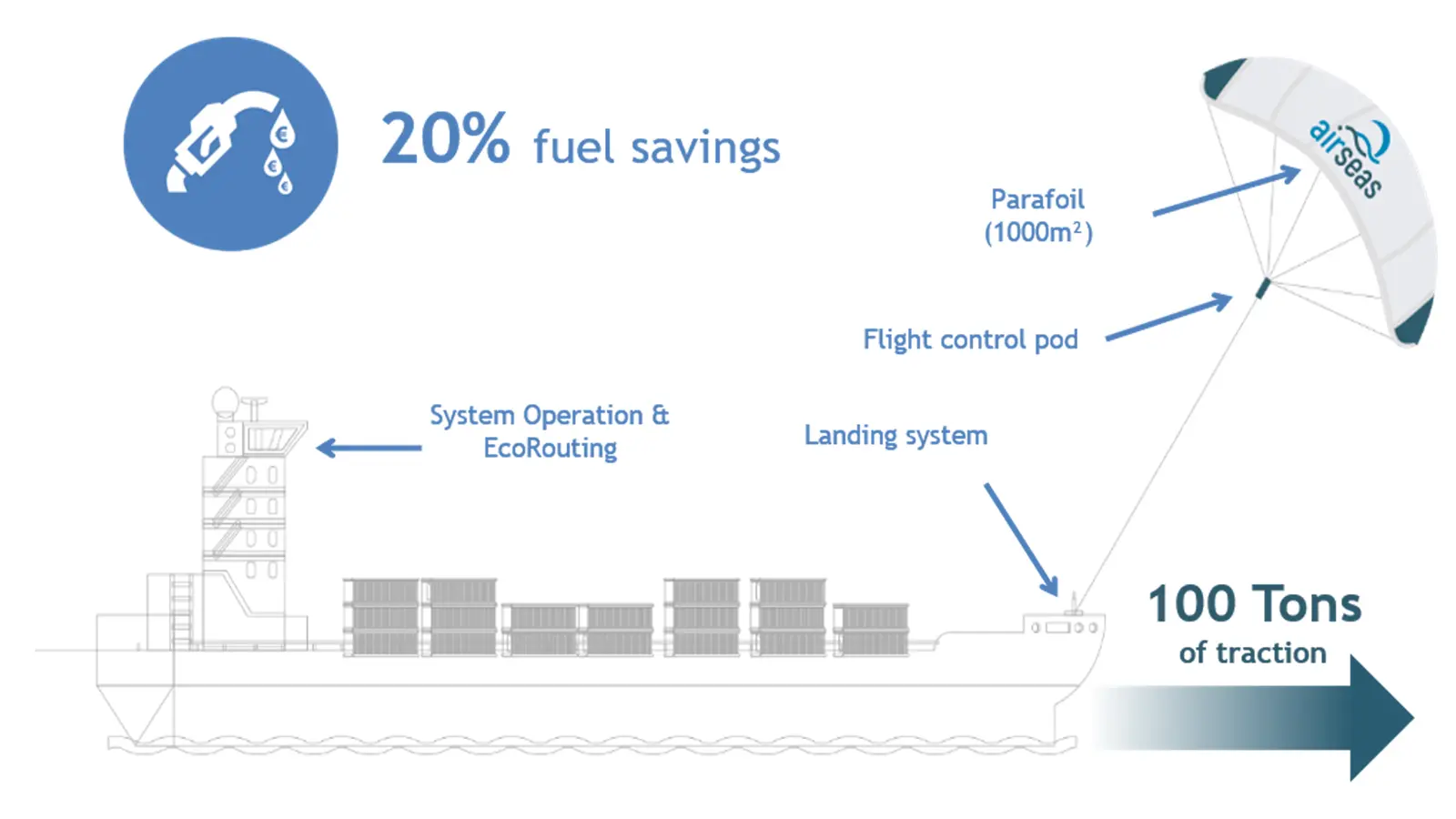
Airseas has received Approval-in-Principle from Bureau Veritas for its 500m² Seawing system installation and from ClassNK for its 1,000m² system installation. Its first pre-series 500m² system will be installed on the Airbus Ville de Bordeaux RORO vessel by the end of 2021. Following this installation, a 1,000m² serially-produced Seawing will be installed on one of “K” Line’s bulkers. “K” Line is then anticipated to install the system on up to 50 of its vessels.
The bow-mounted kite system requires minimal deck space, is easily installed and can be moved between vessels if desired. It does not hinder cargo operations and is suitable for a range of vessels including bulkers, tankers, container ships, PCTCs, ROROs and ROPAX vessels. Luc Reinhard, marketing coordinator for Airseas, says that for both installations, the kite will reduce fuel consumption by an average of 20% – approximately 5,200 tons of CO2 annually for a capsize vessel, depending on the route. “Thanks to our modelling expertise, we developed accurate, state-of-the-art performance prediction software. Our computations led to an estimation of more than 20% savings for both our original customers: more than 20% for a Capesize bulker sailing on an Asia – Oceana route and more than 20% for a RORO vessel sailing on a trans-Atlantic route.”
Reinhard says Seawing is really an aircraft: automatically flown with onboard sensors, it continuously readjusts its trajectory to maximise the traction of the kite and thus generate the maximum savings. Its digital twin model is also used by the Seawing EcoRouting algorithm. For this, Airseas uses its extensive aerospace modelling expertise to ensure maximum use of Seawing in accordance with the best weather systems to be encountered on the vessel’s route. Additionally, Seawing is designed to be easily installed, says Reinhard.
Best candidate for “K” Line
“K” Line has been evaluating the system’s technical development and performance for several years. “We think Seawing is suitable for large size and also low service speed vessels,” says Koji Tsumuraya, “K” Line Advanced Technology Group. “Large oil tankers or large bulk carriers would be the better candidate due to their low service speed, but we don’t eliminate other types of vessels, such as container vessels or car carrier vessels, because wind assist equipment performance really depends on individual vessel speed and route.”
By 2050, “K” Line aims to cut GHG emissions by 50% and CO2 emissions by 70% over 2008 levels. “We believe Airseas is a powerful supporter to have working with us to achieve our targets,” says Tsumuraya. “Wind assist propulsion has the best potential fuel savings among promising energy saving devices. We operate many types of vessels, a fleet of over 400, and we believe that the kite system has the best installation flexibility for the vessel types in our fleet.” He says that is because it results in less cargo space loss (especially on container ships), has less impact on cargo operations (especially for bulk carriers) and provides for better visibility, better vessel stability and is lightweight compared to other wind assist options the company considered.
Dynamic flight
Once activated by the bridge team, Seawing unfolds, operates and refolds autonomously. It flies at an altitude of over 200 metres where it benefits from stronger and more stable winds that are typically over 20% stronger than those at sea level. Seawing’s intelligent, digital twin support system that updates the kite’s position every 300 milliseconds based on a real-time analysis of meteorological and oceanic data. This results in the kite flying dynamically and automatically along a figure-of-eight trajectory. This gives 10 times more power than a static trajectory, because, according to aerodynamic laws, the power generated is proportional to the square of the speed.
“As the kite moves, it generates its own apparent wind, just like ships do,” says Reinhard. “When you are at the bow of the ship, you can always feel a breeze, because the ship is moving and creating its own wind. As our kite accelerates, the wind acting on the kite is stronger, thus generating more lift (traction) to tow the ship.”
The kite can operate in wind speeds of up to 40 knots. “When the wind reaches that force, or our sensors predict that this maximum will be reached, a message is sent to the crew to stop operating the system. If the crew fails to activate the procedure, our system will enter into an override mode and automatically put the system in a safe state (either zenith position or storage sequence). Regarding wave height, they have a limited impact on our system, and the operation will be limited to the usual operational requirement set by the managing crew.”
The various stages of the kite’s operation have been tested in accordance with Aeronautical standards during Seawing’s development to ensure a safe, reliable and repeatable take-off cycle, and reliability and safety are ensured through constant monitoring using a range of sensors. “Our system is designed as an aircraft, limiting the occurrence of a major failure.”
Seawing can be combined with other technologies, even other wind propulsion systems, and is also suitable for older vessels. “Even with +15 year old vessels, Seawing can extend their operational lifetime by maintaining them within emissions regulations,” says Reinhard. “Our current design is focused on a 1,000m² wing, as it addresses the biggest and most polluting vessels on the planet.” To foster its development, the company will move from Toulouse to a new purpose-built facility in Nantes, France.
ClassNK evaluates risks and benefits
ClassNK believes that utilizing wind energy should be one of the key elements of shipping’s zero emissions future, and the classification society released its Guidelines for Wind-Assisted Propulsion Systems for Ships in September 2019.
“Wind-powered systems can be propelled without refueling and can be flexibly introduced on an individual ship basis,” said Motoki Sakagami from Technical Solution Department at ClassNK. “As an assisted propulsion measure, the method also has great potential. Other advantages of wind propulsion systems are that their configuration can be simpler than that of other alternative fuels since they directly harness the physical energy of the wind, and current regulations are likely to be applied without drastic revisions.
“The disadvantages are that the energy density is relatively low and the stability of propulsion power depends largely on the external environment, but those concerns are entering a stage in which they can be complemented with the development of automatic control technology,” said Sakagami.
“Needless to say, sufficient cost efficiency must be established for their widespread use. As approaches are taken for the technology development providing greater propulsion with less capex/opex, ClassNK endeavours to contribute to the dissemination of the system by conducting research and development as well as verification of the latest technology, and providing standards based on the knowledge obtained so that the installation and operation of the systems will take into consideration the safety of the hull structure, ship operation, crew, surrounding environment and more.”
According to ClassNK, the design challenges associated with kite devices include the need for advanced control due to the high degree of freedom of motion, accurate load estimation and organizing appropriate response in emergencies (control failure, waterfall, etc.). “Besides, although not limited to kites, it is of course necessary to pay attention to the impact on the manoeuvrability and stability of the ship. These risks can be covered by designing with properly reference to rules and regulations provided for ships, in addition to verification methods such as more detailed risk assessment (FMEA, etc.), accurate calculation/analysis, and onshore tests. For designing with consideration for safety, our guidelines could offer adequate guidance.”
Wind-powered systems are difficult to operate in headwind conditions, so their efficacy can be maximized by selecting appropriate routes. “For the effective operation of wind-powered systems, access to accurate weather forecast data and routing applications are essential. From the viewpoint of safety, as operating limits for certain meteorological/hydrographic conditions are set for all systems, attention is required to ensure that operations and control flows are performed according to those conditions,” said Sakagami.
“In the safety assessment of new technologies in modern wind assisted propulsion systems, not limited to the Airseas system, it is important to accurately identify potential risks and consider measures to mitigate them, for example, by HAZID during the conceptual stage.”
Related Articles
 ENERGY SAVING DEVICES
 ENERGY SAVING DEVICES
 AMMONIA