



Why voyage optimisation should be all encompassing
Amid the range of carbon cutting solutions from which the shipping industry can choose to meet the reduce greenhouse gas emissions, optimisation software has a role. The final choice of decarbonisation tools and strategies will depend on ship owners’ vessels and business models.
Just as shipowners must choose from a selection of solutions, voyage planning should ideally take into account a number of complex elements. It is only by combining all factors potentially impacting a voyage that the safest, most efficient and cost-effective results can be achieved. Key factors that must be amalgamated to intelligently optimise voyage routes and increase safety include speed profiling, ocean currents, arrival time, engine load, wind, water depth and Emission Control Areas (ECAs). This presents a significant challenge to the industry, because it requires contractual flexibility, the sharing of data and capability to consider all elements to ensure the optimal route.
The perils of sticking to a default route
Too often, this means that, although voyage optimisation software is recognised by owners and operators as a digital solution, which will be significant in the future optimisation of operations, its true potential is yet to be fully realised. If, for instance, a routing tool cannot adequately account for a last minute change in the weather, crew and shoreside staff sensibly prefer to stick to a tried and tested route than attempting something new.
At present most vessels therefore tend to stick to a default route, except in extreme weather conditions. This means the benefits of optimised routeing are not actualised, as voyages which could consider up to date weather conditions currently fail to. While some climatology-based reference routes already exist and can be applied accordingly, weather phenomena changes year-to-year. Automatically assuming a default route therefore risks failing to reflect real-life conditions and can leave ship owners paying avoidable fuel and labour costs.
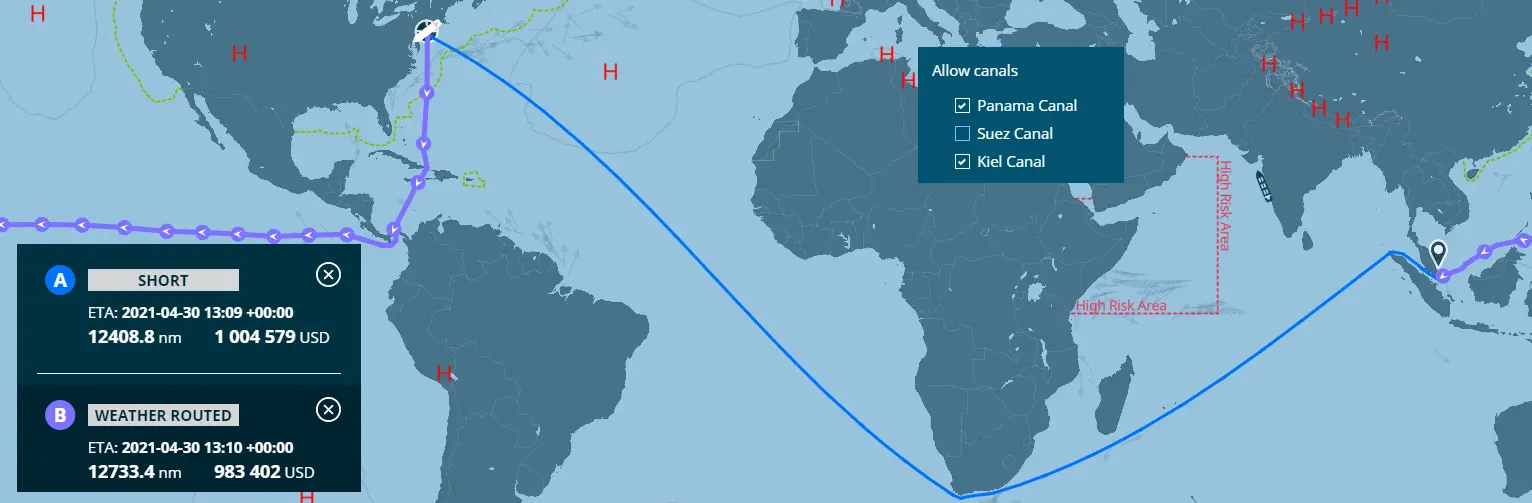
The recent blocking of the Suez Canal exemplifies this point as many owners and operators lost out on potential optimisation gains. For example, a typical vessel re-routing from New York to Singapore would have perceived the route around Africa to be shortest. However, our research found that surfing along the equatorial ocean currents on the Pacific would have been a more fuel-efficient option, which would have saved vessel owners and operators costs and emissions.
In another NAPA study, we analysed over a year of past transatlantic voyage data for MR tankers on the Baltic Exchange route, comparing their actual performance against a retro-optimised voyage using NAPA voyage planning technology, we found the MR tankers could have reduced the time spent in winds above BF5 by 9.8%. This would have allowed a 5% lower RPM, led to 15.9% lower fuel costs and minimised safety risks. The schedules in the retro-optimisation study were kept the same, which highlights the significant capacity for environmental and economic gains had sophisticated voyage optimisation been applied.
Adoption is limited
Although the emissions reduction and cost saving potential of intelligent voyage planning is recognised, the shipping industry is yet to fully adapt its infrastructure to accommodate and incentivise the uptake of such technologies. This is somewhat further complicated by the traditionally strong separation between the voyage stakeholders: shipowners are not incentivised to save fuel, if they can keep the ETA and ship performance (speed and fuel consumption) within charter party limits. Even if the charterer was to be interested in fuel consumption, they typically do not have the same access to sea charts, tools to evaluate safety, and are likely to source a weather routing service for the voyage, but not systematically for each voyage.
A holistic approach to decarbonisation
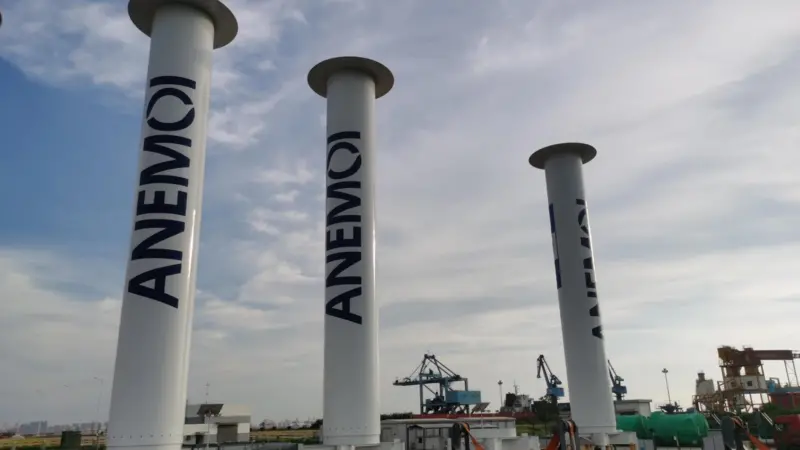
Voyage optimisation software, when combined with proven clean technologies, can not only improve fuel efficiency but also act as a platform to estimate savings potential. For example, our expertise in vessel modelling and optimisation, as well as weather routing and performance analysis, has been valuable to the development of wind-assisted shipping. Collaboration with the likes of C-Job Naval Architects, to explore the applications of wind-assisted propulsion and the consequent carbon reduction savings, enabled us to further showcase the 20% fuel saving potential of rotor sails. Likewise, through our NAPA Voyage Optimization software we proved the untapped fuel saving potential of aligning a vessel’s route with prevailing wind patterns and continue to develop our software to consider a range of factors, such as weather routing, vessel operations, and speed profile.
In a market like shipping, where margins are tight, it’s essential to accurately estimate the saving’s potential of wind propulsion technology to increase ship owner confidence and the development of the low carbon fleet of the future.
Related Articles
 ENERGY SAVING DEVICES
 LNG
LNG
 ALTERNATIVE FUELS & LUBRICANTS