



Germans pioneer low-draught hybrid tankships
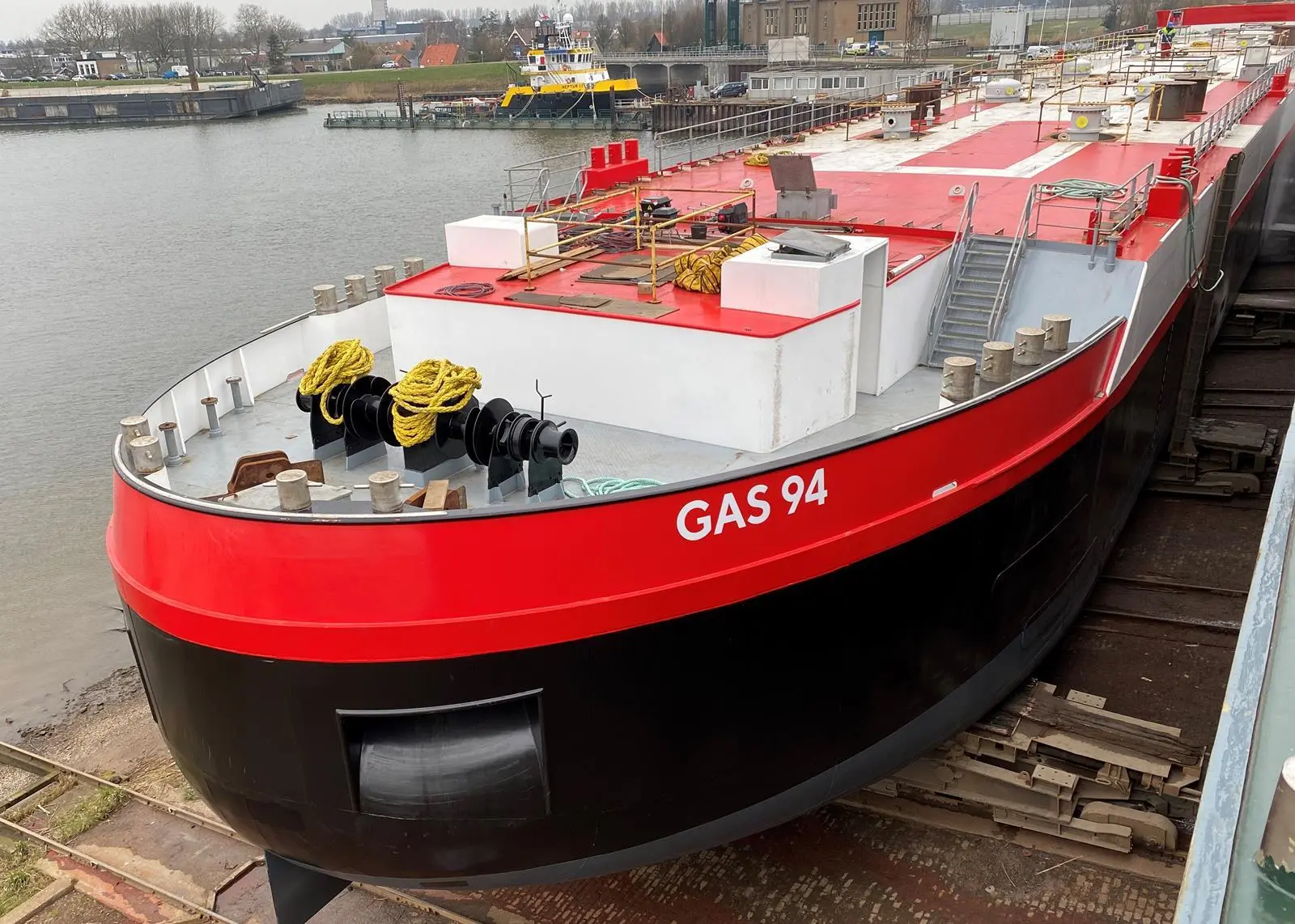
Gas 94 is for delivery in September while Synthese 18 is expected to enter service in 2022. Both are being completed at Dutch shipyards for HGK, described as Europe’s leading inland shipping concern. It moves some 35 million tons a year on more than 300 self-owned and chartered vessels.
HGK says the 110 x 12.5m hybrid drive Gas 94 is “innovative, sustainable and functional”. It adds that low-draught “extremely” deep-duct construction has been achieved through optimising component arrangement. That will enable the ship to operate on the Rhine network even during low-water periods.
The gas tanker is being completed at TeamCo Shipyard on a hull built by Poland’s Partner Stozcnia to HGK design. The newbuild is billed as “unique to gas tanker shipping”.
Gas 94 has a “pioneering hybrid drive” says HGK CEO Steffen Bauer.
The main drivetrain consists of three 405ekW electric motors each supplying rudder propellers and all from Veth Propulsion. Motors are fed by SCANIA diesel gensets fitted with scrubbers and SCR technology and also from Veth Propulsion.
They meet Stage V European emission standards and are said to reduce CO2 emissions by up to 30 percent and also significantly minimise other pollutants. NOX emissions are at least 70% lower than with previous drives, Bauer reported. Thanks to Gas 94’s sophisticated power management system “it will even be possible to operate on smaller stretches using electric power alone”, he predicted.
HGK Gas Shipping MD Anke Bestmann added : “With Gas 94, we are meeting the challenges of climate change twofold. We are minimising transport CO2 levels and, in contrast to conventional ships, we are also able to ensure basic supplies to recipients even in extreme low- water conditions. That is an outstanding, unique selling point in our industry”.
Asked if HGK planned further such hybrid newbuildings, HGK Head of Group Projects and Digitalisation Maria Schippers told The Motorship: “basically we have laid the foundations with the hybrid concept that has now been chosen. In future, this concept can also be used for combinations (i.e. not diesel-electric) utilised and modified as required”.
Schippers added “at the moment we can see still further significant advantages in the hybrid concept. For example, we can compensate for ‘weaknesses’ in alternative fuels and still utilise them”, he noted.
Such considerations appeared likely also with the firm’s planned second ship – the Type C liquid chemical tanker Sythese 18.
HGK said that with the “operationally flexible” chemical newbuild it was like Gas 94 “again combining a low-water optimised concept combined with alternative propulsion train technology”.
No details were revealed but Maria Schippers noted that Sythese 18 was “for a completely different product range” and also that its dimensions would be compatible with European inland navigation standards.
The chemtanker is being built by Scheepsreparatiebedrijf De Gerlien van Tiem on a hull from Romanian yard Santierul Naval Orsova.
German Government funding exists for a range of such low-emission propulsion systems in shipping but HGK has not applied for Berlin funding for either of its two ground-breaking newbuilds.
Maria Schippers explained to the Motorship that under funding guidelines, “the contract for the construction of a ship must not have been placed before the time of the application. Due to a very short-term decision to implement alternative drive technology, HGK Shipping was unable to take advantage of the corresponding funding”, Schippers said.
However HGK’s current fleet “Innovation and Sustainability” expansion programme makes clear the current orders are unlikely to be the last.
Related Articles
 PROPULSION
 GENERAL NEWS
 HYDROGEN